
Job search
10 min read
Career planning for mid-senior professionals is a system. Not a vision board.
Published Date:
|
Last Modified:

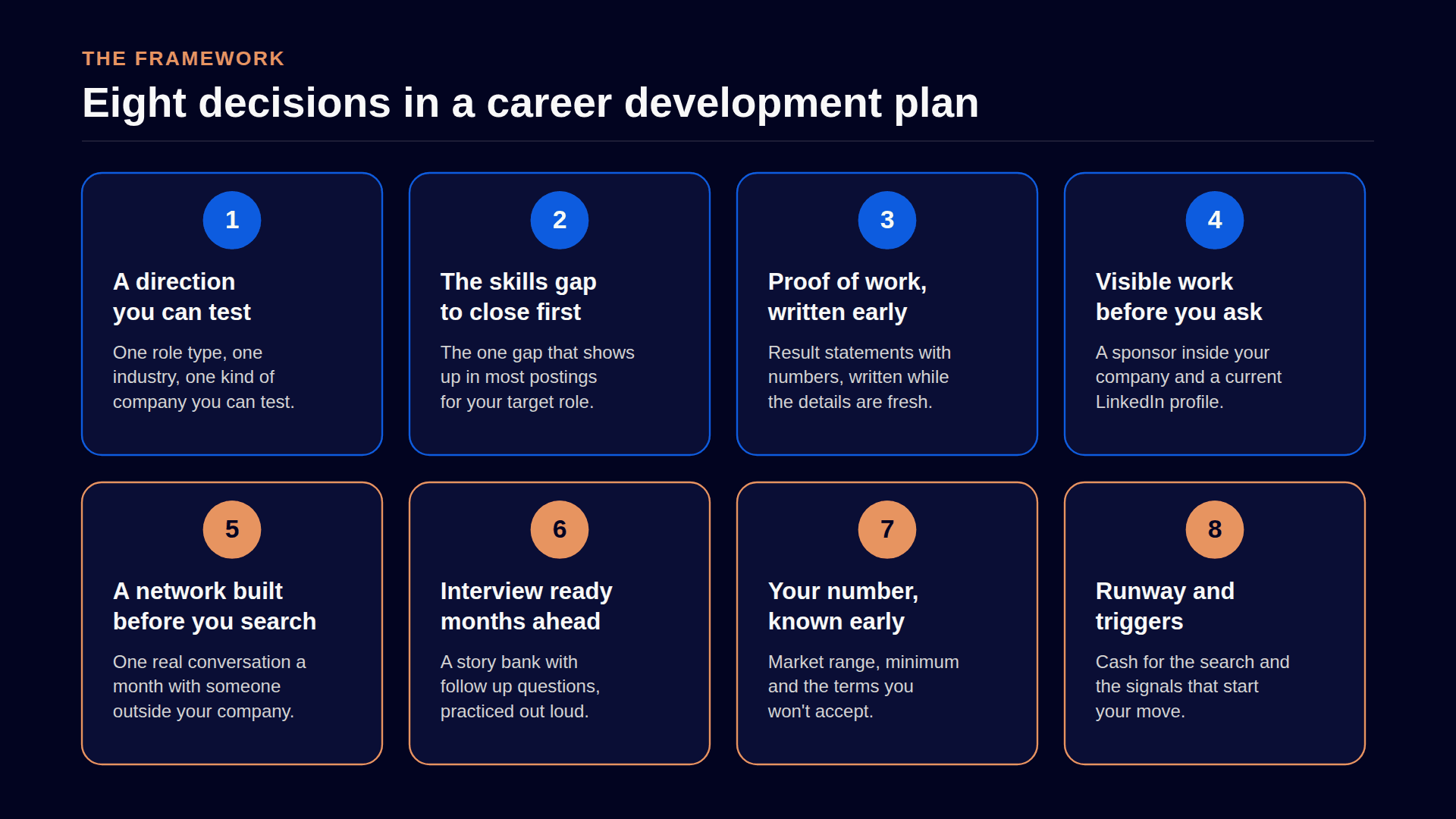
A career plan for a senior professional is eight decisions you review every six months. Your target role and companies. The skills gap you're closing. Your proof of work. Your network. Your interview readiness. Your number. Write them down and act the moment one stops holding.
You need it because the default outcome is a stall. A 2026 NYU study found that about one in four mid-career professionals goes five years or more without a promotion or pay rise. They weren't bad at their jobs. They had no plan for what came next.
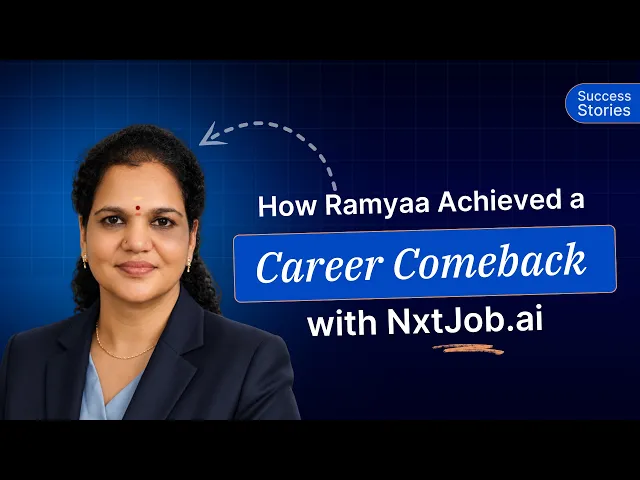
Ramyaa has 22 years of experience and lost her job twice in about a year. Her story runs through this guide.
Want to see a system like this built live? Reserve your seat at our 2-day bootcamp.
The plan on one page
Target: one role type, one industry, and a named list of companies.
Gap: the one skill missing from your profile that shows up most in real postings.
Proof: your last three years of accomplishments, written with numbers.
Visibility: a sponsor inside your company and a current LinkedIn profile.
Network: one real conversation a month with someone outside your company.
Interviews: a bank of stories with follow-up questions, practiced out loud.
Number: your market range, your minimum, and the terms you won't accept.
Trigger: the conditions that start your move, decided in advance.
What career planning means after 10 years
Career planning after 10 years means choosing your next role and building the evidence, skills, and relationships to get it before you need it.
Early in a career, you explore. Now you narrow and execute. Long-term career planning still needs a direction, and a five-year vision is fine for that.
The working document is your career development plan for the next 12 months, and this guide builds it.
Why senior careers stall
Senior careers stall because of your employer, your role type, and the market, more than your effort.
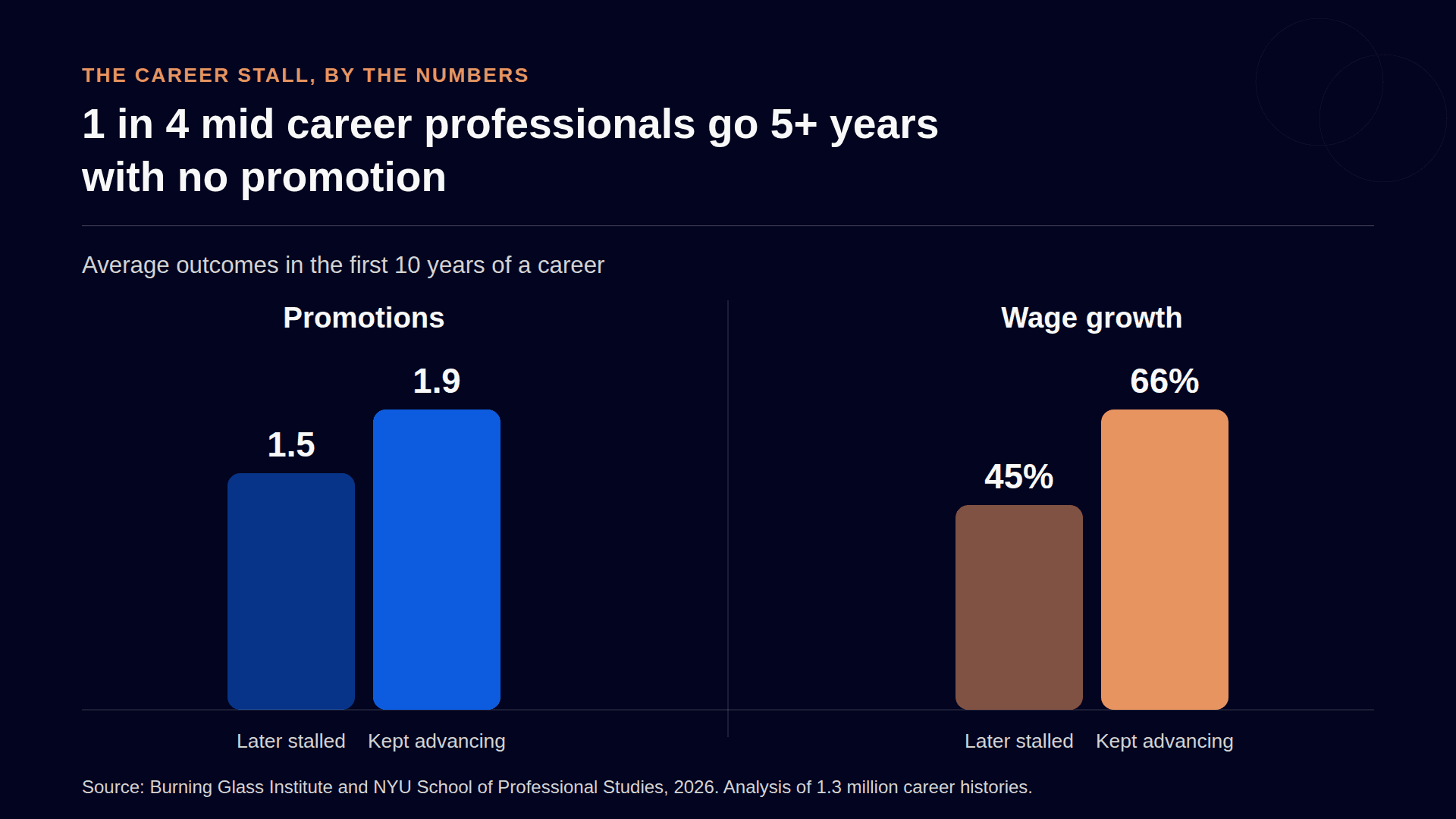
The researchers studied 1.3 million mid-career professionals and defined a stall as no promotion and almost no wage growth for five years or more.
Check your last five years of career progression against that. By year ten, those who later stalled had averaged 1.5 promotions and 45% wage growth. Their peers who kept moving had averaged 1.9 and 66%.
Employer first. Revelio Labs found the odds of a promotion over 12 months were 2.8% at low-promotion firms and 6.2% at high-promotion firms. Role type next. Gusto's payroll data shows the US promotion rate fell from 14.6% in May 2022 to 10.3% in May 2025, mostly among younger workers.
For people 35 and older, it sits in line with 2019, though individual contributor promotions sit about 20% below 2019 against about 10% for people managers. Then the market. Workday's 2025 research found internal hiring down 8% and promotions down in 10 of 11 industries.
This data is mostly from the US, and India-specific numbers are thin. Treat it as direction, not a forecast for your employer.
How to build your career development plan, one decision at a time
Your career development plan is a short list of decisions, made in order and reviewed every eight months. Each section below gives you the answer first and the details after. Start with direction, because everything else gets tested against it.
Pick a direction you can test
Pick one direction for the next 12 months, specific enough to check against a job posting. "Senior Manager" is a title. A direction is a role type, an industry and a kind of company, like "Head of Growth at a Series B or C fintech in Bengaluru or Mumbai."
Your options are to go deeper as a specialist, widen your scope, move into people leadership, change your industry or your function while keeping the other, or go independent. Look inside your current company first.
The NYU report gives one example. Programmers who moved into data science inside the same company cut their stall risk by up to 86%. That's one case, not a promise. Pick the move that reuses most of what you know and pays more for it.
On specialist versus manager, the Gusto split above shows individual contributor promotions slowing more, so ask whether your firm has a senior specialist track before you assume it doesn't.
Then build a company list from your sentence. Your network sits wherever you've spent the most time, and after 10 years in one place, you find out what that costs on the day you leave.
Navigator is our AI agent for this groundwork. It helps you define a target niche, test your fit against real jobs, find your skill gaps, and turn your experience into a master resume. If you're around 40 and feeling stuck, read how to overcome career stagnation at 40.
Close the skills gap that shows up most
Close one skill gap at a time, starting with the one that appears in the most postings for your target role. Every six months, pull five live postings. List every requirement you can't yet prove from your own work, count how often each appears, and close the top one first.
The World Economic Forum's 2025 jobs report says employers expect 39% of workers' core skills to change by 2030. AI and big data grew fastest. At your level, proof beats certificates.
A finished project that used AI to cut process time says more than a course. Where a course helps, NPTEL offers courses from the IITs and IISc.
Write your proof of work before you need it
Write your accomplishments as short result statements while the details are fresh.
The situation, what you did, the result with a number. Say onboarding vendors took six weeks and you rebuilt the process to take three.
That's a made-up example. Write yours the week it happens, because rebuilding three years of work from memory in the middle of a search costs you weeks.
Keep a master resume with everything and a shorter version for each role. Applicant tracking systems parse your resume before a person reads it, so keep the layout plain and use the posting's own terms.
My post on how to make an ATS-friendly resume explains the rules.
Make your work visible before you ask for anything
Promotions and referrals go to people whose work others can describe. Inside your company, find a sponsor, someone senior who can speak about your work in rooms you're not in.
Before you ask for a promotion, write a one-page case with your scope, your results, and what the next level requires, and confirm those requirements with your manager. Outside it, keep your LinkedIn profile in line with your accomplishment statements, so a recruiter or contact who looks you up finds who you are now.
Build the network before you search
Build the network outside your current company and before you need it. Your closest contacts hear what you hear. A 2022 Science study of over 20 million LinkedIn users found that moderately weak ties helped people change jobs most, and that the effect varied by industry. Spread your contacts across both kinds.
Run a quick test. Write down the 20 people you'd call first for a job lead. Count how many work at your employer or used to. If it's more than a few, you have a concentration problem, and it stays hidden until you need those calls.
The fix is one real conversation a month with someone outside your company. Ask about their work and nothing else. Keep a few recruiters at your level warm too, and our post on how to reach out to a recruiter on LinkedIn has the wording.
Our Networker agent finds recruiters, hiring managers, and alumni around your target roles and drafts outreach, and you review it before anything goes out.
At Director level and above, roles are often filled before they're posted, so search firms and reputation matter most. If you want a confidential search run with you, Sw!tch is our coached service for senior leaders.
Want to see how all of this fits together over two days? Join the live bootcamp.
Get interview-ready months ahead
Build a bank of stories before you have an interview, write follow-up questions for each one and practice out loud until the answers come without notes. At senior levels, research the company's business problem too, so you arrive with a point of view and not only a history.
Our Interviewer agent runs role-specific mock interviews across screening, managerial, technical, knowledge, negotiation, and custom modes, and gives feedback on your answers.
Know your number before anyone asks
Decide your market range, your minimum and your terms before a recruiter asks. In India the current and expected CTC question comes early, and whatever you improvise on that call sets the anchor. Break your pay into fixed, variable, ESOPs, joining bonus and benefits.
Check your notice period and buyout terms, since they set your earliest start date. Negotiate scope and title along with pay, because they shape your next move too.
Two of our posts go deeper.
Read how to answer expected CTC before the first call, and counter-offer negotiation for senior leaders before you reply to an offer.
Set your runway and your triggers
Decide how long you can search and what makes you start, while you're calm. Runway is your monthly household spend multiplied by the months you'd want to search, plus your notice period. Knowing it stops fear from deciding for you.
Triggers are your call, and these are my rules of thumb, not a study:
18 to 24 months with no change in scope, title or pay.
Your manager or sponsor leaves.
Your function is restructured or your project ends.
A conversation outside your company comes with a number worth a real look.
You don't have to resign when one fires. You need a real alternative on the table, meaning a conversation with a hiring manager or an interview process running, plus a figure you could say yes to.
If a layoff makes the decision for you, do the same things in week one. Read your severance terms, write down your accomplishments, and tell your closest 10 contacts what you're looking for.
Ramyaa's story
Ramyaa lost her job in November 2024. Her network got her a startup role through one or two contacts. In November 2025, she lost that job too.
She'd spent over ten years at one company before that, and most of her contacts still worked there. The people she'd normally call were the people she'd just left.
She already did real work by hand, with about 50 accomplishment statements in a notes app and one and a half to two hours spent on each application. Then she saw an ad for Major Richik's program. She was skeptical, but she attended the two-day workshop.
Four things changed. She'd been searching for jobs, not companies, so she built a target company list and searched by role type, since companies give similar roles different titles. She learned how to expand her network beyond the contacts she'd used up.
Her resumes dropped to five to ten minutes each. And she grew her STAR story bank from five to ten stories to 20 to 25, with follow-up questions for each, and practiced with ChatGPT about two hours a day, asking it to grade her as a top 1% candidate.
She doesn't oversell it. Others in her cohort reported 12 or 15 callbacks, and hers weren't at that volume.
But HR later told her that the panel decided on her in under ten minutes, though the interview ran 45 minutes to finish a checklist. Her explanation is the prep.
You can watch here:
Using an AI assistant for career planning
An AI assistant is good at drafting options, spotting patterns across job descriptions and grading your practice answers. It's weak on your market, your employer and what a recruiter will really say. Check its facts and don't paste anything confidential from your employer.
"I have [14] years in [digital marketing], and I'm a [Senior Manager]. List five roles I could target in the next 18 months and what each would need me to prove."
"Here are five job descriptions for the role I want. Which requirements appear in most of them, and which can't I yet prove from my resume?"
"Ask me the ten hardest questions for a [Director of Operations] interview. After each answer, grade it as a top 1% candidate would and tell me what's missing."
So, where should you start?
Do two things before Sunday. Write your direction as one sentence, then send one message to someone outside your company asking for 20 minutes.
The sentence tells you what to test everything against. The conversation tells you whether the market agrees.
If you want help building the rest with people who've done it, NxtJob's live two day bootcamp covers target companies, resume structure, networking and interview practice on Zoom. Get your seat.

As a content writer and SEO strategist, I help turn complex AI job search, career-tech, and growth topics into clear, practical content. At NxtJob.ai, I write to help senior professionals make smarter career moves with clarity and confidence.
Githu Ravikkumar
Creative Strategist & Copywriter, Nxtjob
Recent articles

Resume
5 min read
ATS Resume Format: How to Create a Resume That Gets Past Applicant Tracking Systems
Learn how to create an ATS-friendly resume that passes through applicant tracking systems and increases your chances of landing an interview.
Resume
5 min read
ATS Resume Format: How to Create a Resume That Gets Past Applicant Tracking Systems
Learn how to create an ATS-friendly resume that passes through applicant tracking systems and increases your chances of landing an interview.
Resume
5 min read
ATS Resume Format: How to Create a Resume That Gets Past Applicant Tracking Systems
Learn how to create an ATS-friendly resume that passes through applicant tracking systems and increases your chances of landing an interview.
Resume
5 min read
ATS Resume Format: How to Create a Resume That Gets Past Applicant Tracking Systems
Learn how to create an ATS-friendly resume that passes through applicant tracking systems and increases your chances of landing an interview.
Resume
5 min read
ATS Resume Format: How to Create a Resume That Gets Past Applicant Tracking Systems
Learn how to create an ATS-friendly resume that passes through applicant tracking systems and increases your chances of landing an interview.
Resume
5 min read
ATS Resume Format: How to Create a Resume That Gets Past Applicant Tracking Systems
Learn how to create an ATS-friendly resume that passes through applicant tracking systems and increases your chances of landing an interview.
Everything you need to know
Here you can find solutions to all your queries.
What is a career development plan?
How often should I review my career plan?
What should a five-year career plan include?
Job search
10 min read
Career planning for mid-senior professionals is a system. Not a vision board.
Published Date:
|
Last Modified:
A career plan for a senior professional is eight decisions you review every six months. Your target role and companies. The skills gap you're closing. Your proof of work. Your network. Your interview readiness. Your number. Write them down and act the moment one stops holding.
You need it because the default outcome is a stall. A 2026 NYU study found that about one in four mid-career professionals goes five years or more without a promotion or pay rise. They weren't bad at their jobs. They had no plan for what came next.
Ramyaa has 22 years of experience and lost her job twice in about a year. Her story runs through this guide.
Want to see a system like this built live? Reserve your seat at our 2-day bootcamp.
The plan on one page
Target: one role type, one industry, and a named list of companies.
Gap: the one skill missing from your profile that shows up most in real postings.
Proof: your last three years of accomplishments, written with numbers.
Visibility: a sponsor inside your company and a current LinkedIn profile.
Network: one real conversation a month with someone outside your company.
Interviews: a bank of stories with follow-up questions, practiced out loud.
Number: your market range, your minimum, and the terms you won't accept.
Trigger: the conditions that start your move, decided in advance.
What career planning means after 10 years
Career planning after 10 years means choosing your next role and building the evidence, skills, and relationships to get it before you need it.
Early in a career, you explore. Now you narrow and execute. Long-term career planning still needs a direction, and a five-year vision is fine for that.
The working document is your career development plan for the next 12 months, and this guide builds it.
Why senior careers stall
Senior careers stall because of your employer, your role type, and the market, more than your effort.
The researchers studied 1.3 million mid-career professionals and defined a stall as no promotion and almost no wage growth for five years or more.
Check your last five years of career progression against that. By year ten, those who later stalled had averaged 1.5 promotions and 45% wage growth. Their peers who kept moving had averaged 1.9 and 66%.
Employer first. Revelio Labs found the odds of a promotion over 12 months were 2.8% at low-promotion firms and 6.2% at high-promotion firms. Role type next. Gusto's payroll data shows the US promotion rate fell from 14.6% in May 2022 to 10.3% in May 2025, mostly among younger workers.
For people 35 and older, it sits in line with 2019, though individual contributor promotions sit about 20% below 2019 against about 10% for people managers. Then the market. Workday's 2025 research found internal hiring down 8% and promotions down in 10 of 11 industries.
This data is mostly from the US, and India-specific numbers are thin. Treat it as direction, not a forecast for your employer.
How to build your career development plan, one decision at a time
Your career development plan is a short list of decisions, made in order and reviewed every eight months. Each section below gives you the answer first and the details after. Start with direction, because everything else gets tested against it.
Pick a direction you can test
Pick one direction for the next 12 months, specific enough to check against a job posting. "Senior Manager" is a title. A direction is a role type, an industry and a kind of company, like "Head of Growth at a Series B or C fintech in Bengaluru or Mumbai."
Your options are to go deeper as a specialist, widen your scope, move into people leadership, change your industry or your function while keeping the other, or go independent. Look inside your current company first.
The NYU report gives one example. Programmers who moved into data science inside the same company cut their stall risk by up to 86%. That's one case, not a promise. Pick the move that reuses most of what you know and pays more for it.
On specialist versus manager, the Gusto split above shows individual contributor promotions slowing more, so ask whether your firm has a senior specialist track before you assume it doesn't.
Then build a company list from your sentence. Your network sits wherever you've spent the most time, and after 10 years in one place, you find out what that costs on the day you leave.
Navigator is our AI agent for this groundwork. It helps you define a target niche, test your fit against real jobs, find your skill gaps, and turn your experience into a master resume. If you're around 40 and feeling stuck, read how to overcome career stagnation at 40.
Close the skills gap that shows up most
Close one skill gap at a time, starting with the one that appears in the most postings for your target role. Every six months, pull five live postings. List every requirement you can't yet prove from your own work, count how often each appears, and close the top one first.
The World Economic Forum's 2025 jobs report says employers expect 39% of workers' core skills to change by 2030. AI and big data grew fastest. At your level, proof beats certificates.
A finished project that used AI to cut process time says more than a course. Where a course helps, NPTEL offers courses from the IITs and IISc.
Write your proof of work before you need it
Write your accomplishments as short result statements while the details are fresh.
The situation, what you did, the result with a number. Say onboarding vendors took six weeks and you rebuilt the process to take three.
That's a made-up example. Write yours the week it happens, because rebuilding three years of work from memory in the middle of a search costs you weeks.
Keep a master resume with everything and a shorter version for each role. Applicant tracking systems parse your resume before a person reads it, so keep the layout plain and use the posting's own terms.
My post on how to make an ATS-friendly resume explains the rules.
Make your work visible before you ask for anything
Promotions and referrals go to people whose work others can describe. Inside your company, find a sponsor, someone senior who can speak about your work in rooms you're not in.
Before you ask for a promotion, write a one-page case with your scope, your results, and what the next level requires, and confirm those requirements with your manager. Outside it, keep your LinkedIn profile in line with your accomplishment statements, so a recruiter or contact who looks you up finds who you are now.
Build the network before you search
Build the network outside your current company and before you need it. Your closest contacts hear what you hear. A 2022 Science study of over 20 million LinkedIn users found that moderately weak ties helped people change jobs most, and that the effect varied by industry. Spread your contacts across both kinds.
Run a quick test. Write down the 20 people you'd call first for a job lead. Count how many work at your employer or used to. If it's more than a few, you have a concentration problem, and it stays hidden until you need those calls.
The fix is one real conversation a month with someone outside your company. Ask about their work and nothing else. Keep a few recruiters at your level warm too, and our post on how to reach out to a recruiter on LinkedIn has the wording.
Our Networker agent finds recruiters, hiring managers, and alumni around your target roles and drafts outreach, and you review it before anything goes out.
At Director level and above, roles are often filled before they're posted, so search firms and reputation matter most. If you want a confidential search run with you, Sw!tch is our coached service for senior leaders.
Want to see how all of this fits together over two days? Join the live bootcamp.
Get interview-ready months ahead
Build a bank of stories before you have an interview, write follow-up questions for each one and practice out loud until the answers come without notes. At senior levels, research the company's business problem too, so you arrive with a point of view and not only a history.
Our Interviewer agent runs role-specific mock interviews across screening, managerial, technical, knowledge, negotiation, and custom modes, and gives feedback on your answers.
Know your number before anyone asks
Decide your market range, your minimum and your terms before a recruiter asks. In India the current and expected CTC question comes early, and whatever you improvise on that call sets the anchor. Break your pay into fixed, variable, ESOPs, joining bonus and benefits.
Check your notice period and buyout terms, since they set your earliest start date. Negotiate scope and title along with pay, because they shape your next move too.
Two of our posts go deeper.
Read how to answer expected CTC before the first call, and counter-offer negotiation for senior leaders before you reply to an offer.
Set your runway and your triggers
Decide how long you can search and what makes you start, while you're calm. Runway is your monthly household spend multiplied by the months you'd want to search, plus your notice period. Knowing it stops fear from deciding for you.
Triggers are your call, and these are my rules of thumb, not a study:
18 to 24 months with no change in scope, title or pay.
Your manager or sponsor leaves.
Your function is restructured or your project ends.
A conversation outside your company comes with a number worth a real look.
You don't have to resign when one fires. You need a real alternative on the table, meaning a conversation with a hiring manager or an interview process running, plus a figure you could say yes to.
If a layoff makes the decision for you, do the same things in week one. Read your severance terms, write down your accomplishments, and tell your closest 10 contacts what you're looking for.
Ramyaa's story
Ramyaa lost her job in November 2024. Her network got her a startup role through one or two contacts. In November 2025, she lost that job too.
She'd spent over ten years at one company before that, and most of her contacts still worked there. The people she'd normally call were the people she'd just left.
She already did real work by hand, with about 50 accomplishment statements in a notes app and one and a half to two hours spent on each application. Then she saw an ad for Major Richik's program. She was skeptical, but she attended the two-day workshop.
Four things changed. She'd been searching for jobs, not companies, so she built a target company list and searched by role type, since companies give similar roles different titles. She learned how to expand her network beyond the contacts she'd used up.
Her resumes dropped to five to ten minutes each. And she grew her STAR story bank from five to ten stories to 20 to 25, with follow-up questions for each, and practiced with ChatGPT about two hours a day, asking it to grade her as a top 1% candidate.
She doesn't oversell it. Others in her cohort reported 12 or 15 callbacks, and hers weren't at that volume.
But HR later told her that the panel decided on her in under ten minutes, though the interview ran 45 minutes to finish a checklist. Her explanation is the prep.
You can watch here:
Using an AI assistant for career planning
An AI assistant is good at drafting options, spotting patterns across job descriptions and grading your practice answers. It's weak on your market, your employer and what a recruiter will really say. Check its facts and don't paste anything confidential from your employer.
"I have [14] years in [digital marketing], and I'm a [Senior Manager]. List five roles I could target in the next 18 months and what each would need me to prove."
"Here are five job descriptions for the role I want. Which requirements appear in most of them, and which can't I yet prove from my resume?"
"Ask me the ten hardest questions for a [Director of Operations] interview. After each answer, grade it as a top 1% candidate would and tell me what's missing."
So, where should you start?
Do two things before Sunday. Write your direction as one sentence, then send one message to someone outside your company asking for 20 minutes.
The sentence tells you what to test everything against. The conversation tells you whether the market agrees.
If you want help building the rest with people who've done it, NxtJob's live two day bootcamp covers target companies, resume structure, networking and interview practice on Zoom. Get your seat.
Table of content

Negotiation
Counter Offer Negotiation: A Strategic Guide for Senior Leaders
A guide for senior professionals on why most counter offers fail and how to use market research to decide your next move.
Interview
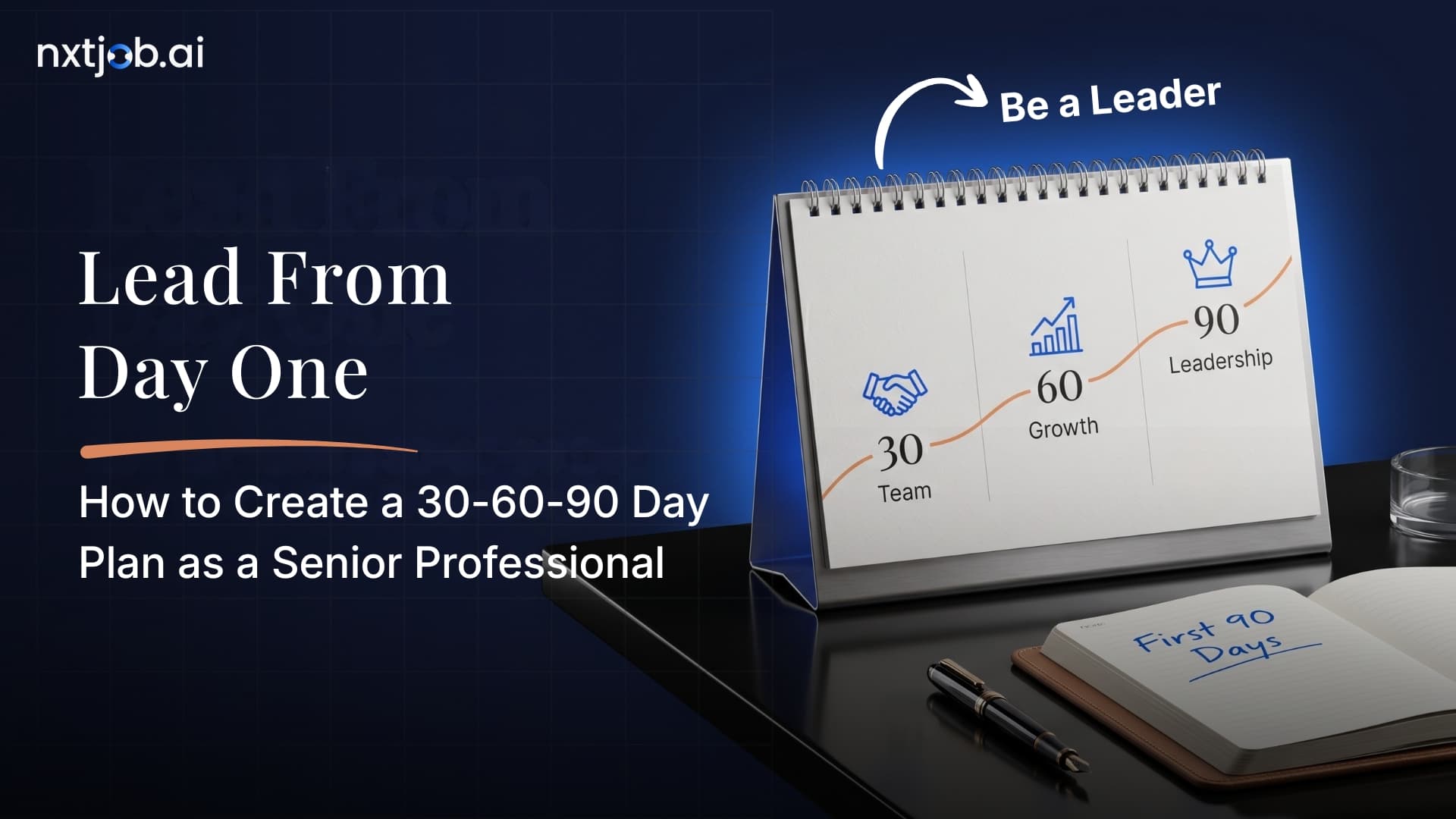
How to Create a 30 60 90 Plan for Senior Professionals
A 30-60-90 Day Plan for Senior Professionals that shows you can lead, get the team on the same page, and get results from day one.
As a content writer and SEO strategist, I help turn complex AI job search, career-tech, and growth topics into clear, practical content. At NxtJob.ai, I write to help senior professionals make smarter career moves with clarity and confidence.
Githu Ravikkumar
Creative Strategist & Copywriter, Nxtjob
What is a career development plan?
How often should I review my career plan?
What should a five-year career plan include?
Everything you need to know
Here you can find solutions to all your queries.
Job search
10 min read
Published Date:
|
Last Modified:
Career planning for mid-senior professionals is a system. Not a vision board.
A career plan for a senior professional is eight decisions you review every six months. Your target role and companies. The skills gap you're closing. Your proof of work. Your network. Your interview readiness. Your number. Write them down and act the moment one stops holding.
You need it because the default outcome is a stall. A 2026 NYU study found that about one in four mid-career professionals goes five years or more without a promotion or pay rise. They weren't bad at their jobs. They had no plan for what came next.
Ramyaa has 22 years of experience and lost her job twice in about a year. Her story runs through this guide.
Want to see a system like this built live? Reserve your seat at our 2-day bootcamp.
The plan on one page
Target: one role type, one industry, and a named list of companies.
Gap: the one skill missing from your profile that shows up most in real postings.
Proof: your last three years of accomplishments, written with numbers.
Visibility: a sponsor inside your company and a current LinkedIn profile.
Network: one real conversation a month with someone outside your company.
Interviews: a bank of stories with follow-up questions, practiced out loud.
Number: your market range, your minimum, and the terms you won't accept.
Trigger: the conditions that start your move, decided in advance.
What career planning means after 10 years
Career planning after 10 years means choosing your next role and building the evidence, skills, and relationships to get it before you need it.
Early in a career, you explore. Now you narrow and execute. Long-term career planning still needs a direction, and a five-year vision is fine for that.
The working document is your career development plan for the next 12 months, and this guide builds it.
Why senior careers stall
Senior careers stall because of your employer, your role type, and the market, more than your effort.
The researchers studied 1.3 million mid-career professionals and defined a stall as no promotion and almost no wage growth for five years or more.
Check your last five years of career progression against that. By year ten, those who later stalled had averaged 1.5 promotions and 45% wage growth. Their peers who kept moving had averaged 1.9 and 66%.
Employer first. Revelio Labs found the odds of a promotion over 12 months were 2.8% at low-promotion firms and 6.2% at high-promotion firms. Role type next. Gusto's payroll data shows the US promotion rate fell from 14.6% in May 2022 to 10.3% in May 2025, mostly among younger workers.
For people 35 and older, it sits in line with 2019, though individual contributor promotions sit about 20% below 2019 against about 10% for people managers. Then the market. Workday's 2025 research found internal hiring down 8% and promotions down in 10 of 11 industries.
This data is mostly from the US, and India-specific numbers are thin. Treat it as direction, not a forecast for your employer.
How to build your career development plan, one decision at a time
Your career development plan is a short list of decisions, made in order and reviewed every eight months. Each section below gives you the answer first and the details after. Start with direction, because everything else gets tested against it.
Pick a direction you can test
Pick one direction for the next 12 months, specific enough to check against a job posting. "Senior Manager" is a title. A direction is a role type, an industry and a kind of company, like "Head of Growth at a Series B or C fintech in Bengaluru or Mumbai."
Your options are to go deeper as a specialist, widen your scope, move into people leadership, change your industry or your function while keeping the other, or go independent. Look inside your current company first.
The NYU report gives one example. Programmers who moved into data science inside the same company cut their stall risk by up to 86%. That's one case, not a promise. Pick the move that reuses most of what you know and pays more for it.
On specialist versus manager, the Gusto split above shows individual contributor promotions slowing more, so ask whether your firm has a senior specialist track before you assume it doesn't.
Then build a company list from your sentence. Your network sits wherever you've spent the most time, and after 10 years in one place, you find out what that costs on the day you leave.
Navigator is our AI agent for this groundwork. It helps you define a target niche, test your fit against real jobs, find your skill gaps, and turn your experience into a master resume. If you're around 40 and feeling stuck, read how to overcome career stagnation at 40.
Close the skills gap that shows up most
Close one skill gap at a time, starting with the one that appears in the most postings for your target role. Every six months, pull five live postings. List every requirement you can't yet prove from your own work, count how often each appears, and close the top one first.
The World Economic Forum's 2025 jobs report says employers expect 39% of workers' core skills to change by 2030. AI and big data grew fastest. At your level, proof beats certificates.
A finished project that used AI to cut process time says more than a course. Where a course helps, NPTEL offers courses from the IITs and IISc.
Write your proof of work before you need it
Write your accomplishments as short result statements while the details are fresh.
The situation, what you did, the result with a number. Say onboarding vendors took six weeks and you rebuilt the process to take three.
That's a made-up example. Write yours the week it happens, because rebuilding three years of work from memory in the middle of a search costs you weeks.
Keep a master resume with everything and a shorter version for each role. Applicant tracking systems parse your resume before a person reads it, so keep the layout plain and use the posting's own terms.
My post on how to make an ATS-friendly resume explains the rules.
Make your work visible before you ask for anything
Promotions and referrals go to people whose work others can describe. Inside your company, find a sponsor, someone senior who can speak about your work in rooms you're not in.
Before you ask for a promotion, write a one-page case with your scope, your results, and what the next level requires, and confirm those requirements with your manager. Outside it, keep your LinkedIn profile in line with your accomplishment statements, so a recruiter or contact who looks you up finds who you are now.
Build the network before you search
Build the network outside your current company and before you need it. Your closest contacts hear what you hear. A 2022 Science study of over 20 million LinkedIn users found that moderately weak ties helped people change jobs most, and that the effect varied by industry. Spread your contacts across both kinds.
Run a quick test. Write down the 20 people you'd call first for a job lead. Count how many work at your employer or used to. If it's more than a few, you have a concentration problem, and it stays hidden until you need those calls.
The fix is one real conversation a month with someone outside your company. Ask about their work and nothing else. Keep a few recruiters at your level warm too, and our post on how to reach out to a recruiter on LinkedIn has the wording.
Our Networker agent finds recruiters, hiring managers, and alumni around your target roles and drafts outreach, and you review it before anything goes out.
At Director level and above, roles are often filled before they're posted, so search firms and reputation matter most. If you want a confidential search run with you, Sw!tch is our coached service for senior leaders.
Want to see how all of this fits together over two days? Join the live bootcamp.
Get interview-ready months ahead
Build a bank of stories before you have an interview, write follow-up questions for each one and practice out loud until the answers come without notes. At senior levels, research the company's business problem too, so you arrive with a point of view and not only a history.
Our Interviewer agent runs role-specific mock interviews across screening, managerial, technical, knowledge, negotiation, and custom modes, and gives feedback on your answers.
Know your number before anyone asks
Decide your market range, your minimum and your terms before a recruiter asks. In India the current and expected CTC question comes early, and whatever you improvise on that call sets the anchor. Break your pay into fixed, variable, ESOPs, joining bonus and benefits.
Check your notice period and buyout terms, since they set your earliest start date. Negotiate scope and title along with pay, because they shape your next move too.
Two of our posts go deeper.
Read how to answer expected CTC before the first call, and counter-offer negotiation for senior leaders before you reply to an offer.
Set your runway and your triggers
Decide how long you can search and what makes you start, while you're calm. Runway is your monthly household spend multiplied by the months you'd want to search, plus your notice period. Knowing it stops fear from deciding for you.
Triggers are your call, and these are my rules of thumb, not a study:
18 to 24 months with no change in scope, title or pay.
Your manager or sponsor leaves.
Your function is restructured or your project ends.
A conversation outside your company comes with a number worth a real look.
You don't have to resign when one fires. You need a real alternative on the table, meaning a conversation with a hiring manager or an interview process running, plus a figure you could say yes to.
If a layoff makes the decision for you, do the same things in week one. Read your severance terms, write down your accomplishments, and tell your closest 10 contacts what you're looking for.
Ramyaa's story
Ramyaa lost her job in November 2024. Her network got her a startup role through one or two contacts. In November 2025, she lost that job too.
She'd spent over ten years at one company before that, and most of her contacts still worked there. The people she'd normally call were the people she'd just left.
She already did real work by hand, with about 50 accomplishment statements in a notes app and one and a half to two hours spent on each application. Then she saw an ad for Major Richik's program. She was skeptical, but she attended the two-day workshop.
Four things changed. She'd been searching for jobs, not companies, so she built a target company list and searched by role type, since companies give similar roles different titles. She learned how to expand her network beyond the contacts she'd used up.
Her resumes dropped to five to ten minutes each. And she grew her STAR story bank from five to ten stories to 20 to 25, with follow-up questions for each, and practiced with ChatGPT about two hours a day, asking it to grade her as a top 1% candidate.
She doesn't oversell it. Others in her cohort reported 12 or 15 callbacks, and hers weren't at that volume.
But HR later told her that the panel decided on her in under ten minutes, though the interview ran 45 minutes to finish a checklist. Her explanation is the prep.
You can watch here:
Using an AI assistant for career planning
An AI assistant is good at drafting options, spotting patterns across job descriptions and grading your practice answers. It's weak on your market, your employer and what a recruiter will really say. Check its facts and don't paste anything confidential from your employer.
"I have [14] years in [digital marketing], and I'm a [Senior Manager]. List five roles I could target in the next 18 months and what each would need me to prove."
"Here are five job descriptions for the role I want. Which requirements appear in most of them, and which can't I yet prove from my resume?"
"Ask me the ten hardest questions for a [Director of Operations] interview. After each answer, grade it as a top 1% candidate would and tell me what's missing."
So, where should you start?
Do two things before Sunday. Write your direction as one sentence, then send one message to someone outside your company asking for 20 minutes.
The sentence tells you what to test everything against. The conversation tells you whether the market agrees.
If you want help building the rest with people who've done it, NxtJob's live two day bootcamp covers target companies, resume structure, networking and interview practice on Zoom. Get your seat.
Table of content
Negotiation
Counter Offer Negotiation: A Strategic Guide for Senior Leaders
A guide for senior professionals on why most counter offers fail and how to use market research to decide your next move.
Interview
How to Create a 30 60 90 Plan for Senior Professionals
A 30-60-90 Day Plan for Senior Professionals that shows you can lead, get the team on the same page, and get results from day one.
As a content writer and SEO strategist, I help turn complex AI job search, career-tech, and growth topics into clear, practical content. At NxtJob.ai, I write to help senior professionals make smarter career moves with clarity and confidence.
Githu Ravikkumar
Creative Strategist & Copywriter, Nxtjob
Recent articles
Resume
5 min read
How to Create a 30 60 90 Plan for Senior Professionals
A 30-60-90 Day Plan for Senior Professionals that shows you can lead, get the team on the same page, and get results from day one.

Resume
5 min read
Expected CTC: How to Answer Salary Expectations As a Senior Professional Copy
Learn how to answer the expected CTC question. Avoid early anchoring, handling HR pushback, and getting a fair salary offer.
Resume
5 min read
Expected CTC: How to Answer Salary Expectations As a Senior Professional
Learn how to answer the expected CTC question. Avoid early anchoring, handling HR pushback, and getting a fair salary offer.
Resume
5 min read
How to Create a 30 60 90 Plan for Senior Professionals
A 30-60-90 Day Plan for Senior Professionals that shows you can lead, get the team on the same page, and get results from day one.
Resume
5 min read
Expected CTC: How to Answer Salary Expectations As a Senior Professional Copy
Learn how to answer the expected CTC question. Avoid early anchoring, handling HR pushback, and getting a fair salary offer.
Everything you need to know
Here you can find solutions to all your queries.
What is a career development plan?
How often should I review my career plan?
What should a five-year career plan include?
Join the Revolution
Your AI career copilot to land you top jobs in under 90 days.
Join the Revolution
Your AI career copilot to land you top jobs in under 90 days.
Join the Revolution
Your AI career copilot to land you top jobs in under 90 days.