
Interview
10 min read
Interview Questions by HR at Senior Level: What Recruiters Screen For and How to Rehearse
Published Date:
|
Last Modified:

If you have 15 years behind you, the round that kills your candidacy is almost never the panel. It is the 25-minute call that felt like a formality.
HR opens with something that sounds like small talk, and that is where senior professionals stumble. A screening call runs 25 to 35 minutes, and the recruiter asks five to seven questions.
Each one checks something the panel never checks. Are you a retention risk? Will you accept the offer? Does your CV overstate what you owned?
Interview questions by HR are not filler. This guide shows what each one tests, why interview calls do not turn into offers, and how to rehearse until they do.
Want to rehearse with people? Join our live two-day bootcamp.
The HR round at a glance
Nine questions come up again and again, and each has a fixed purpose. Recruiters want short answers with a number and a date in them.
# | HR round question | What it tests | How to answer
|
|---|---|---|---|
1 | Walk me through your current scope | Your real mandate, not your career history | 60 to 90 seconds. Team size, budget, what you decide alone |
2 | Why did you leave your last two roles | Moving towards something or escaping something | A reason tied to scope, ownership, or market. No blame |
3 | What is your current CTC | Honesty, checked at offer stage | Share it accurately, then state your target |
4 | What are you expecting, and is there room to move | Budget fit. The screening filter | A range of 15 to 20 percent. Ask what the team budgeted |
5 | What is your notice period, and can it be bought out | Start date and your leverage | Give the days and the buyout. "I can join sooner if we align" |
6 | Why three companies in six years, or 11 years in one | Retention risk or culture fit | Say what changed in the role. Never criticise a manager |
7 | Why the gap | Whether the story is closed | Say what it was and what you did in it |
8 | Tell me about a time your team missed a target | Ownership | The target, what you saw late, what you changed, the number |
9 | Are you interviewing elsewhere, and how far along | Urgency and market validation | "Yes, at an early stage" is fine |
What changes at senior level
At senior level, the HR round tests scope and logistics before anything else. Titles rarely reflect the real scope of a role, so the questions separate what you owned from what your team delivered.
Say "I led the migration" and the recruiter listens for whether you ran it, sponsored it, or watched it happen. Your resume has to show scope in numbers too, and my post on how to make an ATS-friendly resume is a good start.
Logistics change as well. At 25 lakhs, a notice period is usually an admin detail. At 60 lakhs or a crore, it is a hiring decision, because the seat has a start date tied to a quarter.
The nine HR round questions in detail

Walk me through your current scope
Give your current mandate, not your career. Team size, budget, what reports to you, what you decide alone. Sixty to ninety seconds, with numbers.
Why did you leave your last two roles?
Notice the plural. The recruiter sorts you into two buckets: moving towards something or escaping something. Only the first gets forwarded. Tie your reason to scope, ownership, or market, and criticise nobody.
What is your current CTC?
Nothing in Indian law forces you to share it with a recruiter, but most companies ask, and lying is risky because it usually gets checked through Form 16 or payslips at the offer stage. Answer honestly and pivot in the same breath to your target.
What are you expecting, and is there room to move
This is the filter, not the negotiation. Many recruiters screen on expected CTC before your profile reaches the hiring manager, and large firms often negotiate inside fixed bands.
Give a range of 15 to 20 percent. Targeting 50, say 48 to 56. If they insist you go first, try: "I would rather not name a figure that is out of range and waste both our time. What has the team budgeted for?"
My posts on how to answer expected CTC and salary negotiation with HR cover the follow-ups.
What is your notice period, and can it be bought out
Give the actual number of days and say whether buyout is possible. A notice period is leverage if you use it as leverage. "I can join sooner if we align on compensation" is a real card at this level.
Why three companies in six years
Or the reverse: why 11 years in one place. Both get asked. One suggests you leave; the other suggests you may not survive a different culture.
Answer with what changed in the role, not how you felt about the manager.
Why the gap
Say what it was and what you did in it. A specific answer closes the question. A vague one stays open for the rest of the process.
Tell me about a time your team missed a target
It is the only behavioural question most recruiters bother with at screening, and senior candidates handle it worst.
They take no responsibility or all of it. Say what the target was, what you saw late, what you changed, and what the number ended up being.
Are you interviewing elsewhere, and how far along
They are measuring urgency and market validation. "Yes, and at an early stage" is fine.
Sounding like nine months in the market with nothing to show is not.
And when they ask what questions you have, ask about the first 12 months, the reporting line, and why the seat is open.
Manager-level interview questions now start in the screening round
Manager-level interview questions used to arrive in round two.
For anyone with people or money underneath them, they now show up on the first call, because HR is screening for real authority over hiring, firing, and budget.
Expect these. How many people reported to you? How many did you hire and exit? Did you own a P&L? What is the largest budget you signed off on?
Why are you applying for a role that looks smaller than your last one?
That last one is the downlevel question, and a Director applying for a Senior Manager role gets it every time.
The honest answer that the market is thin reads as desperation. Talk about the scope of the seat, not the size of the title.
At head-of-function level, be ready for "why hire you over someone earlier in their career and cheaper."
HR recruiter interview questions and hiring manager questions are two different calls
HR recruiter interview questions want short answers.
Give the number, give the date, stop talking. Hiring manager questions invite three or four minutes with specifics, scope, and the trade-offs you made.
Most senior candidates do this in reverse.
They give the recruiter a four-minute monologue about strategy, then give the hiring manager two lines. "Tell me about yourself" opens most of these calls, so drill it on its own.
Why interview calls do not turn into offers
Getting interviews and winning offers are two different problems, and most senior candidates only fix the first.
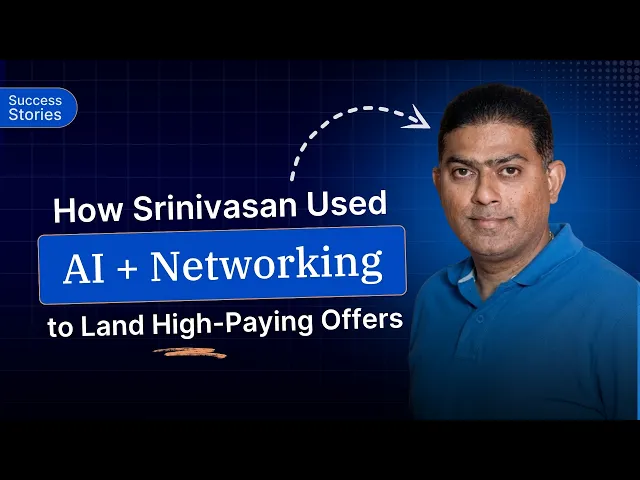
Srinivasan's success story shows both:
He was applying to about five jobs a day and asking ChatGPT to rewrite his resume for each description. Interviews came. But he says ChatGPT added things to the resume he could not defend, and he could not live up to it in the room.
His fix was to stop over-editing. Keep the resume roughly 70 percent aligned with the description so you can justify every line. Heavy tailoring gets you a call. It does not survive the recruiter's follow-up.
Then a second problem showed up. Interview after interview, and no offers. His weekly feedback said it plainly: offer conversion was not happening.

Rehearse out loud, and rehearse what you avoid
Practice out loud is what turns interviews into offers. Srinivasan lost several offers before he saw the gap.
In his words, plenty of people talk to a screen, but face-to-face is different because you do not know what will be thrown at you, especially when you are between jobs.
So he started rehearsing on our tool, then added a second one that builds an avatar of you and asks questions by phone.
The sharpest moment was negotiation. He practised against a negotiation bot, took a hard line, thought he was the smartest person in the room, and the bot broke him. Then he ran it 10 to 15 times over two months.
His point is worth keeping: HRs have done this all their working lives, so if you can convince the bot on hard mode, you are ready for the human.
There is research behind repetition. In a randomized trial of 46 adults, those who practised with a virtual interviewer scored higher in role-plays and felt less anxious.
They had severe mental illness, so read it as evidence for how practice works, not a promise.
An AI mock interview, or any interview simulator, gives you what a busy friend cannot.
Repetition, so the compensation question gets asked 20 times. Timing, so you learn your quick summary runs four minutes.
Playback, so you hear "basically" eight times in one answer. And targeting the actual job description.
Our Interviewer agent runs role-specific mock interviews across screening, managerial, technical, knowledge, negotiation, and custom modes, and our Negotiator agent helps you prepare for salary negotiations and counteroffers.
A simulator cannot read a company's politics or tell you the hiring manager has gone cold. Take those to a human.
Practise for an AI interviewer too
Expect an AI in the room.
Greenhouse's 2026 candidate report found 63 percent of 2,950 job seekers had been interviewed by an AI, up 13 percentage points in six months, and 70 percent were never clearly told.

HireVue launched a voice-based AI interviewer on 18 June 2026. It does not nod or rescue you when you trail off, so test that in rehearsal.
A 10-day interview rehearsal plan
Rehearsal only works if it is close to the real thing.

Day one. Write two answers only. Your 90-second scope answer, and your compensation answer as one range plus one sentence of reasoning.
Day two. Run all nine questions out loud, no notes, recorded, in one sitting. Do not stop to fix anything.
Day three. Listen back once. It is unpleasant. Mark your two worst answers and ignore the rest.
Days four to seven. Drill only those two, 10 to 15 reps a day, until they come out the same way every time.
Day eight. Run everything again at half the length. You are almost certainly too long.
Day nine. Run the full screen at the time of day your calls usually land, in the clothes you would wear, camera on.
Day ten. Nothing. Let it settle. On the call itself, say what you want remembered in the first four minutes, with a number attached, because the recruiter decides to move forward or drop inside half an hour.
Want the room, the feedback, and the accountability? Join the live bootcamp.
Do this before your next screening call
Pick the two questions you like least, most likely CTC and the gap.
Write a 60-second answer to each. Then say them out loud with a timer, record yourself, and listen back once. It will be uncomfortable, and that is exactly why it works.
Srinivasan kept losing offers until he practised out loud. You can close the same gap in ten days, and you can start tonight. Answers you have said out loud a dozen times stop feeling like a performance and start feeling like facts.
If you want a room of senior professionals to practise with, our live two-day bootcamp covers interviews, networking and negotiation. Get your seat.

As a content writer and SEO strategist, I help turn complex AI job search, career-tech, and growth topics into clear, practical content. At NxtJob.ai, I write to help senior professionals make smarter career moves with clarity and confidence.
Githu Ravikkumar
Creative Strategist & Copywriter, Nxtjob
Recent articles

Resume
5 min read
ATS Resume Format: How to Create a Resume That Gets Past Applicant Tracking Systems
Learn how to create an ATS-friendly resume that passes through applicant tracking systems and increases your chances of landing an interview.
Resume
5 min read
ATS Resume Format: How to Create a Resume That Gets Past Applicant Tracking Systems
Learn how to create an ATS-friendly resume that passes through applicant tracking systems and increases your chances of landing an interview.
Resume
5 min read
ATS Resume Format: How to Create a Resume That Gets Past Applicant Tracking Systems
Learn how to create an ATS-friendly resume that passes through applicant tracking systems and increases your chances of landing an interview.
Resume
5 min read
ATS Resume Format: How to Create a Resume That Gets Past Applicant Tracking Systems
Learn how to create an ATS-friendly resume that passes through applicant tracking systems and increases your chances of landing an interview.
Resume
5 min read
ATS Resume Format: How to Create a Resume That Gets Past Applicant Tracking Systems
Learn how to create an ATS-friendly resume that passes through applicant tracking systems and increases your chances of landing an interview.
Resume
5 min read
ATS Resume Format: How to Create a Resume That Gets Past Applicant Tracking Systems
Learn how to create an ATS-friendly resume that passes through applicant tracking systems and increases your chances of landing an interview.
Everything you need to know
Here you can find solutions to all your queries.
What are the most common interview questions by HR at senior level?
What is the HR round in an interview, and what does it check?
How do I answer "Tell me about yourself" in an HR round?
How do I answer "Why should we hire you?"
What should you not say in an HR interview?
Should I share my current CTC in an HR round in India?
How are manager-level interview questions different from HR round questions?
How do I prepare for an HR interview, and is an AI mock interview enough?
Interview
10 min read
Interview Questions by HR at Senior Level: What Recruiters Screen For and How to Rehearse
Published Date:
|
Last Modified:
If you have 15 years behind you, the round that kills your candidacy is almost never the panel. It is the 25-minute call that felt like a formality.
HR opens with something that sounds like small talk, and that is where senior professionals stumble. A screening call runs 25 to 35 minutes, and the recruiter asks five to seven questions.
Each one checks something the panel never checks. Are you a retention risk? Will you accept the offer? Does your CV overstate what you owned?
Interview questions by HR are not filler. This guide shows what each one tests, why interview calls do not turn into offers, and how to rehearse until they do.
Want to rehearse with people? Join our live two-day bootcamp.
The HR round at a glance
Nine questions come up again and again, and each has a fixed purpose. Recruiters want short answers with a number and a date in them.
# | HR round question | What it tests | How to answer
|
|---|---|---|---|
1 | Walk me through your current scope | Your real mandate, not your career history | 60 to 90 seconds. Team size, budget, what you decide alone |
2 | Why did you leave your last two roles | Moving towards something or escaping something | A reason tied to scope, ownership, or market. No blame |
3 | What is your current CTC | Honesty, checked at offer stage | Share it accurately, then state your target |
4 | What are you expecting, and is there room to move | Budget fit. The screening filter | A range of 15 to 20 percent. Ask what the team budgeted |
5 | What is your notice period, and can it be bought out | Start date and your leverage | Give the days and the buyout. "I can join sooner if we align" |
6 | Why three companies in six years, or 11 years in one | Retention risk or culture fit | Say what changed in the role. Never criticise a manager |
7 | Why the gap | Whether the story is closed | Say what it was and what you did in it |
8 | Tell me about a time your team missed a target | Ownership | The target, what you saw late, what you changed, the number |
9 | Are you interviewing elsewhere, and how far along | Urgency and market validation | "Yes, at an early stage" is fine |
What changes at senior level
At senior level, the HR round tests scope and logistics before anything else. Titles rarely reflect the real scope of a role, so the questions separate what you owned from what your team delivered.
Say "I led the migration" and the recruiter listens for whether you ran it, sponsored it, or watched it happen. Your resume has to show scope in numbers too, and my post on how to make an ATS-friendly resume is a good start.
Logistics change as well. At 25 lakhs, a notice period is usually an admin detail. At 60 lakhs or a crore, it is a hiring decision, because the seat has a start date tied to a quarter.
The nine HR round questions in detail
Walk me through your current scope
Give your current mandate, not your career. Team size, budget, what reports to you, what you decide alone. Sixty to ninety seconds, with numbers.
Why did you leave your last two roles?
Notice the plural. The recruiter sorts you into two buckets: moving towards something or escaping something. Only the first gets forwarded. Tie your reason to scope, ownership, or market, and criticise nobody.
What is your current CTC?
Nothing in Indian law forces you to share it with a recruiter, but most companies ask, and lying is risky because it usually gets checked through Form 16 or payslips at the offer stage. Answer honestly and pivot in the same breath to your target.
What are you expecting, and is there room to move
This is the filter, not the negotiation. Many recruiters screen on expected CTC before your profile reaches the hiring manager, and large firms often negotiate inside fixed bands.
Give a range of 15 to 20 percent. Targeting 50, say 48 to 56. If they insist you go first, try: "I would rather not name a figure that is out of range and waste both our time. What has the team budgeted for?"
My posts on how to answer expected CTC and salary negotiation with HR cover the follow-ups.
What is your notice period, and can it be bought out
Give the actual number of days and say whether buyout is possible. A notice period is leverage if you use it as leverage. "I can join sooner if we align on compensation" is a real card at this level.
Why three companies in six years
Or the reverse: why 11 years in one place. Both get asked. One suggests you leave; the other suggests you may not survive a different culture.
Answer with what changed in the role, not how you felt about the manager.
Why the gap
Say what it was and what you did in it. A specific answer closes the question. A vague one stays open for the rest of the process.
Tell me about a time your team missed a target
It is the only behavioural question most recruiters bother with at screening, and senior candidates handle it worst.
They take no responsibility or all of it. Say what the target was, what you saw late, what you changed, and what the number ended up being.
Are you interviewing elsewhere, and how far along
They are measuring urgency and market validation. "Yes, and at an early stage" is fine.
Sounding like nine months in the market with nothing to show is not.
And when they ask what questions you have, ask about the first 12 months, the reporting line, and why the seat is open.
Manager-level interview questions now start in the screening round
Manager-level interview questions used to arrive in round two.
For anyone with people or money underneath them, they now show up on the first call, because HR is screening for real authority over hiring, firing, and budget.
Expect these. How many people reported to you? How many did you hire and exit? Did you own a P&L? What is the largest budget you signed off on?
Why are you applying for a role that looks smaller than your last one?
That last one is the downlevel question, and a Director applying for a Senior Manager role gets it every time.
The honest answer that the market is thin reads as desperation. Talk about the scope of the seat, not the size of the title.
At head-of-function level, be ready for "why hire you over someone earlier in their career and cheaper."
HR recruiter interview questions and hiring manager questions are two different calls
HR recruiter interview questions want short answers.
Give the number, give the date, stop talking. Hiring manager questions invite three or four minutes with specifics, scope, and the trade-offs you made.
Most senior candidates do this in reverse.
They give the recruiter a four-minute monologue about strategy, then give the hiring manager two lines. "Tell me about yourself" opens most of these calls, so drill it on its own.
Why interview calls do not turn into offers
Getting interviews and winning offers are two different problems, and most senior candidates only fix the first.
Srinivasan's success story shows both:
He was applying to about five jobs a day and asking ChatGPT to rewrite his resume for each description. Interviews came. But he says ChatGPT added things to the resume he could not defend, and he could not live up to it in the room.
His fix was to stop over-editing. Keep the resume roughly 70 percent aligned with the description so you can justify every line. Heavy tailoring gets you a call. It does not survive the recruiter's follow-up.
Then a second problem showed up. Interview after interview, and no offers. His weekly feedback said it plainly: offer conversion was not happening.
Rehearse out loud, and rehearse what you avoid
Practice out loud is what turns interviews into offers. Srinivasan lost several offers before he saw the gap.
In his words, plenty of people talk to a screen, but face-to-face is different because you do not know what will be thrown at you, especially when you are between jobs.
So he started rehearsing on our tool, then added a second one that builds an avatar of you and asks questions by phone.
The sharpest moment was negotiation. He practised against a negotiation bot, took a hard line, thought he was the smartest person in the room, and the bot broke him. Then he ran it 10 to 15 times over two months.
His point is worth keeping: HRs have done this all their working lives, so if you can convince the bot on hard mode, you are ready for the human.
There is research behind repetition. In a randomized trial of 46 adults, those who practised with a virtual interviewer scored higher in role-plays and felt less anxious.
They had severe mental illness, so read it as evidence for how practice works, not a promise.
An AI mock interview, or any interview simulator, gives you what a busy friend cannot.
Repetition, so the compensation question gets asked 20 times. Timing, so you learn your quick summary runs four minutes.
Playback, so you hear "basically" eight times in one answer. And targeting the actual job description.
Our Interviewer agent runs role-specific mock interviews across screening, managerial, technical, knowledge, negotiation, and custom modes, and our Negotiator agent helps you prepare for salary negotiations and counteroffers.
A simulator cannot read a company's politics or tell you the hiring manager has gone cold. Take those to a human.
Practise for an AI interviewer too
Expect an AI in the room.
Greenhouse's 2026 candidate report found 63 percent of 2,950 job seekers had been interviewed by an AI, up 13 percentage points in six months, and 70 percent were never clearly told.
HireVue launched a voice-based AI interviewer on 18 June 2026. It does not nod or rescue you when you trail off, so test that in rehearsal.
A 10-day interview rehearsal plan
Rehearsal only works if it is close to the real thing.
Day one. Write two answers only. Your 90-second scope answer, and your compensation answer as one range plus one sentence of reasoning.
Day two. Run all nine questions out loud, no notes, recorded, in one sitting. Do not stop to fix anything.
Day three. Listen back once. It is unpleasant. Mark your two worst answers and ignore the rest.
Days four to seven. Drill only those two, 10 to 15 reps a day, until they come out the same way every time.
Day eight. Run everything again at half the length. You are almost certainly too long.
Day nine. Run the full screen at the time of day your calls usually land, in the clothes you would wear, camera on.
Day ten. Nothing. Let it settle. On the call itself, say what you want remembered in the first four minutes, with a number attached, because the recruiter decides to move forward or drop inside half an hour.
Want the room, the feedback, and the accountability? Join the live bootcamp.
Do this before your next screening call
Pick the two questions you like least, most likely CTC and the gap.
Write a 60-second answer to each. Then say them out loud with a timer, record yourself, and listen back once. It will be uncomfortable, and that is exactly why it works.
Srinivasan kept losing offers until he practised out loud. You can close the same gap in ten days, and you can start tonight. Answers you have said out loud a dozen times stop feeling like a performance and start feeling like facts.
If you want a room of senior professionals to practise with, our live two-day bootcamp covers interviews, networking and negotiation. Get your seat.
Table of content

Job search
Career planning for mid-senior professionals is a system. Not a vision board.
A guide to career planning for mid-senior professionals, built on eight decisions and backed by 2025 and 2026 data. It includes a real case, prompts you can use with an AI assistant, and a plan you can start this week

Negotiation
Counter Offer Negotiation: A Strategic Guide for Senior Leaders
A guide for senior professionals on why most counter offers fail and how to use market research to decide your next move.
As a content writer and SEO strategist, I help turn complex AI job search, career-tech, and growth topics into clear, practical content. At NxtJob.ai, I write to help senior professionals make smarter career moves with clarity and confidence.
Githu Ravikkumar
Creative Strategist & Copywriter, Nxtjob
What are the most common interview questions by HR at senior level?
What is the HR round in an interview, and what does it check?
How do I answer "Tell me about yourself" in an HR round?
How do I answer "Why should we hire you?"
What should you not say in an HR interview?
Should I share my current CTC in an HR round in India?
How are manager-level interview questions different from HR round questions?
How do I prepare for an HR interview, and is an AI mock interview enough?
Everything you need to know
Here you can find solutions to all your queries.
Interview
10 min read
Published Date:
|
Last Modified:
Interview Questions by HR at Senior Level: What Recruiters Screen For and How to Rehearse
If you have 15 years behind you, the round that kills your candidacy is almost never the panel. It is the 25-minute call that felt like a formality.
HR opens with something that sounds like small talk, and that is where senior professionals stumble. A screening call runs 25 to 35 minutes, and the recruiter asks five to seven questions.
Each one checks something the panel never checks. Are you a retention risk? Will you accept the offer? Does your CV overstate what you owned?
Interview questions by HR are not filler. This guide shows what each one tests, why interview calls do not turn into offers, and how to rehearse until they do.
Want to rehearse with people? Join our live two-day bootcamp.
The HR round at a glance
Nine questions come up again and again, and each has a fixed purpose. Recruiters want short answers with a number and a date in them.
# | HR round question | What it tests | How to answer
|
|---|---|---|---|
1 | Walk me through your current scope | Your real mandate, not your career history | 60 to 90 seconds. Team size, budget, what you decide alone |
2 | Why did you leave your last two roles | Moving towards something or escaping something | A reason tied to scope, ownership, or market. No blame |
3 | What is your current CTC | Honesty, checked at offer stage | Share it accurately, then state your target |
4 | What are you expecting, and is there room to move | Budget fit. The screening filter | A range of 15 to 20 percent. Ask what the team budgeted |
5 | What is your notice period, and can it be bought out | Start date and your leverage | Give the days and the buyout. "I can join sooner if we align" |
6 | Why three companies in six years, or 11 years in one | Retention risk or culture fit | Say what changed in the role. Never criticise a manager |
7 | Why the gap | Whether the story is closed | Say what it was and what you did in it |
8 | Tell me about a time your team missed a target | Ownership | The target, what you saw late, what you changed, the number |
9 | Are you interviewing elsewhere, and how far along | Urgency and market validation | "Yes, at an early stage" is fine |
What changes at senior level
At senior level, the HR round tests scope and logistics before anything else. Titles rarely reflect the real scope of a role, so the questions separate what you owned from what your team delivered.
Say "I led the migration" and the recruiter listens for whether you ran it, sponsored it, or watched it happen. Your resume has to show scope in numbers too, and my post on how to make an ATS-friendly resume is a good start.
Logistics change as well. At 25 lakhs, a notice period is usually an admin detail. At 60 lakhs or a crore, it is a hiring decision, because the seat has a start date tied to a quarter.
The nine HR round questions in detail
Walk me through your current scope
Give your current mandate, not your career. Team size, budget, what reports to you, what you decide alone. Sixty to ninety seconds, with numbers.
Why did you leave your last two roles?
Notice the plural. The recruiter sorts you into two buckets: moving towards something or escaping something. Only the first gets forwarded. Tie your reason to scope, ownership, or market, and criticise nobody.
What is your current CTC?
Nothing in Indian law forces you to share it with a recruiter, but most companies ask, and lying is risky because it usually gets checked through Form 16 or payslips at the offer stage. Answer honestly and pivot in the same breath to your target.
What are you expecting, and is there room to move
This is the filter, not the negotiation. Many recruiters screen on expected CTC before your profile reaches the hiring manager, and large firms often negotiate inside fixed bands.
Give a range of 15 to 20 percent. Targeting 50, say 48 to 56. If they insist you go first, try: "I would rather not name a figure that is out of range and waste both our time. What has the team budgeted for?"
My posts on how to answer expected CTC and salary negotiation with HR cover the follow-ups.
What is your notice period, and can it be bought out
Give the actual number of days and say whether buyout is possible. A notice period is leverage if you use it as leverage. "I can join sooner if we align on compensation" is a real card at this level.
Why three companies in six years
Or the reverse: why 11 years in one place. Both get asked. One suggests you leave; the other suggests you may not survive a different culture.
Answer with what changed in the role, not how you felt about the manager.
Why the gap
Say what it was and what you did in it. A specific answer closes the question. A vague one stays open for the rest of the process.
Tell me about a time your team missed a target
It is the only behavioural question most recruiters bother with at screening, and senior candidates handle it worst.
They take no responsibility or all of it. Say what the target was, what you saw late, what you changed, and what the number ended up being.
Are you interviewing elsewhere, and how far along
They are measuring urgency and market validation. "Yes, and at an early stage" is fine.
Sounding like nine months in the market with nothing to show is not.
And when they ask what questions you have, ask about the first 12 months, the reporting line, and why the seat is open.
Manager-level interview questions now start in the screening round
Manager-level interview questions used to arrive in round two.
For anyone with people or money underneath them, they now show up on the first call, because HR is screening for real authority over hiring, firing, and budget.
Expect these. How many people reported to you? How many did you hire and exit? Did you own a P&L? What is the largest budget you signed off on?
Why are you applying for a role that looks smaller than your last one?
That last one is the downlevel question, and a Director applying for a Senior Manager role gets it every time.
The honest answer that the market is thin reads as desperation. Talk about the scope of the seat, not the size of the title.
At head-of-function level, be ready for "why hire you over someone earlier in their career and cheaper."
HR recruiter interview questions and hiring manager questions are two different calls
HR recruiter interview questions want short answers.
Give the number, give the date, stop talking. Hiring manager questions invite three or four minutes with specifics, scope, and the trade-offs you made.
Most senior candidates do this in reverse.
They give the recruiter a four-minute monologue about strategy, then give the hiring manager two lines. "Tell me about yourself" opens most of these calls, so drill it on its own.
Why interview calls do not turn into offers
Getting interviews and winning offers are two different problems, and most senior candidates only fix the first.
Srinivasan's success story shows both:
He was applying to about five jobs a day and asking ChatGPT to rewrite his resume for each description. Interviews came. But he says ChatGPT added things to the resume he could not defend, and he could not live up to it in the room.
His fix was to stop over-editing. Keep the resume roughly 70 percent aligned with the description so you can justify every line. Heavy tailoring gets you a call. It does not survive the recruiter's follow-up.
Then a second problem showed up. Interview after interview, and no offers. His weekly feedback said it plainly: offer conversion was not happening.
Rehearse out loud, and rehearse what you avoid
Practice out loud is what turns interviews into offers. Srinivasan lost several offers before he saw the gap.
In his words, plenty of people talk to a screen, but face-to-face is different because you do not know what will be thrown at you, especially when you are between jobs.
So he started rehearsing on our tool, then added a second one that builds an avatar of you and asks questions by phone.
The sharpest moment was negotiation. He practised against a negotiation bot, took a hard line, thought he was the smartest person in the room, and the bot broke him. Then he ran it 10 to 15 times over two months.
His point is worth keeping: HRs have done this all their working lives, so if you can convince the bot on hard mode, you are ready for the human.
There is research behind repetition. In a randomized trial of 46 adults, those who practised with a virtual interviewer scored higher in role-plays and felt less anxious.
They had severe mental illness, so read it as evidence for how practice works, not a promise.
An AI mock interview, or any interview simulator, gives you what a busy friend cannot.
Repetition, so the compensation question gets asked 20 times. Timing, so you learn your quick summary runs four minutes.
Playback, so you hear "basically" eight times in one answer. And targeting the actual job description.
Our Interviewer agent runs role-specific mock interviews across screening, managerial, technical, knowledge, negotiation, and custom modes, and our Negotiator agent helps you prepare for salary negotiations and counteroffers.
A simulator cannot read a company's politics or tell you the hiring manager has gone cold. Take those to a human.
Practise for an AI interviewer too
Expect an AI in the room.
Greenhouse's 2026 candidate report found 63 percent of 2,950 job seekers had been interviewed by an AI, up 13 percentage points in six months, and 70 percent were never clearly told.
HireVue launched a voice-based AI interviewer on 18 June 2026. It does not nod or rescue you when you trail off, so test that in rehearsal.
A 10-day interview rehearsal plan
Rehearsal only works if it is close to the real thing.
Day one. Write two answers only. Your 90-second scope answer, and your compensation answer as one range plus one sentence of reasoning.
Day two. Run all nine questions out loud, no notes, recorded, in one sitting. Do not stop to fix anything.
Day three. Listen back once. It is unpleasant. Mark your two worst answers and ignore the rest.
Days four to seven. Drill only those two, 10 to 15 reps a day, until they come out the same way every time.
Day eight. Run everything again at half the length. You are almost certainly too long.
Day nine. Run the full screen at the time of day your calls usually land, in the clothes you would wear, camera on.
Day ten. Nothing. Let it settle. On the call itself, say what you want remembered in the first four minutes, with a number attached, because the recruiter decides to move forward or drop inside half an hour.
Want the room, the feedback, and the accountability? Join the live bootcamp.
Do this before your next screening call
Pick the two questions you like least, most likely CTC and the gap.
Write a 60-second answer to each. Then say them out loud with a timer, record yourself, and listen back once. It will be uncomfortable, and that is exactly why it works.
Srinivasan kept losing offers until he practised out loud. You can close the same gap in ten days, and you can start tonight. Answers you have said out loud a dozen times stop feeling like a performance and start feeling like facts.
If you want a room of senior professionals to practise with, our live two-day bootcamp covers interviews, networking and negotiation. Get your seat.
Table of content
Job search
Career planning for mid-senior professionals is a system. Not a vision board.
A guide to career planning for mid-senior professionals, built on eight decisions and backed by 2025 and 2026 data. It includes a real case, prompts you can use with an AI assistant, and a plan you can start this week
Negotiation
Counter Offer Negotiation: A Strategic Guide for Senior Leaders
A guide for senior professionals on why most counter offers fail and how to use market research to decide your next move.
As a content writer and SEO strategist, I help turn complex AI job search, career-tech, and growth topics into clear, practical content. At NxtJob.ai, I write to help senior professionals make smarter career moves with clarity and confidence.
Githu Ravikkumar
Creative Strategist & Copywriter, Nxtjob
Recent articles
Resume
5 min read
Counter Offer Negotiation: A Strategic Guide for Senior Leaders
A guide for senior professionals on why most counter offers fail and how to use market research to decide your next move.
Resume
5 min read
How to Create a 30 60 90 Plan for Senior Professionals
A 30-60-90 Day Plan for Senior Professionals that shows you can lead, get the team on the same page, and get results from day one.
Resume
5 min read
Expected CTC: How to Answer Salary Expectations As a Senior Professional Copy
Learn how to answer the expected CTC question. Avoid early anchoring, handling HR pushback, and getting a fair salary offer.
Resume
5 min read
Counter Offer Negotiation: A Strategic Guide for Senior Leaders
A guide for senior professionals on why most counter offers fail and how to use market research to decide your next move.
Resume
5 min read
How to Create a 30 60 90 Plan for Senior Professionals
A 30-60-90 Day Plan for Senior Professionals that shows you can lead, get the team on the same page, and get results from day one.
Everything you need to know
Here you can find solutions to all your queries.
What are the most common interview questions by HR at senior level?
What is the HR round in an interview, and what does it check?
How do I answer "Tell me about yourself" in an HR round?
How do I answer "Why should we hire you?"
What should you not say in an HR interview?
Should I share my current CTC in an HR round in India?
How are manager-level interview questions different from HR round questions?
How do I prepare for an HR interview, and is an AI mock interview enough?
Join the Revolution
Your AI career copilot to land you top jobs in under 90 days.
Join the Revolution
Your AI career copilot to land you top jobs in under 90 days.
Join the Revolution
Your AI career copilot to land you top jobs in under 90 days.