
Job search
5 min read
Why Senior Talent Needs Strategy, Not More Applications
Published Date:
|
Last Modified:
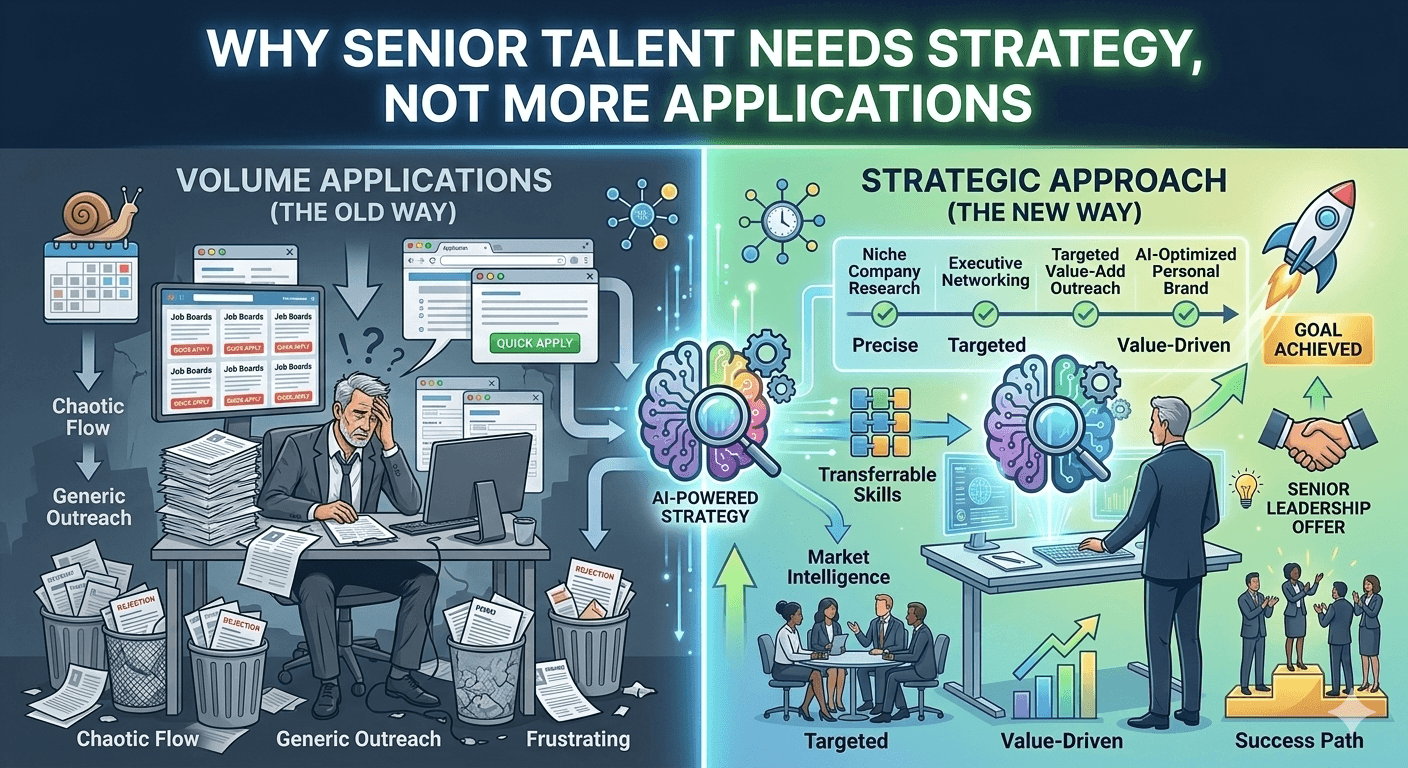
For mid–senior professionals, the job search often becomes a numbers game. When responses slow down, the instinct is simple: apply to more roles. Send more resumes. Try more job boards.
But here’s the uncomfortable truth.
For professionals with 10–25+ years of experience, the problem is rarely a lack of applications.
The real problem is a lack of strategy.
And without strategy, even the most accomplished professionals end up invisible in a crowded market.
The Broken Logic of “More Applications”
Most professionals approach their job search the same way they did earlier in their careers.
They assume:
More applications = more chances
More chances = more interviews
More interviews = better offers
In reality, the opposite often happens.
Senior professionals apply to 50–100 roles, receive little response, and conclude that the market is slow or biased.
But the market is not ignoring senior talent.
It is filtering poorly positioned talent.
Recruiters today use a combination of ATS systems, keyword filters, and referral networks to narrow the candidate pool quickly. When your resume is slightly misaligned with the job description, the system eliminates you before a human ever sees your profile.
Sending the same resume to dozens of roles does not increase your odds.
It simply multiplies rejection.
Senior Hiring Is Not a Volume Game
At junior levels, hiring often focuses on skills and availability.
At senior levels, hiring is fundamentally different.
Companies are not just hiring someone who can do tasks.
They are hiring someone who can solve business problems.
This changes everything about the job search.
Hiring managers evaluate senior candidates through questions like:
Can this person drive measurable impact?
Can they solve a problem we are currently facing?
Can they lead teams and deliver outcomes?
Will they justify a ₹50L–₹1Cr salary?
If your resume reads like a career history, it fails this test.
Senior candidates must present themselves as strategic problem-solvers, not experienced employees.
That shift requires a strategy.
The Visibility Problem
Another major reason senior professionals struggle is low market visibility.
Many accomplished leaders have spent decades focusing on internal results rather than external visibility.
They have strong experience but:
Limited LinkedIn presence
No published insights or thought leadership
Few active recruiter relationships
Weak referral pipelines
Meanwhile, companies increasingly hire through warm networks and referrals.
When recruiters search for candidates, they prioritize people who are:
Visible in the industry
Referenced by peers
Known for expertise
Without deliberate visibility, even high-performing professionals remain invisible.
More applications do not solve this problem.
Strategic positioning does.
The Resume Misalignment Trap
Another major mistake is using a generic resume for every application.
Senior professionals often create one detailed resume and send it everywhere.
But modern hiring systems reward precision positioning.
Every role has a specific mix of priorities, including:
Keywords
Leadership scope
Business outcomes
Industry relevance
If your resume does not match the job description closely, the ATS ranks it poorly.
This is why professionals with exceptional backgrounds still experience silence from employers.
Their resumes are not strategically aligned with the opportunity.
The Strategic Job Search Model
A strategic job search focuses on control and leverage, not volume.
Instead of applying everywhere, professionals should focus on five key pillars.
1. Career Intelligence
The first step is understanding how the market views your experience.
This includes analyzing job descriptions to identify:
Frequently requested skills
Leadership expectations
Strategic responsibilities
From there, professionals can identify their strongest market positioning.
2. Strategic Resume Positioning
Your resume should function as a business case, not a career summary.
Strong senior resumes emphasize:
measurable outcomes
leadership scope
revenue or efficiency impact
strategic initiatives led
Instead of listing responsibilities, they demonstrate business value.
3. Opportunity Discovery
High-quality opportunities are often hidden.
Many leadership roles are filled through:
internal referrals
recruiter pipelines
executive search firms
Strategic job seekers focus on high-fit roles rather than applying everywhere.
4. Network Leverage
For senior professionals, referrals outperform cold applications dramatically.
Building relationships with recruiters, hiring managers, and industry peers significantly increases interview probability.
This requires deliberate outreach and relationship nurturing.
5. Interview and Offer Strategy
Senior interviews are not simply about answering questions.
They are about demonstrating strategic thinking and business impact.
Candidates who frame their experience around solving the company’s problems consistently outperform those who only describe past roles.
The same applies to offer negotiations, where strategic preparation can dramatically improve compensation outcomes.
Why Strategy Changes the Outcome
When professionals shift from volume applications to strategic execution, three things happen.
First, interview rates increase significantly, because applications are tailored to the role.
Second, recruiters respond more often, because positioning is clearer and stronger.
Third, offers improve, because candidates demonstrate strategic value rather than just experience.
This is why structured job search systems consistently outperform traditional approaches.
They replace randomness with predictable outcomes.
The Future of Job Search
The modern job market rewards professionals who treat their career moves like strategic missions rather than passive job hunts.
Senior professionals cannot rely on outdated tactics such as mass applications and generic resumes.
The competition for ₹50L–₹1Cr roles is too intense, and hiring processes are too sophisticated.
Success now depends on career intelligence, precise positioning, visibility, and network leverage.
In other words:
The most successful professionals do not apply more.
They execute better strategies.

As a co-founder and CEO of NxtJob.ai, I help mid and senior level professionals land 3-5 job offers within 3 months with a substantial salary hike. I am an Internationally Certified Career Coach, Resume Writing Expert, Job Interview and LinkedIn Strategist, and a Motivational Speaker.
Richik Sinha Roy
CEO, NxtJob
Recent articles

Resume
5 min read
ATS Resume Format: How to Create a Resume That Gets Past Applicant Tracking Systems
Learn how to create an ATS-friendly resume that passes through applicant tracking systems and increases your chances of landing an interview.
Resume
5 min read
ATS Resume Format: How to Create a Resume That Gets Past Applicant Tracking Systems
Learn how to create an ATS-friendly resume that passes through applicant tracking systems and increases your chances of landing an interview.
Resume
5 min read
ATS Resume Format: How to Create a Resume That Gets Past Applicant Tracking Systems
Learn how to create an ATS-friendly resume that passes through applicant tracking systems and increases your chances of landing an interview.
Resume
5 min read
ATS Resume Format: How to Create a Resume That Gets Past Applicant Tracking Systems
Learn how to create an ATS-friendly resume that passes through applicant tracking systems and increases your chances of landing an interview.
Resume
5 min read
ATS Resume Format: How to Create a Resume That Gets Past Applicant Tracking Systems
Learn how to create an ATS-friendly resume that passes through applicant tracking systems and increases your chances of landing an interview.
Resume
5 min read
ATS Resume Format: How to Create a Resume That Gets Past Applicant Tracking Systems
Learn how to create an ATS-friendly resume that passes through applicant tracking systems and increases your chances of landing an interview.
Everything you need to know
Here you can find solutions to all your queries.
Job search
5 min read
Why Senior Talent Needs Strategy, Not More Applications
Published Date:
|
Last Modified:
For mid–senior professionals, the job search often becomes a numbers game. When responses slow down, the instinct is simple: apply to more roles. Send more resumes. Try more job boards.
But here’s the uncomfortable truth.
For professionals with 10–25+ years of experience, the problem is rarely a lack of applications.
The real problem is a lack of strategy.
And without strategy, even the most accomplished professionals end up invisible in a crowded market.
The Broken Logic of “More Applications”
Most professionals approach their job search the same way they did earlier in their careers.
They assume:
More applications = more chances
More chances = more interviews
More interviews = better offers
In reality, the opposite often happens.
Senior professionals apply to 50–100 roles, receive little response, and conclude that the market is slow or biased.
But the market is not ignoring senior talent.
It is filtering poorly positioned talent.
Recruiters today use a combination of ATS systems, keyword filters, and referral networks to narrow the candidate pool quickly. When your resume is slightly misaligned with the job description, the system eliminates you before a human ever sees your profile.
Sending the same resume to dozens of roles does not increase your odds.
It simply multiplies rejection.
Senior Hiring Is Not a Volume Game
At junior levels, hiring often focuses on skills and availability.
At senior levels, hiring is fundamentally different.
Companies are not just hiring someone who can do tasks.
They are hiring someone who can solve business problems.
This changes everything about the job search.
Hiring managers evaluate senior candidates through questions like:
Can this person drive measurable impact?
Can they solve a problem we are currently facing?
Can they lead teams and deliver outcomes?
Will they justify a ₹50L–₹1Cr salary?
If your resume reads like a career history, it fails this test.
Senior candidates must present themselves as strategic problem-solvers, not experienced employees.
That shift requires a strategy.
The Visibility Problem
Another major reason senior professionals struggle is low market visibility.
Many accomplished leaders have spent decades focusing on internal results rather than external visibility.
They have strong experience but:
Limited LinkedIn presence
No published insights or thought leadership
Few active recruiter relationships
Weak referral pipelines
Meanwhile, companies increasingly hire through warm networks and referrals.
When recruiters search for candidates, they prioritize people who are:
Visible in the industry
Referenced by peers
Known for expertise
Without deliberate visibility, even high-performing professionals remain invisible.
More applications do not solve this problem.
Strategic positioning does.
The Resume Misalignment Trap
Another major mistake is using a generic resume for every application.
Senior professionals often create one detailed resume and send it everywhere.
But modern hiring systems reward precision positioning.
Every role has a specific mix of priorities, including:
Keywords
Leadership scope
Business outcomes
Industry relevance
If your resume does not match the job description closely, the ATS ranks it poorly.
This is why professionals with exceptional backgrounds still experience silence from employers.
Their resumes are not strategically aligned with the opportunity.
The Strategic Job Search Model
A strategic job search focuses on control and leverage, not volume.
Instead of applying everywhere, professionals should focus on five key pillars.
1. Career Intelligence
The first step is understanding how the market views your experience.
This includes analyzing job descriptions to identify:
Frequently requested skills
Leadership expectations
Strategic responsibilities
From there, professionals can identify their strongest market positioning.
2. Strategic Resume Positioning
Your resume should function as a business case, not a career summary.
Strong senior resumes emphasize:
measurable outcomes
leadership scope
revenue or efficiency impact
strategic initiatives led
Instead of listing responsibilities, they demonstrate business value.
3. Opportunity Discovery
High-quality opportunities are often hidden.
Many leadership roles are filled through:
internal referrals
recruiter pipelines
executive search firms
Strategic job seekers focus on high-fit roles rather than applying everywhere.
4. Network Leverage
For senior professionals, referrals outperform cold applications dramatically.
Building relationships with recruiters, hiring managers, and industry peers significantly increases interview probability.
This requires deliberate outreach and relationship nurturing.
5. Interview and Offer Strategy
Senior interviews are not simply about answering questions.
They are about demonstrating strategic thinking and business impact.
Candidates who frame their experience around solving the company’s problems consistently outperform those who only describe past roles.
The same applies to offer negotiations, where strategic preparation can dramatically improve compensation outcomes.
Why Strategy Changes the Outcome
When professionals shift from volume applications to strategic execution, three things happen.
First, interview rates increase significantly, because applications are tailored to the role.
Second, recruiters respond more often, because positioning is clearer and stronger.
Third, offers improve, because candidates demonstrate strategic value rather than just experience.
This is why structured job search systems consistently outperform traditional approaches.
They replace randomness with predictable outcomes.
The Future of Job Search
The modern job market rewards professionals who treat their career moves like strategic missions rather than passive job hunts.
Senior professionals cannot rely on outdated tactics such as mass applications and generic resumes.
The competition for ₹50L–₹1Cr roles is too intense, and hiring processes are too sophisticated.
Success now depends on career intelligence, precise positioning, visibility, and network leverage.
In other words:
The most successful professionals do not apply more.
They execute better strategies.
Table of content

Interview
Behavioral interview questions & answers for senior leaders
A senior resume summary is four lines: your level, your scope, one proven result, and the role you want. Here is the formula, five examples, and a rewrite you can copy tonight.
Resume
Professional Summary Resumes to Grab Recruiters' Attention
A senior resume summary is four lines: your level, your scope, one proven result, and the role you want. Here is the formula, five examples, and a rewrite you can copy tonight.
As a co-founder and CEO of NxtJob.ai, I help mid and senior level professionals land 3-5 job offers within 3 months with a substantial salary hike. I am an Internationally Certified Career Coach, Resume Writing Expert, Job Interview and LinkedIn Strategist, and a Motivational Speaker.
Richik Sinha Roy
CEO, NxtJob
Everything you need to know
Here you can find solutions to all your queries.
Job search
5 min read
Published Date:
|
Last Modified:
Why Senior Talent Needs Strategy, Not More Applications
For mid–senior professionals, the job search often becomes a numbers game. When responses slow down, the instinct is simple: apply to more roles. Send more resumes. Try more job boards.
But here’s the uncomfortable truth.
For professionals with 10–25+ years of experience, the problem is rarely a lack of applications.
The real problem is a lack of strategy.
And without strategy, even the most accomplished professionals end up invisible in a crowded market.
The Broken Logic of “More Applications”
Most professionals approach their job search the same way they did earlier in their careers.
They assume:
More applications = more chances
More chances = more interviews
More interviews = better offers
In reality, the opposite often happens.
Senior professionals apply to 50–100 roles, receive little response, and conclude that the market is slow or biased.
But the market is not ignoring senior talent.
It is filtering poorly positioned talent.
Recruiters today use a combination of ATS systems, keyword filters, and referral networks to narrow the candidate pool quickly. When your resume is slightly misaligned with the job description, the system eliminates you before a human ever sees your profile.
Sending the same resume to dozens of roles does not increase your odds.
It simply multiplies rejection.
Senior Hiring Is Not a Volume Game
At junior levels, hiring often focuses on skills and availability.
At senior levels, hiring is fundamentally different.
Companies are not just hiring someone who can do tasks.
They are hiring someone who can solve business problems.
This changes everything about the job search.
Hiring managers evaluate senior candidates through questions like:
Can this person drive measurable impact?
Can they solve a problem we are currently facing?
Can they lead teams and deliver outcomes?
Will they justify a ₹50L–₹1Cr salary?
If your resume reads like a career history, it fails this test.
Senior candidates must present themselves as strategic problem-solvers, not experienced employees.
That shift requires a strategy.
The Visibility Problem
Another major reason senior professionals struggle is low market visibility.
Many accomplished leaders have spent decades focusing on internal results rather than external visibility.
They have strong experience but:
Limited LinkedIn presence
No published insights or thought leadership
Few active recruiter relationships
Weak referral pipelines
Meanwhile, companies increasingly hire through warm networks and referrals.
When recruiters search for candidates, they prioritize people who are:
Visible in the industry
Referenced by peers
Known for expertise
Without deliberate visibility, even high-performing professionals remain invisible.
More applications do not solve this problem.
Strategic positioning does.
The Resume Misalignment Trap
Another major mistake is using a generic resume for every application.
Senior professionals often create one detailed resume and send it everywhere.
But modern hiring systems reward precision positioning.
Every role has a specific mix of priorities, including:
Keywords
Leadership scope
Business outcomes
Industry relevance
If your resume does not match the job description closely, the ATS ranks it poorly.
This is why professionals with exceptional backgrounds still experience silence from employers.
Their resumes are not strategically aligned with the opportunity.
The Strategic Job Search Model
A strategic job search focuses on control and leverage, not volume.
Instead of applying everywhere, professionals should focus on five key pillars.
1. Career Intelligence
The first step is understanding how the market views your experience.
This includes analyzing job descriptions to identify:
Frequently requested skills
Leadership expectations
Strategic responsibilities
From there, professionals can identify their strongest market positioning.
2. Strategic Resume Positioning
Your resume should function as a business case, not a career summary.
Strong senior resumes emphasize:
measurable outcomes
leadership scope
revenue or efficiency impact
strategic initiatives led
Instead of listing responsibilities, they demonstrate business value.
3. Opportunity Discovery
High-quality opportunities are often hidden.
Many leadership roles are filled through:
internal referrals
recruiter pipelines
executive search firms
Strategic job seekers focus on high-fit roles rather than applying everywhere.
4. Network Leverage
For senior professionals, referrals outperform cold applications dramatically.
Building relationships with recruiters, hiring managers, and industry peers significantly increases interview probability.
This requires deliberate outreach and relationship nurturing.
5. Interview and Offer Strategy
Senior interviews are not simply about answering questions.
They are about demonstrating strategic thinking and business impact.
Candidates who frame their experience around solving the company’s problems consistently outperform those who only describe past roles.
The same applies to offer negotiations, where strategic preparation can dramatically improve compensation outcomes.
Why Strategy Changes the Outcome
When professionals shift from volume applications to strategic execution, three things happen.
First, interview rates increase significantly, because applications are tailored to the role.
Second, recruiters respond more often, because positioning is clearer and stronger.
Third, offers improve, because candidates demonstrate strategic value rather than just experience.
This is why structured job search systems consistently outperform traditional approaches.
They replace randomness with predictable outcomes.
The Future of Job Search
The modern job market rewards professionals who treat their career moves like strategic missions rather than passive job hunts.
Senior professionals cannot rely on outdated tactics such as mass applications and generic resumes.
The competition for ₹50L–₹1Cr roles is too intense, and hiring processes are too sophisticated.
Success now depends on career intelligence, precise positioning, visibility, and network leverage.
In other words:
The most successful professionals do not apply more.
They execute better strategies.
Table of content
Interview
Behavioral interview questions & answers for senior leaders
A senior resume summary is four lines: your level, your scope, one proven result, and the role you want. Here is the formula, five examples, and a rewrite you can copy tonight.
Resume
Professional Summary Resumes to Grab Recruiters' Attention
A senior resume summary is four lines: your level, your scope, one proven result, and the role you want. Here is the formula, five examples, and a rewrite you can copy tonight.
As a co-founder and CEO of NxtJob.ai, I help mid and senior level professionals land 3-5 job offers within 3 months with a substantial salary hike. I am an Internationally Certified Career Coach, Resume Writing Expert, Job Interview and LinkedIn Strategist, and a Motivational Speaker.
Richik Sinha Roy
CEO, NxtJob
Recent articles

Resume
5 min read
Interview Questions by HR at Senior Level: What Recruiters Screen For and How to Rehearse
The nine HR round questions senior professionals face, what each one really tests, and why interview calls fail to turn into offers. Includes a 10-day rehearsal plan and a real success story.

Resume
5 min read
Career planning for mid-senior professionals is a system. Not a vision board.
A guide to career planning for mid-senior professionals, built on eight decisions and backed by 2025 and 2026 data. It includes a real case, prompts you can use with an AI assistant, and a plan you can start this week

Resume
5 min read
Counter Offer Negotiation: A Strategic Guide for Senior Leaders
A guide for senior professionals on why most counter offers fail and how to use market research to decide your next move.
Resume
5 min read
Interview Questions by HR at Senior Level: What Recruiters Screen For and How to Rehearse
The nine HR round questions senior professionals face, what each one really tests, and why interview calls fail to turn into offers. Includes a 10-day rehearsal plan and a real success story.
Resume
5 min read
Career planning for mid-senior professionals is a system. Not a vision board.
A guide to career planning for mid-senior professionals, built on eight decisions and backed by 2025 and 2026 data. It includes a real case, prompts you can use with an AI assistant, and a plan you can start this week
Everything you need to know
Here you can find solutions to all your queries.
Join the Revolution
Your AI career copilot to land you top jobs in under 90 days.
Join the Revolution
Your AI career copilot to land you top jobs in under 90 days.
Join the Revolution
Your AI career copilot to land you top jobs in under 90 days.