

Negotiation
10 min read
Counter Offer Negotiation: A Strategic Guide for Senior Leaders
Published Date:
|
Last Modified:

You handed in your resignation. Now your boss offers more money and a better title to keep you.
It feels like a win.
But for senior professionals, a counter offer negotiation can be risky. If you stay only for the money, you may regret it. Many leaders who accept a counter offer leave within a year.
You need to know if your company truly values you or is simply trying to avoid the cost of replacing you. This guide helps you make the right decision using market data and practical advice. It shows you how to handle the conversation without burning bridges.
Success comes from positioning.
Learn how to approach counter offer negotiation, understand your true market value, and make the right decision before you sign.
What is Counter Offer Negotiation?
Counter offer negotiation is the discussion that happens after an employee resigns and the employer offers a higher salary, promotion, improved benefits, or other incentives to persuade them to stay.
The goal is not just to compare salaries, but to decide whether staying aligns with your long-term career goals.
For senior leaders, a counter offer negotiation is not just about salary. It is a strategic decision that affects future career growth, leadership opportunities, and long-term positioning.
Salary Counter Offer: The Stay vs. Go Decision Matrix
Decision Factor | Staying with a Counter Offer | Leaving for a New Role |
Immediate Pay | Quick hike to match market. | Fresh hike based on new value. |
Trust Level | Loyalty is now in doubt. | New start with high trust. |
Career Story | Repeating the same chapter. | New scope and new impact. |
Risk Level | 80% leave within 6 months. | Growth is more likely. |
Why Senior Professionals Face the Counter Offer Trap
Companies do not like to lose senior leaders.
It costs them time and money to replace them. Hiring a new VP or Director can cost up to twice their annual salary because of search fees, onboarding, and lost productivity.
This is why many organizations focus on retaining top talent, a trend also highlighted in Harvard Business Review's research on employee retention.
That is why many companies make a salary counter offer. It helps the company keep the role filled, but it does not fix the reasons you wanted to leave.
After you resign, trust often changes. Your employer knows you were ready to move on. Even if you accept the salary counter offer, they may see you as a retention risk.
You might get a higher salary today, but they could also start looking for someone to replace you in the future.
This is why counter offer negotiation can be risky. Many leaders who accept a counter offer leave within months because the original problems remain, or the company decides to move on.
Before accepting a salary counter offer, ask yourself whether it solves your real career goals or only delays your decision.
Hiring teams understand these risks. They know that counter offer negotiation often ends badly when the underlying issues are never addressed.
A higher salary cannot fix a poor culture, limited growth, or a lack of new opportunities. It only makes staying more expensive for the company.
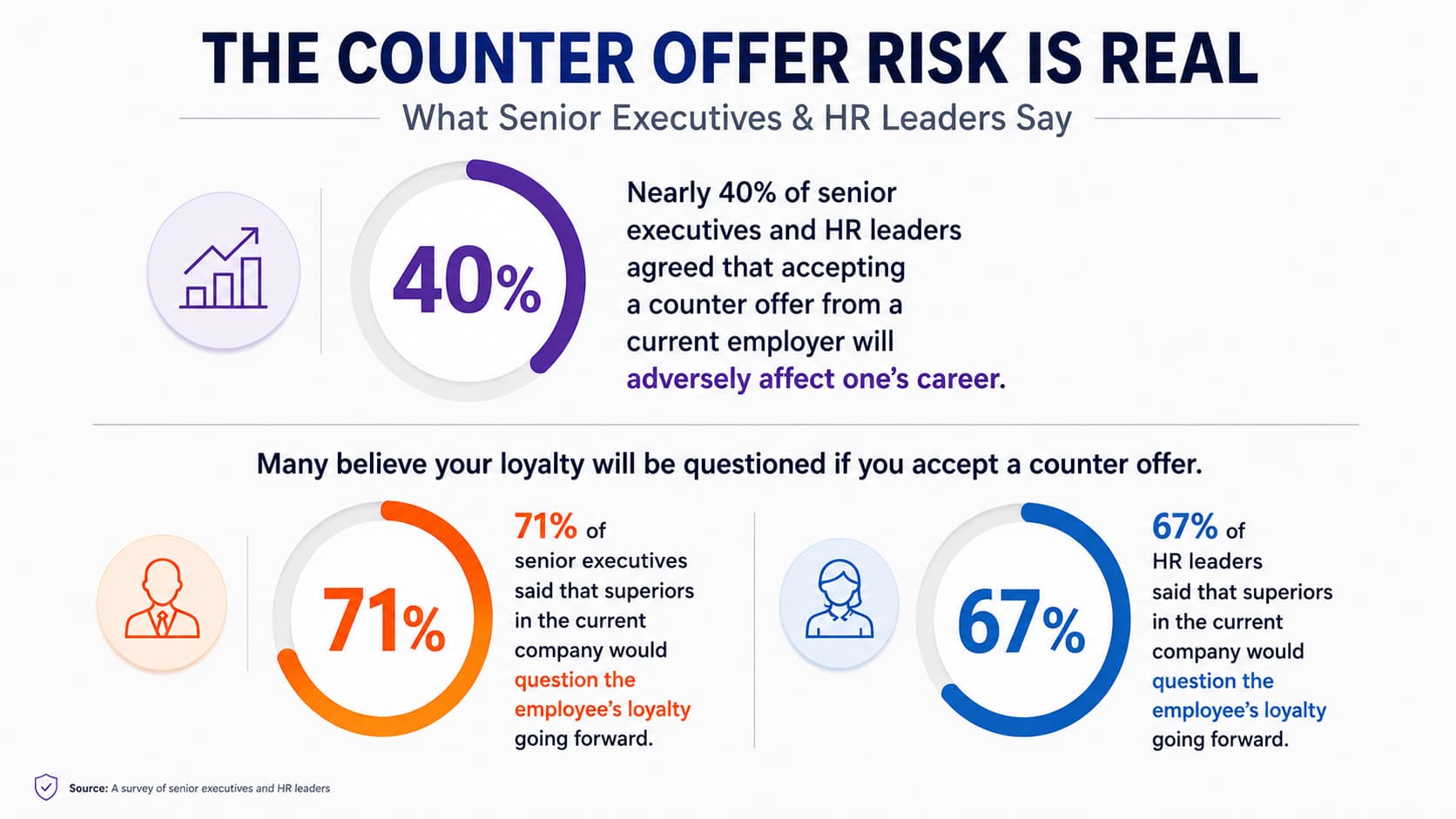
Why Counter Offers Often Fail
Many counter offer negotiations fail because they treat the symptom instead of the problem.
A higher salary may improve your paycheck, but it rarely changes poor leadership, limited career growth, burnout, or a lack of meaningful work.
For senior leaders, accepting a counter offer can also change how the organization sees you. Once you resign, your employer knows you were prepared to leave.
Even if they value your skills, they may start succession planning or reconsider future leadership opportunities.
At the same time, you may continue to question whether staying was the right decision.
A successful counter offer should improve more than your compensation. It should address the reasons you wanted to leave in the first place and provide a clear path for future growth.
3 Questions to Ask Before You Negotiate
Before you negotiate counter offer terms, look at the full picture. Most senior professionals leave for reasons beyond salary. If you focus only on money, you may ignore the real problem. Ask yourself these three questions.
1. Why did I start looking for a new job?
Think about why you began your search. Was it a bad manager, poor growth, or burnout? A higher salary can fix your pay, but it cannot fix a toxic workplace or a poor boss.
2. Does this counter offer improve my daily work?
A job offer counter offer may include a higher salary or a better title. But will it reduce your workload, improve support, or give you better work-life balance? If not, the main issue may remain.
3. Is this the best choice for my future?
Think about your long-term career. Is your company growing? Will staying help you build new skills and move into better leadership roles? Choose the option that supports your future, not just your next paycheck.
Job Factor | Importance to Leaders | Fixable with a Counter Offer? |
Monthly Pay | High | Yes |
Work Balance | High | Medium |
Trust with Boss | Critical | Low |
Clear Growth Path | Very High | Low |
What Can Be Included in a Salary Counter Offer?
A counter offer is not always about a higher salary. Companies often use several incentives to retain experienced professionals, especially those in leadership roles.
A counter offer may include:
Counter Offer Component | Purpose |
Higher salary | Match or exceed market pay |
Promotion | Increase responsibilities and title |
Retention bonus | Encourage you to stay for a fixed period |
Flexible work | Improve work-life balance |
Additional leave | Improve employee satisfaction |
Better reporting structure | Address leadership or management concerns |
Learning budget | Support long-term career development |
How to Prepare for Counter Offer Negotiation Conversation
Senior leaders do not negotiate based on percentages.
A 20% or 30% raise keeps your salary tied to your current pay.
Instead, focus on the market. Use executive compensation benchmarks to understand what your role is really worth.
Reports such as Mercer's Global Talent Trends can help you understand how organizations approach compensation, retention, and talent strategy.
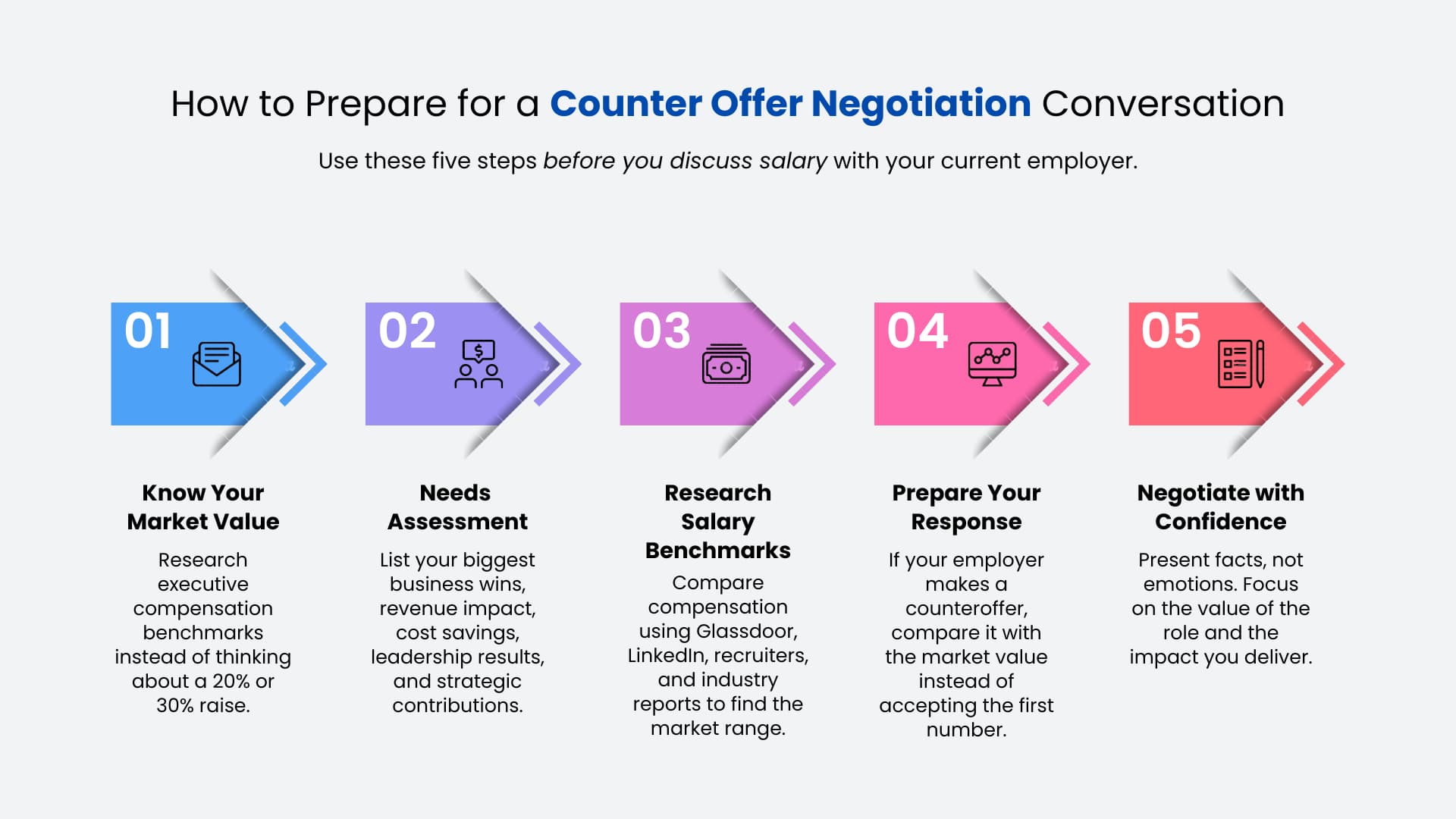
Roopa followed this approach and secured a 70% salary increase. She did not base her expectations on her old salary.
She researched what similar roles paid in the market, including the US and Europe, and adjusted those figures for India. She explained that the role had a market value, not a personal price tag.
This is the foundation of senior leadership salary negotiation.
Hear from her:
A counter offer may include a 20% raise, but that does not mean it is fair.
If the market pays 50% more for your skills, you are still underpaid. Knowing the market range helps you negotiate with confidence.
You can use the Glassdoor Salary Guide and Robert Half's Salary Guide, along with conversations with recruiters who specialize in executive hiring, to understand current market pay for senior roles.
With this information, you are not asking for a favor. You are presenting market facts.
When you use market data, companies see you as a business leader who understands value, not just a candidate asking for a higher salary.
Practice is the only way to stay calm. You can use the nxtjob.ai Negotiator Agent to run mock talks. It helps you prepare for the hardest version of the conversation until your responses are automatic.
I have explained the detailed steps in this guide: How to Handle Salary Negotiation With HR.
Scripts for Counter Offer Negotiation
Go into the meeting with a plan. Stay calm. Let your boss know what you want. Use these scripts to handle your counter offer negotiation with confidence.
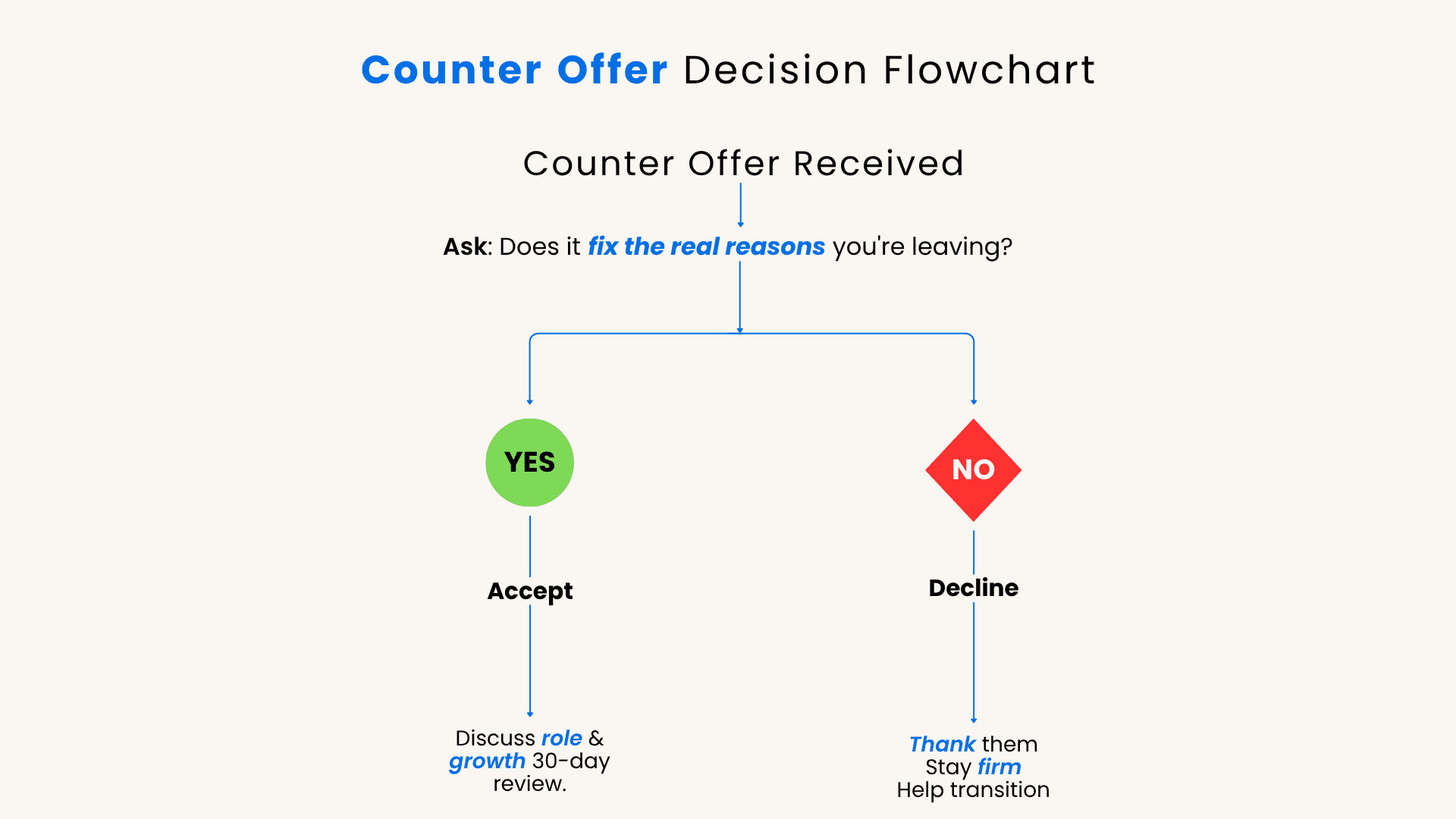
Option A: Accept the Counter Offer
Only accept if the company fixes the real reasons you wanted to leave. A higher salary alone is not enough.
"Thank you for the offer. I'm happy to stay if we can also address the reasons I wanted to move. I'd like a clear plan for my role and team, and a follow-up meeting in 30 days to review our progress. Does that work for you?"
This keeps the conversation focused on long-term change, not just money.
Option B: Decline the Job Offer Counter Offer
If you decide to leave, be polite but firm. Do not leave room for negotiation.
"Thank you for the offer. I've enjoyed working here and appreciate the opportunity. But this new role is the right step for my long-term goals. My decision is final, and I'll do everything I can to ensure a smooth handover."
This ends the conversation respectfully and helps you leave on good terms. It shows that your decision is final while helping you leave on good terms. It also helps you protect your professional reputation and avoid burning bridges.
If you're preparing for your next role, read our guide to answering the expected CTC. For more tips on handling salary discussions, check out our guide on salary negotiation tactics.
Expert Advice 💡
During any counter offer negotiation, let the company make the first offer. Avoid naming a salary before they do. This gives you more room to negotiate and make a better decision.
When Should You Accept vs Decline a Counter Offer?
There is no universal right answer. The best decision depends on why you started looking for a new opportunity.
Consider accepting a counter offer if:
Salary was your main concern.
Your employer genuinely addresses your concerns.
The new role includes clear responsibilities, career growth, or leadership opportunities.
Every commitment is documented in writing.
Consider declining the counter offer if:
You no longer trust your leadership.
The work environment is unhealthy.
Career growth remains limited.
You accepted another role that better matches your long-term goals.
The offer only increases your salary without fixing the underlying issues.
For senior professionals, the best decision is rarely about the highest salary. It is about choosing the role where you can create the greatest impact and continue to grow over the next several years.
5 Common Mistakes During Counter Offer Negotiation
Counter offer negotiation is about getting the best outcome while protecting your reputation. Avoid these common mistakes.
1. Naming your salary first
If you mention a number first, you may ask for less than the company is willing to pay. Let the employer share their offer before you discuss compensation. This gives you more room to negotiate. Read our guide on salary negotiation tactics to learn more.
2. Using offers to start a bidding war
Avoid going back and forth between your current and new employer just to increase your pay. It can make you look focused solely on money rather than on your long-term value.
Instead of playing games, keep your search active. Learn how to reach out to a recruiter on LinkedIn to find roles that fit your worth. This helps you find better options that do not require high-pressure tactics.
3. Letting emotions take over
Don't negotiate when you're angry, frustrated, or feeling guilty. Keep the conversation focused on your skills, achievements, and the value you bring.
4. Leaving without a proper handover
If you decide to move on, complete a smooth handover. It shows professionalism and helps protect your reputation. People remember how you leave.
5. Accepting verbal promises
Never rely on verbal promises about future raises or promotions. Ask for every offer and commitment in writing before making your decision.
Before accepting or rejecting an offer, compare it with the average salary hike percentage in India to make sure you're making an informed choice.
Conclusion
A counter offer negotiation is not just about money. It is about making the right career decision.
During a salary counter offer, rely on facts and market data instead of guilt, fear, or frustration.
Many senior professionals make the wrong choice because they think like job seekers. They accept the first offer they receive or stay because they fear change.
A successful job offer counter offer starts with knowing your true market value and choosing the opportunity that supports your long-term career growth.
Think about where you want to be in five years. Choose the path where you can solve bigger problems, create greater impact, and continue to grow.
Your value is defined by the results you deliver, not just your current title or salary.
Ready to discover your true market value?
Use nxtjob.ai to benchmark your market value, prepare your negotiation strategy, and decide whether accepting a counter offer is the right career move.

As a content writer and SEO strategist, I help turn complex AI job search, career-tech, and growth topics into clear, practical content. At NxtJob.ai, I write to help senior professionals make smarter career moves with clarity and confidence.
Githu Ravikkumar
Creative Strategist & Copywriter, Nxtjob
Recent articles

Resume
5 min read
ATS Resume Format: How to Create a Resume That Gets Past Applicant Tracking Systems
Learn how to create an ATS-friendly resume that passes through applicant tracking systems and increases your chances of landing an interview.
Resume
5 min read
ATS Resume Format: How to Create a Resume That Gets Past Applicant Tracking Systems
Learn how to create an ATS-friendly resume that passes through applicant tracking systems and increases your chances of landing an interview.
Resume
5 min read
ATS Resume Format: How to Create a Resume That Gets Past Applicant Tracking Systems
Learn how to create an ATS-friendly resume that passes through applicant tracking systems and increases your chances of landing an interview.
Resume
5 min read
ATS Resume Format: How to Create a Resume That Gets Past Applicant Tracking Systems
Learn how to create an ATS-friendly resume that passes through applicant tracking systems and increases your chances of landing an interview.
Resume
5 min read
ATS Resume Format: How to Create a Resume That Gets Past Applicant Tracking Systems
Learn how to create an ATS-friendly resume that passes through applicant tracking systems and increases your chances of landing an interview.
Resume
5 min read
ATS Resume Format: How to Create a Resume That Gets Past Applicant Tracking Systems
Learn how to create an ATS-friendly resume that passes through applicant tracking systems and increases your chances of landing an interview.
Everything you need to know
Here you can find solutions to all your queries.
Why do companies make counter offers?
Is it ever a good idea to accept a counter offer?
Will my boss trust me after I resign?
How long should I wait to sign a counter offer?
How do I tell my new employer I am staying?
Negotiation
10 min read
Counter Offer Negotiation: A Strategic Guide for Senior Leaders
Published Date:
|
Last Modified:
You handed in your resignation. Now your boss offers more money and a better title to keep you.
It feels like a win.
But for senior professionals, a counter offer negotiation can be risky. If you stay only for the money, you may regret it. Many leaders who accept a counter offer leave within a year.
You need to know if your company truly values you or is simply trying to avoid the cost of replacing you. This guide helps you make the right decision using market data and practical advice. It shows you how to handle the conversation without burning bridges.
Success comes from positioning.
Learn how to approach counter offer negotiation, understand your true market value, and make the right decision before you sign.
What is Counter Offer Negotiation?
Counter offer negotiation is the discussion that happens after an employee resigns and the employer offers a higher salary, promotion, improved benefits, or other incentives to persuade them to stay.
The goal is not just to compare salaries, but to decide whether staying aligns with your long-term career goals.
For senior leaders, a counter offer negotiation is not just about salary. It is a strategic decision that affects future career growth, leadership opportunities, and long-term positioning.
Salary Counter Offer: The Stay vs. Go Decision Matrix
Decision Factor | Staying with a Counter Offer | Leaving for a New Role |
Immediate Pay | Quick hike to match market. | Fresh hike based on new value. |
Trust Level | Loyalty is now in doubt. | New start with high trust. |
Career Story | Repeating the same chapter. | New scope and new impact. |
Risk Level | 80% leave within 6 months. | Growth is more likely. |
Why Senior Professionals Face the Counter Offer Trap
Companies do not like to lose senior leaders.
It costs them time and money to replace them. Hiring a new VP or Director can cost up to twice their annual salary because of search fees, onboarding, and lost productivity.
This is why many organizations focus on retaining top talent, a trend also highlighted in Harvard Business Review's research on employee retention.
That is why many companies make a salary counter offer. It helps the company keep the role filled, but it does not fix the reasons you wanted to leave.
After you resign, trust often changes. Your employer knows you were ready to move on. Even if you accept the salary counter offer, they may see you as a retention risk.
You might get a higher salary today, but they could also start looking for someone to replace you in the future.
This is why counter offer negotiation can be risky. Many leaders who accept a counter offer leave within months because the original problems remain, or the company decides to move on.
Before accepting a salary counter offer, ask yourself whether it solves your real career goals or only delays your decision.
Hiring teams understand these risks. They know that counter offer negotiation often ends badly when the underlying issues are never addressed.
A higher salary cannot fix a poor culture, limited growth, or a lack of new opportunities. It only makes staying more expensive for the company.
Why Counter Offers Often Fail
Many counter offer negotiations fail because they treat the symptom instead of the problem.
A higher salary may improve your paycheck, but it rarely changes poor leadership, limited career growth, burnout, or a lack of meaningful work.
For senior leaders, accepting a counter offer can also change how the organization sees you. Once you resign, your employer knows you were prepared to leave.
Even if they value your skills, they may start succession planning or reconsider future leadership opportunities.
At the same time, you may continue to question whether staying was the right decision.
A successful counter offer should improve more than your compensation. It should address the reasons you wanted to leave in the first place and provide a clear path for future growth.
3 Questions to Ask Before You Negotiate
Before you negotiate counter offer terms, look at the full picture. Most senior professionals leave for reasons beyond salary. If you focus only on money, you may ignore the real problem. Ask yourself these three questions.
1. Why did I start looking for a new job?
Think about why you began your search. Was it a bad manager, poor growth, or burnout? A higher salary can fix your pay, but it cannot fix a toxic workplace or a poor boss.
2. Does this counter offer improve my daily work?
A job offer counter offer may include a higher salary or a better title. But will it reduce your workload, improve support, or give you better work-life balance? If not, the main issue may remain.
3. Is this the best choice for my future?
Think about your long-term career. Is your company growing? Will staying help you build new skills and move into better leadership roles? Choose the option that supports your future, not just your next paycheck.
Job Factor | Importance to Leaders | Fixable with a Counter Offer? |
Monthly Pay | High | Yes |
Work Balance | High | Medium |
Trust with Boss | Critical | Low |
Clear Growth Path | Very High | Low |
What Can Be Included in a Salary Counter Offer?
A counter offer is not always about a higher salary. Companies often use several incentives to retain experienced professionals, especially those in leadership roles.
A counter offer may include:
Counter Offer Component | Purpose |
Higher salary | Match or exceed market pay |
Promotion | Increase responsibilities and title |
Retention bonus | Encourage you to stay for a fixed period |
Flexible work | Improve work-life balance |
Additional leave | Improve employee satisfaction |
Better reporting structure | Address leadership or management concerns |
Learning budget | Support long-term career development |
How to Prepare for Counter Offer Negotiation Conversation
Senior leaders do not negotiate based on percentages.
A 20% or 30% raise keeps your salary tied to your current pay.
Instead, focus on the market. Use executive compensation benchmarks to understand what your role is really worth.
Reports such as Mercer's Global Talent Trends can help you understand how organizations approach compensation, retention, and talent strategy.
Roopa followed this approach and secured a 70% salary increase. She did not base her expectations on her old salary.
She researched what similar roles paid in the market, including the US and Europe, and adjusted those figures for India. She explained that the role had a market value, not a personal price tag.
This is the foundation of senior leadership salary negotiation.
Hear from her:
A counter offer may include a 20% raise, but that does not mean it is fair.
If the market pays 50% more for your skills, you are still underpaid. Knowing the market range helps you negotiate with confidence.
You can use the Glassdoor Salary Guide and Robert Half's Salary Guide, along with conversations with recruiters who specialize in executive hiring, to understand current market pay for senior roles.
With this information, you are not asking for a favor. You are presenting market facts.
When you use market data, companies see you as a business leader who understands value, not just a candidate asking for a higher salary.
Practice is the only way to stay calm. You can use the nxtjob.ai Negotiator Agent to run mock talks. It helps you prepare for the hardest version of the conversation until your responses are automatic.
I have explained the detailed steps in this guide: How to Handle Salary Negotiation With HR.
Scripts for Counter Offer Negotiation
Go into the meeting with a plan. Stay calm. Let your boss know what you want. Use these scripts to handle your counter offer negotiation with confidence.
Option A: Accept the Counter Offer
Only accept if the company fixes the real reasons you wanted to leave. A higher salary alone is not enough.
"Thank you for the offer. I'm happy to stay if we can also address the reasons I wanted to move. I'd like a clear plan for my role and team, and a follow-up meeting in 30 days to review our progress. Does that work for you?"
This keeps the conversation focused on long-term change, not just money.
Option B: Decline the Job Offer Counter Offer
If you decide to leave, be polite but firm. Do not leave room for negotiation.
"Thank you for the offer. I've enjoyed working here and appreciate the opportunity. But this new role is the right step for my long-term goals. My decision is final, and I'll do everything I can to ensure a smooth handover."
This ends the conversation respectfully and helps you leave on good terms. It shows that your decision is final while helping you leave on good terms. It also helps you protect your professional reputation and avoid burning bridges.
If you're preparing for your next role, read our guide to answering the expected CTC. For more tips on handling salary discussions, check out our guide on salary negotiation tactics.
Expert Advice 💡
During any counter offer negotiation, let the company make the first offer. Avoid naming a salary before they do. This gives you more room to negotiate and make a better decision.
When Should You Accept vs Decline a Counter Offer?
There is no universal right answer. The best decision depends on why you started looking for a new opportunity.
Consider accepting a counter offer if:
Salary was your main concern.
Your employer genuinely addresses your concerns.
The new role includes clear responsibilities, career growth, or leadership opportunities.
Every commitment is documented in writing.
Consider declining the counter offer if:
You no longer trust your leadership.
The work environment is unhealthy.
Career growth remains limited.
You accepted another role that better matches your long-term goals.
The offer only increases your salary without fixing the underlying issues.
For senior professionals, the best decision is rarely about the highest salary. It is about choosing the role where you can create the greatest impact and continue to grow over the next several years.
5 Common Mistakes During Counter Offer Negotiation
Counter offer negotiation is about getting the best outcome while protecting your reputation. Avoid these common mistakes.
1. Naming your salary first
If you mention a number first, you may ask for less than the company is willing to pay. Let the employer share their offer before you discuss compensation. This gives you more room to negotiate. Read our guide on salary negotiation tactics to learn more.
2. Using offers to start a bidding war
Avoid going back and forth between your current and new employer just to increase your pay. It can make you look focused solely on money rather than on your long-term value.
Instead of playing games, keep your search active. Learn how to reach out to a recruiter on LinkedIn to find roles that fit your worth. This helps you find better options that do not require high-pressure tactics.
3. Letting emotions take over
Don't negotiate when you're angry, frustrated, or feeling guilty. Keep the conversation focused on your skills, achievements, and the value you bring.
4. Leaving without a proper handover
If you decide to move on, complete a smooth handover. It shows professionalism and helps protect your reputation. People remember how you leave.
5. Accepting verbal promises
Never rely on verbal promises about future raises or promotions. Ask for every offer and commitment in writing before making your decision.
Before accepting or rejecting an offer, compare it with the average salary hike percentage in India to make sure you're making an informed choice.
Conclusion
A counter offer negotiation is not just about money. It is about making the right career decision.
During a salary counter offer, rely on facts and market data instead of guilt, fear, or frustration.
Many senior professionals make the wrong choice because they think like job seekers. They accept the first offer they receive or stay because they fear change.
A successful job offer counter offer starts with knowing your true market value and choosing the opportunity that supports your long-term career growth.
Think about where you want to be in five years. Choose the path where you can solve bigger problems, create greater impact, and continue to grow.
Your value is defined by the results you deliver, not just your current title or salary.
Ready to discover your true market value?
Use nxtjob.ai to benchmark your market value, prepare your negotiation strategy, and decide whether accepting a counter offer is the right career move.
Table of content

Interview
Behavioral interview questions & answers for senior leaders
A senior resume summary is four lines: your level, your scope, one proven result, and the role you want. Here is the formula, five examples, and a rewrite you can copy tonight.
Resume
Professional Summary Resumes to Grab Recruiters' Attention
A senior resume summary is four lines: your level, your scope, one proven result, and the role you want. Here is the formula, five examples, and a rewrite you can copy tonight.
As a content writer and SEO strategist, I help turn complex AI job search, career-tech, and growth topics into clear, practical content. At NxtJob.ai, I write to help senior professionals make smarter career moves with clarity and confidence.
Githu Ravikkumar
Creative Strategist & Copywriter, Nxtjob
Why do companies make counter offers?
Is it ever a good idea to accept a counter offer?
Will my boss trust me after I resign?
How long should I wait to sign a counter offer?
How do I tell my new employer I am staying?
Everything you need to know
Here you can find solutions to all your queries.
Negotiation
10 min read
Published Date:
|
Last Modified:
Counter Offer Negotiation: A Strategic Guide for Senior Leaders
You handed in your resignation. Now your boss offers more money and a better title to keep you.
It feels like a win.
But for senior professionals, a counter offer negotiation can be risky. If you stay only for the money, you may regret it. Many leaders who accept a counter offer leave within a year.
You need to know if your company truly values you or is simply trying to avoid the cost of replacing you. This guide helps you make the right decision using market data and practical advice. It shows you how to handle the conversation without burning bridges.
Success comes from positioning.
Learn how to approach counter offer negotiation, understand your true market value, and make the right decision before you sign.
What is Counter Offer Negotiation?
Counter offer negotiation is the discussion that happens after an employee resigns and the employer offers a higher salary, promotion, improved benefits, or other incentives to persuade them to stay.
The goal is not just to compare salaries, but to decide whether staying aligns with your long-term career goals.
For senior leaders, a counter offer negotiation is not just about salary. It is a strategic decision that affects future career growth, leadership opportunities, and long-term positioning.
Salary Counter Offer: The Stay vs. Go Decision Matrix
Decision Factor | Staying with a Counter Offer | Leaving for a New Role |
Immediate Pay | Quick hike to match market. | Fresh hike based on new value. |
Trust Level | Loyalty is now in doubt. | New start with high trust. |
Career Story | Repeating the same chapter. | New scope and new impact. |
Risk Level | 80% leave within 6 months. | Growth is more likely. |
Why Senior Professionals Face the Counter Offer Trap
Companies do not like to lose senior leaders.
It costs them time and money to replace them. Hiring a new VP or Director can cost up to twice their annual salary because of search fees, onboarding, and lost productivity.
This is why many organizations focus on retaining top talent, a trend also highlighted in Harvard Business Review's research on employee retention.
That is why many companies make a salary counter offer. It helps the company keep the role filled, but it does not fix the reasons you wanted to leave.
After you resign, trust often changes. Your employer knows you were ready to move on. Even if you accept the salary counter offer, they may see you as a retention risk.
You might get a higher salary today, but they could also start looking for someone to replace you in the future.
This is why counter offer negotiation can be risky. Many leaders who accept a counter offer leave within months because the original problems remain, or the company decides to move on.
Before accepting a salary counter offer, ask yourself whether it solves your real career goals or only delays your decision.
Hiring teams understand these risks. They know that counter offer negotiation often ends badly when the underlying issues are never addressed.
A higher salary cannot fix a poor culture, limited growth, or a lack of new opportunities. It only makes staying more expensive for the company.
Why Counter Offers Often Fail
Many counter offer negotiations fail because they treat the symptom instead of the problem.
A higher salary may improve your paycheck, but it rarely changes poor leadership, limited career growth, burnout, or a lack of meaningful work.
For senior leaders, accepting a counter offer can also change how the organization sees you. Once you resign, your employer knows you were prepared to leave.
Even if they value your skills, they may start succession planning or reconsider future leadership opportunities.
At the same time, you may continue to question whether staying was the right decision.
A successful counter offer should improve more than your compensation. It should address the reasons you wanted to leave in the first place and provide a clear path for future growth.
3 Questions to Ask Before You Negotiate
Before you negotiate counter offer terms, look at the full picture. Most senior professionals leave for reasons beyond salary. If you focus only on money, you may ignore the real problem. Ask yourself these three questions.
1. Why did I start looking for a new job?
Think about why you began your search. Was it a bad manager, poor growth, or burnout? A higher salary can fix your pay, but it cannot fix a toxic workplace or a poor boss.
2. Does this counter offer improve my daily work?
A job offer counter offer may include a higher salary or a better title. But will it reduce your workload, improve support, or give you better work-life balance? If not, the main issue may remain.
3. Is this the best choice for my future?
Think about your long-term career. Is your company growing? Will staying help you build new skills and move into better leadership roles? Choose the option that supports your future, not just your next paycheck.
Job Factor | Importance to Leaders | Fixable with a Counter Offer? |
Monthly Pay | High | Yes |
Work Balance | High | Medium |
Trust with Boss | Critical | Low |
Clear Growth Path | Very High | Low |
What Can Be Included in a Salary Counter Offer?
A counter offer is not always about a higher salary. Companies often use several incentives to retain experienced professionals, especially those in leadership roles.
A counter offer may include:
Counter Offer Component | Purpose |
Higher salary | Match or exceed market pay |
Promotion | Increase responsibilities and title |
Retention bonus | Encourage you to stay for a fixed period |
Flexible work | Improve work-life balance |
Additional leave | Improve employee satisfaction |
Better reporting structure | Address leadership or management concerns |
Learning budget | Support long-term career development |
How to Prepare for Counter Offer Negotiation Conversation
Senior leaders do not negotiate based on percentages.
A 20% or 30% raise keeps your salary tied to your current pay.
Instead, focus on the market. Use executive compensation benchmarks to understand what your role is really worth.
Reports such as Mercer's Global Talent Trends can help you understand how organizations approach compensation, retention, and talent strategy.
Roopa followed this approach and secured a 70% salary increase. She did not base her expectations on her old salary.
She researched what similar roles paid in the market, including the US and Europe, and adjusted those figures for India. She explained that the role had a market value, not a personal price tag.
This is the foundation of senior leadership salary negotiation.
Hear from her:
A counter offer may include a 20% raise, but that does not mean it is fair.
If the market pays 50% more for your skills, you are still underpaid. Knowing the market range helps you negotiate with confidence.
You can use the Glassdoor Salary Guide and Robert Half's Salary Guide, along with conversations with recruiters who specialize in executive hiring, to understand current market pay for senior roles.
With this information, you are not asking for a favor. You are presenting market facts.
When you use market data, companies see you as a business leader who understands value, not just a candidate asking for a higher salary.
Practice is the only way to stay calm. You can use the nxtjob.ai Negotiator Agent to run mock talks. It helps you prepare for the hardest version of the conversation until your responses are automatic.
I have explained the detailed steps in this guide: How to Handle Salary Negotiation With HR.
Scripts for Counter Offer Negotiation
Go into the meeting with a plan. Stay calm. Let your boss know what you want. Use these scripts to handle your counter offer negotiation with confidence.
Option A: Accept the Counter Offer
Only accept if the company fixes the real reasons you wanted to leave. A higher salary alone is not enough.
"Thank you for the offer. I'm happy to stay if we can also address the reasons I wanted to move. I'd like a clear plan for my role and team, and a follow-up meeting in 30 days to review our progress. Does that work for you?"
This keeps the conversation focused on long-term change, not just money.
Option B: Decline the Job Offer Counter Offer
If you decide to leave, be polite but firm. Do not leave room for negotiation.
"Thank you for the offer. I've enjoyed working here and appreciate the opportunity. But this new role is the right step for my long-term goals. My decision is final, and I'll do everything I can to ensure a smooth handover."
This ends the conversation respectfully and helps you leave on good terms. It shows that your decision is final while helping you leave on good terms. It also helps you protect your professional reputation and avoid burning bridges.
If you're preparing for your next role, read our guide to answering the expected CTC. For more tips on handling salary discussions, check out our guide on salary negotiation tactics.
Expert Advice 💡
During any counter offer negotiation, let the company make the first offer. Avoid naming a salary before they do. This gives you more room to negotiate and make a better decision.
When Should You Accept vs Decline a Counter Offer?
There is no universal right answer. The best decision depends on why you started looking for a new opportunity.
Consider accepting a counter offer if:
Salary was your main concern.
Your employer genuinely addresses your concerns.
The new role includes clear responsibilities, career growth, or leadership opportunities.
Every commitment is documented in writing.
Consider declining the counter offer if:
You no longer trust your leadership.
The work environment is unhealthy.
Career growth remains limited.
You accepted another role that better matches your long-term goals.
The offer only increases your salary without fixing the underlying issues.
For senior professionals, the best decision is rarely about the highest salary. It is about choosing the role where you can create the greatest impact and continue to grow over the next several years.
5 Common Mistakes During Counter Offer Negotiation
Counter offer negotiation is about getting the best outcome while protecting your reputation. Avoid these common mistakes.
1. Naming your salary first
If you mention a number first, you may ask for less than the company is willing to pay. Let the employer share their offer before you discuss compensation. This gives you more room to negotiate. Read our guide on salary negotiation tactics to learn more.
2. Using offers to start a bidding war
Avoid going back and forth between your current and new employer just to increase your pay. It can make you look focused solely on money rather than on your long-term value.
Instead of playing games, keep your search active. Learn how to reach out to a recruiter on LinkedIn to find roles that fit your worth. This helps you find better options that do not require high-pressure tactics.
3. Letting emotions take over
Don't negotiate when you're angry, frustrated, or feeling guilty. Keep the conversation focused on your skills, achievements, and the value you bring.
4. Leaving without a proper handover
If you decide to move on, complete a smooth handover. It shows professionalism and helps protect your reputation. People remember how you leave.
5. Accepting verbal promises
Never rely on verbal promises about future raises or promotions. Ask for every offer and commitment in writing before making your decision.
Before accepting or rejecting an offer, compare it with the average salary hike percentage in India to make sure you're making an informed choice.
Conclusion
A counter offer negotiation is not just about money. It is about making the right career decision.
During a salary counter offer, rely on facts and market data instead of guilt, fear, or frustration.
Many senior professionals make the wrong choice because they think like job seekers. They accept the first offer they receive or stay because they fear change.
A successful job offer counter offer starts with knowing your true market value and choosing the opportunity that supports your long-term career growth.
Think about where you want to be in five years. Choose the path where you can solve bigger problems, create greater impact, and continue to grow.
Your value is defined by the results you deliver, not just your current title or salary.
Ready to discover your true market value?
Use nxtjob.ai to benchmark your market value, prepare your negotiation strategy, and decide whether accepting a counter offer is the right career move.
Table of content
Interview
Behavioral interview questions & answers for senior leaders
A senior resume summary is four lines: your level, your scope, one proven result, and the role you want. Here is the formula, five examples, and a rewrite you can copy tonight.
Resume
Professional Summary Resumes to Grab Recruiters' Attention
A senior resume summary is four lines: your level, your scope, one proven result, and the role you want. Here is the formula, five examples, and a rewrite you can copy tonight.
As a content writer and SEO strategist, I help turn complex AI job search, career-tech, and growth topics into clear, practical content. At NxtJob.ai, I write to help senior professionals make smarter career moves with clarity and confidence.
Githu Ravikkumar
Creative Strategist & Copywriter, Nxtjob
Recent articles

Resume
5 min read
Interview Questions by HR at Senior Level: What Recruiters Screen For and How to Rehearse
The nine HR round questions senior professionals face, what each one really tests, and why interview calls fail to turn into offers. Includes a 10-day rehearsal plan and a real success story.

Resume
5 min read
Career planning for mid-senior professionals is a system. Not a vision board.
A guide to career planning for mid-senior professionals, built on eight decisions and backed by 2025 and 2026 data. It includes a real case, prompts you can use with an AI assistant, and a plan you can start this week
Resume
5 min read
Counter Offer Negotiation: A Strategic Guide for Senior Leaders
A guide for senior professionals on why most counter offers fail and how to use market research to decide your next move.
Resume
5 min read
Interview Questions by HR at Senior Level: What Recruiters Screen For and How to Rehearse
The nine HR round questions senior professionals face, what each one really tests, and why interview calls fail to turn into offers. Includes a 10-day rehearsal plan and a real success story.
Resume
5 min read
Career planning for mid-senior professionals is a system. Not a vision board.
A guide to career planning for mid-senior professionals, built on eight decisions and backed by 2025 and 2026 data. It includes a real case, prompts you can use with an AI assistant, and a plan you can start this week
Everything you need to know
Here you can find solutions to all your queries.
Why do companies make counter offers?
Is it ever a good idea to accept a counter offer?
Will my boss trust me after I resign?
How long should I wait to sign a counter offer?
How do I tell my new employer I am staying?
Join the Revolution
Your AI career copilot to land you top jobs in under 90 days.
Join the Revolution
Your AI career copilot to land you top jobs in under 90 days.
Join the Revolution
Your AI career copilot to land you top jobs in under 90 days.