
Interview
10 min read
Behavioral interview questions & answers for senior leaders
Published Date:
|
Last Modified:

Behavioral interview questions ask you to prove, with a real past example, how you behave at work. At director and VP level the questions sound the same as at entry level. The difference is what the panel listens for: decisions, trade offs and money, told in about two minutes.
The STAR method still works. Situation, Task, Action, Result. What changes is the weight.
A senior answer spends most of its time on the Action, puts a rupee figure or a percentage in the Result and ends with what you would do differently. This guide gives you that shape and five answers written at director and VP level. It also covers Indian HR and CXO rounds and how to prepare ten stories instead of thirty.
If you want to rehearse these out loud with honest feedback before a real panel, join the live two day bootcamp.
Senior behavioral interview questions at a glance
Most senior panels draw from the same eight themes, and each one needs a particular kind of proof.
Question | What it tests | What your answer must contain
|
|---|---|---|
A change people resisted | Influence without authority | Who resisted, what you traded, the adoption number |
A decision with incomplete data | Judgement and speed | What you knew, what you did not, the cost of waiting |
Your biggest failure | Ownership | Your share of the fault, the cost, what you changed |
A disagreement with your boss or CEO | Disagree and still deliver | How it closed and the relationship after |
A team you turned around | People judgement | Who you moved, the metric before and after |
Cutting cost or headcount | Hard calls made with care | The number and how you told people |
Influencing a board or CXO | Executive presence | The ask, your data, their decision |
A hire that went wrong | Hiring judgement | What you missed and what you check now |
Why companies keep asking them
Structured interviews predict job performance better than almost any other hiring method, and behavioral questions sit at their centre.

A 2022 meta-analysis by Sackett, Zhang, Berry and Lievens in the Journal of Applied Psychology put structured interviews on top at .42, ahead of cognitive ability tests at .31, as HumRRO's summary of the paper explains.
Google's structured interviewing guide says Google documents what a poor, borderline, solid or outstanding answer covers. Its follow-up questions are decided in advance. So the panel often has a rubric in front of it.
Amazon's interview prep page for development managers tells candidates to use the STAR method. Each interviewer asks two or three behavioral questions tied to its Leadership Principles, and answers should include metrics where applicable.
How the STAR method interview answer changes at senior level
Keep the four parts and change the time each one gets. A junior answer is mostly Situation. A senior answer is mostly Action.
The Situation gets two sentences, 15 to 20 seconds.
Give the scale in one number and stop. The Task is your mandate: what you owned and who you answered to, in ten seconds.
The Action gets a full minute or a little more, because this is where you get scored. Talk about the choices you made, the options you rejected and who you had to convince. A list of activities sounds like a project report. Choices sound like a leader.
The Result gets about 20 seconds. The number before and after, the time it took and one effect still true a year later.
Then add a fifth beat.

Ten seconds on what you would do differently. Even the UK Civil Service tells candidates to consider the STAR method. The format is settled. The weighting is yours.
Which round asks what in India
The same story gets told three times in an Indian senior hiring loop, and each listener wants a different cut of it.
Round | Who sits in it | What they listen for | Questions you will hear
|
|---|---|---|---|
HR round | Talent acquisition or HR business partner | Stability, reasons for moving, blame | Why did you leave? A conflict with your manager |
Hiring manager | Your future boss | Can you do the job from week one | A turnaround. A decision with incomplete data |
CXO or founder | CEO, CFO, founder, sometimes a board member | Judgement and whether they trust you with money | Your biggest failure. A time you disagreed with your CEO |
In the HR round, keep the story shorter and spend more of it on how you handled people. One line about a "toxic" old boss can end the process. Our guide to HR round questions covers that screening call, including CTC and notice period.
In the CXO round, lead with the decision and the number.

Founders interrupt. If your first 30 seconds are background, you may never reach the Action. Keep your leadership interview introduction just as tight.
Five behavioral interview questions and answers at director and VP level
These answers are hypothetical, with made up companies and numbers to show the shape.
"Tell me about a change people resisted"
"In 2023 I ran operations for a logistics firm with 1,400 people across six warehouses in western India. The board wanted cost per order down 12% in a year, and that number was mine. I spent three weeks on the floor first and found two sites caused 70% of our late orders, so I proposed two hubs instead of one. That cost more and kept our Pune customers on next day delivery. The resistance came from the heads of the closing sites. I offered each of them a role in the new hubs before the announcement. We closed four sites in nine months, cost per order fell 14% and we lost one client out of 60. Next time I would bring finance in on day one. Their numbers changed twice and cost us a month."
"Tell me about a decision you made with incomplete data"
"I was Director of Engineering at a payments company with 90 engineers. Halfway through a platform migration, the festive season forecast came in 40% above plan. I had a week to decide whether to finish before Diwali, with no load test data at that volume. I froze the migration. I told our CTO the cost plainly: two months of delay and about ₹1.2 crore to run both systems. We handled peak with no major outage and finished in January. Now I ask for the traffic forecast before I commit to any migration date."
"Tell me about your biggest failure"
"As VP Sales at a B2B software company, I pushed to open a Middle East office in 2022. I hired eight people and we spent about ₹8 crore over 18 months. We closed three customers against a plan of fifteen. The mistake was mine. I copied our India playbook, and buyers there wanted local partners and longer pilots. I saw the signs at month nine and did not act until month fifteen, because I did not want to admit the case was wrong. Since then I write a stop rule for any new market before it opens, with a date and a number."
"Tell me about a time you disagreed with your CEO"
"I was Finance Director at a ₹900 crore consumer brand. Our CEO wanted to buy a D2C brand at about eight times revenue. I backed the deal and disagreed with the price. My model showed the target had to triple sales in three years for us to break even. I took it to the CEO alone first, so he did not hear the objection in a board meeting. He still wanted it, so I proposed 60% upfront with the rest tied to revenue milestones. The board approved that. The brand hit about half the milestones and we paid roughly ₹40 crore less. I learned to walk in with an alternative every time I disagree."
"Tell me about a team you turned around"
"I took over customer support at an edtech company as Director, with 320 agents. Attrition was 60% a year and CSAT was 71%. I spent a month listening to calls and found the problem was the incentive. Agents were paid on calls closed, so customers called back. I moved the incentive to first call resolution and defended a six week dip in volume to the CEO every Monday. I also replaced four of eleven team leads. In six months CSAT reached 84% and attrition fell to 38%. I would change the incentive and the leads in the same month next time."
All five keep the Situation short and spend most of the time on decisions. That is what a senior rubric rewards.
The bootcamp shows you how to use our Interviewer agent to pressure test exactly these stories, so see what the bootcamp covers before your next panel.
The follow up is where senior answers break
Your first two minutes earn the follow up, and the follow up decides the score. Expect these:
What exactly did you do, and what did your team do?
What did you consider and reject?
How do you know the result came from you and not the market?
What was the number before you started?
If another team shared the result, say so up front. A probe will find the overlap and doubt every number you gave.
Then there is "we". Leaders of large teams say it out of habit, and it makes you sound like a spectator.
Say "we" for the work and "I" for the decisions. "We rebuilt onboarding. I decided to cut the second approval step." The panel can score the second sentence.
Four habits that cost senior candidates the offer
A three minute Situation. By the time you reach the Action, the panel has stopped writing.
A result without a baseline. "Improved retention" cannot be scored. "From 76% to 88% in a year" can.
A failure that is secretly a strength. Pick a real failure with a real cost.
One story for every question. Interviewers compare notes and notice repeats.
Build a story bank of ten, not thirty answers
Prepare ten stories and map each one to three or four questions.

The warehouse story above answers a change, conflict or cost question, depending on what you lead with. Before each loop, research the company and put the stories closest to its problems first.
Write down the biggest moments of your last ten years. Wins, failures, conflicts, hires, exits.
Pick ten. Include at least two failures, two conflicts and one story with a CEO or board.
Write each on one page in STAR order, with the reflection line and the before and after numbers.
Map them against the eight themes at the top. Every theme needs two stories, so you never repeat one in a loop.
Say each aloud in two minutes and record it. Cut what runs long.
Practise follow ups on the three stories you least want probed.
Step six is the one people skip, because it is uncomfortable alone.

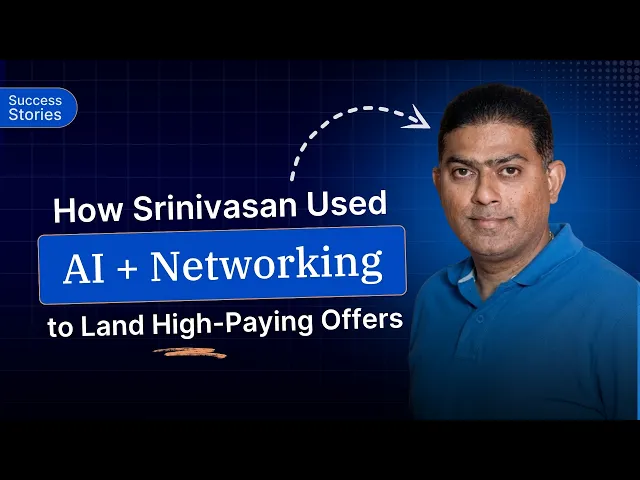
But here's how Srinivasan, a NxtJob member, did it what skipping it cost him:
He was having interview after interview and losing the offers, at PwC, Callaway Golf, Coforge and others. The missing piece, he realised, was face to face practice, because in a real room you do not know what will get thrown at you.
So he started rehearsing out loud, on our tool and on an app that asked him questions. "When you practice," he said, "that is when things happened."
Our Interviewer agent builds practice around your target role and job description. It runs screening, managerial or custom rounds and gives feedback on clarity, relevance and depth, so you hear where a story goes soft before a panel does.
Two AI prompts that help without inventing claims
AI turns a messy memory into a clean STAR draft in a minute. It also adds numbers you never gave it.
Prompt 1:
"Here is a work story in my own words and the job description I am targeting. Rewrite it as a two minute STAR answer at VP level. Use only facts I gave you. Put a question mark next to any number you assumed. End with one line on what I would do differently."
Prompt 2:
"Act as the CEO interviewing me for this role. Ask five follow up questions on this answer, hardest first. Do not accept a vague reply."
Delete anything you cannot defend with a document, a dashboard or a reference.
Say your hardest story out loud today
Pick the story you would least like to be asked about. For most senior people that is the biggest failure. Write it on one page in STAR order, with the number before, the number after and what it cost.
Add one line on what you would do differently. Then set a timer for two minutes, say it out loud and record it on your phone. Play it back and check one thing: how long did the Situation run? If it went past 20 seconds, cut it and record again. Fix the timing first, then the numbers.
One honest recording tells you more about your readiness than any list of questions. If you want to run the full set with feedback and follow ups, book your bootcamp seat.

As a content writer and SEO strategist, I help turn complex AI job search, career-tech, and growth topics into clear, practical content. At NxtJob.ai, I write to help senior professionals make smarter career moves with clarity and confidence.
Githu Ravikkumar
Creative Strategist & Copywriter, Nxtjob
Recent articles

Resume
5 min read
ATS Resume Format: How to Create a Resume That Gets Past Applicant Tracking Systems
Learn how to create an ATS-friendly resume that passes through applicant tracking systems and increases your chances of landing an interview.
Resume
5 min read
ATS Resume Format: How to Create a Resume That Gets Past Applicant Tracking Systems
Learn how to create an ATS-friendly resume that passes through applicant tracking systems and increases your chances of landing an interview.
Resume
5 min read
ATS Resume Format: How to Create a Resume That Gets Past Applicant Tracking Systems
Learn how to create an ATS-friendly resume that passes through applicant tracking systems and increases your chances of landing an interview.
Resume
5 min read
ATS Resume Format: How to Create a Resume That Gets Past Applicant Tracking Systems
Learn how to create an ATS-friendly resume that passes through applicant tracking systems and increases your chances of landing an interview.
Resume
5 min read
ATS Resume Format: How to Create a Resume That Gets Past Applicant Tracking Systems
Learn how to create an ATS-friendly resume that passes through applicant tracking systems and increases your chances of landing an interview.
Resume
5 min read
ATS Resume Format: How to Create a Resume That Gets Past Applicant Tracking Systems
Learn how to create an ATS-friendly resume that passes through applicant tracking systems and increases your chances of landing an interview.
Everything you need to know
Here you can find solutions to all your queries.
What are behavioral interview questions?
What is the STAR method in an interview?
How long should a STAR answer be at senior level?
What is the difference between behavioral and situational interview questions?
What behavioral interview questions do CXO rounds ask?
Should I say "I" or "we" in a behavioral interview?
How many STAR stories should I prepare for a senior interview?
Can I use the same example for different behavioral questions?
Interview
10 min read
Behavioral interview questions & answers for senior leaders
Published Date:
|
Last Modified:
Behavioral interview questions ask you to prove, with a real past example, how you behave at work. At director and VP level the questions sound the same as at entry level. The difference is what the panel listens for: decisions, trade offs and money, told in about two minutes.
The STAR method still works. Situation, Task, Action, Result. What changes is the weight.
A senior answer spends most of its time on the Action, puts a rupee figure or a percentage in the Result and ends with what you would do differently. This guide gives you that shape and five answers written at director and VP level. It also covers Indian HR and CXO rounds and how to prepare ten stories instead of thirty.
If you want to rehearse these out loud with honest feedback before a real panel, join the live two day bootcamp.
Senior behavioral interview questions at a glance
Most senior panels draw from the same eight themes, and each one needs a particular kind of proof.
Question | What it tests | What your answer must contain
|
|---|---|---|
A change people resisted | Influence without authority | Who resisted, what you traded, the adoption number |
A decision with incomplete data | Judgement and speed | What you knew, what you did not, the cost of waiting |
Your biggest failure | Ownership | Your share of the fault, the cost, what you changed |
A disagreement with your boss or CEO | Disagree and still deliver | How it closed and the relationship after |
A team you turned around | People judgement | Who you moved, the metric before and after |
Cutting cost or headcount | Hard calls made with care | The number and how you told people |
Influencing a board or CXO | Executive presence | The ask, your data, their decision |
A hire that went wrong | Hiring judgement | What you missed and what you check now |
Why companies keep asking them
Structured interviews predict job performance better than almost any other hiring method, and behavioral questions sit at their centre.
A 2022 meta-analysis by Sackett, Zhang, Berry and Lievens in the Journal of Applied Psychology put structured interviews on top at .42, ahead of cognitive ability tests at .31, as HumRRO's summary of the paper explains.
Google's structured interviewing guide says Google documents what a poor, borderline, solid or outstanding answer covers. Its follow-up questions are decided in advance. So the panel often has a rubric in front of it.
Amazon's interview prep page for development managers tells candidates to use the STAR method. Each interviewer asks two or three behavioral questions tied to its Leadership Principles, and answers should include metrics where applicable.
How the STAR method interview answer changes at senior level
Keep the four parts and change the time each one gets. A junior answer is mostly Situation. A senior answer is mostly Action.
The Situation gets two sentences, 15 to 20 seconds.
Give the scale in one number and stop. The Task is your mandate: what you owned and who you answered to, in ten seconds.
The Action gets a full minute or a little more, because this is where you get scored. Talk about the choices you made, the options you rejected and who you had to convince. A list of activities sounds like a project report. Choices sound like a leader.
The Result gets about 20 seconds. The number before and after, the time it took and one effect still true a year later.
Then add a fifth beat.
Ten seconds on what you would do differently. Even the UK Civil Service tells candidates to consider the STAR method. The format is settled. The weighting is yours.
Which round asks what in India
The same story gets told three times in an Indian senior hiring loop, and each listener wants a different cut of it.
Round | Who sits in it | What they listen for | Questions you will hear
|
|---|---|---|---|
HR round | Talent acquisition or HR business partner | Stability, reasons for moving, blame | Why did you leave? A conflict with your manager |
Hiring manager | Your future boss | Can you do the job from week one | A turnaround. A decision with incomplete data |
CXO or founder | CEO, CFO, founder, sometimes a board member | Judgement and whether they trust you with money | Your biggest failure. A time you disagreed with your CEO |
In the HR round, keep the story shorter and spend more of it on how you handled people. One line about a "toxic" old boss can end the process. Our guide to HR round questions covers that screening call, including CTC and notice period.
In the CXO round, lead with the decision and the number.
Founders interrupt. If your first 30 seconds are background, you may never reach the Action. Keep your leadership interview introduction just as tight.
Five behavioral interview questions and answers at director and VP level
These answers are hypothetical, with made up companies and numbers to show the shape.
"Tell me about a change people resisted"
"In 2023 I ran operations for a logistics firm with 1,400 people across six warehouses in western India. The board wanted cost per order down 12% in a year, and that number was mine. I spent three weeks on the floor first and found two sites caused 70% of our late orders, so I proposed two hubs instead of one. That cost more and kept our Pune customers on next day delivery. The resistance came from the heads of the closing sites. I offered each of them a role in the new hubs before the announcement. We closed four sites in nine months, cost per order fell 14% and we lost one client out of 60. Next time I would bring finance in on day one. Their numbers changed twice and cost us a month."
"Tell me about a decision you made with incomplete data"
"I was Director of Engineering at a payments company with 90 engineers. Halfway through a platform migration, the festive season forecast came in 40% above plan. I had a week to decide whether to finish before Diwali, with no load test data at that volume. I froze the migration. I told our CTO the cost plainly: two months of delay and about ₹1.2 crore to run both systems. We handled peak with no major outage and finished in January. Now I ask for the traffic forecast before I commit to any migration date."
"Tell me about your biggest failure"
"As VP Sales at a B2B software company, I pushed to open a Middle East office in 2022. I hired eight people and we spent about ₹8 crore over 18 months. We closed three customers against a plan of fifteen. The mistake was mine. I copied our India playbook, and buyers there wanted local partners and longer pilots. I saw the signs at month nine and did not act until month fifteen, because I did not want to admit the case was wrong. Since then I write a stop rule for any new market before it opens, with a date and a number."
"Tell me about a time you disagreed with your CEO"
"I was Finance Director at a ₹900 crore consumer brand. Our CEO wanted to buy a D2C brand at about eight times revenue. I backed the deal and disagreed with the price. My model showed the target had to triple sales in three years for us to break even. I took it to the CEO alone first, so he did not hear the objection in a board meeting. He still wanted it, so I proposed 60% upfront with the rest tied to revenue milestones. The board approved that. The brand hit about half the milestones and we paid roughly ₹40 crore less. I learned to walk in with an alternative every time I disagree."
"Tell me about a team you turned around"
"I took over customer support at an edtech company as Director, with 320 agents. Attrition was 60% a year and CSAT was 71%. I spent a month listening to calls and found the problem was the incentive. Agents were paid on calls closed, so customers called back. I moved the incentive to first call resolution and defended a six week dip in volume to the CEO every Monday. I also replaced four of eleven team leads. In six months CSAT reached 84% and attrition fell to 38%. I would change the incentive and the leads in the same month next time."
All five keep the Situation short and spend most of the time on decisions. That is what a senior rubric rewards.
The bootcamp shows you how to use our Interviewer agent to pressure test exactly these stories, so see what the bootcamp covers before your next panel.
The follow up is where senior answers break
Your first two minutes earn the follow up, and the follow up decides the score. Expect these:
What exactly did you do, and what did your team do?
What did you consider and reject?
How do you know the result came from you and not the market?
What was the number before you started?
If another team shared the result, say so up front. A probe will find the overlap and doubt every number you gave.
Then there is "we". Leaders of large teams say it out of habit, and it makes you sound like a spectator.
Say "we" for the work and "I" for the decisions. "We rebuilt onboarding. I decided to cut the second approval step." The panel can score the second sentence.
Four habits that cost senior candidates the offer
A three minute Situation. By the time you reach the Action, the panel has stopped writing.
A result without a baseline. "Improved retention" cannot be scored. "From 76% to 88% in a year" can.
A failure that is secretly a strength. Pick a real failure with a real cost.
One story for every question. Interviewers compare notes and notice repeats.
Build a story bank of ten, not thirty answers
Prepare ten stories and map each one to three or four questions.
The warehouse story above answers a change, conflict or cost question, depending on what you lead with. Before each loop, research the company and put the stories closest to its problems first.
Write down the biggest moments of your last ten years. Wins, failures, conflicts, hires, exits.
Pick ten. Include at least two failures, two conflicts and one story with a CEO or board.
Write each on one page in STAR order, with the reflection line and the before and after numbers.
Map them against the eight themes at the top. Every theme needs two stories, so you never repeat one in a loop.
Say each aloud in two minutes and record it. Cut what runs long.
Practise follow ups on the three stories you least want probed.
Step six is the one people skip, because it is uncomfortable alone.
But here's how Srinivasan, a NxtJob member, did it what skipping it cost him:
He was having interview after interview and losing the offers, at PwC, Callaway Golf, Coforge and others. The missing piece, he realised, was face to face practice, because in a real room you do not know what will get thrown at you.
So he started rehearsing out loud, on our tool and on an app that asked him questions. "When you practice," he said, "that is when things happened."
Our Interviewer agent builds practice around your target role and job description. It runs screening, managerial or custom rounds and gives feedback on clarity, relevance and depth, so you hear where a story goes soft before a panel does.
Two AI prompts that help without inventing claims
AI turns a messy memory into a clean STAR draft in a minute. It also adds numbers you never gave it.
Prompt 1:
"Here is a work story in my own words and the job description I am targeting. Rewrite it as a two minute STAR answer at VP level. Use only facts I gave you. Put a question mark next to any number you assumed. End with one line on what I would do differently."
Prompt 2:
"Act as the CEO interviewing me for this role. Ask five follow up questions on this answer, hardest first. Do not accept a vague reply."
Delete anything you cannot defend with a document, a dashboard or a reference.
Say your hardest story out loud today
Pick the story you would least like to be asked about. For most senior people that is the biggest failure. Write it on one page in STAR order, with the number before, the number after and what it cost.
Add one line on what you would do differently. Then set a timer for two minutes, say it out loud and record it on your phone. Play it back and check one thing: how long did the Situation run? If it went past 20 seconds, cut it and record again. Fix the timing first, then the numbers.
One honest recording tells you more about your readiness than any list of questions. If you want to run the full set with feedback and follow ups, book your bootcamp seat.
Table of content
Resume
Professional Summary Resumes to Grab Recruiters' Attention
A senior resume summary is four lines: your level, your scope, one proven result, and the role you want. Here is the formula, five examples, and a rewrite you can copy tonight.

Interview
Interview Questions by HR at Senior Level: What Recruiters Screen For and How to Rehearse
The nine HR round questions senior professionals face, what each one really tests, and why interview calls fail to turn into offers. Includes a 10-day rehearsal plan and a real success story.
As a content writer and SEO strategist, I help turn complex AI job search, career-tech, and growth topics into clear, practical content. At NxtJob.ai, I write to help senior professionals make smarter career moves with clarity and confidence.
Githu Ravikkumar
Creative Strategist & Copywriter, Nxtjob
What are behavioral interview questions?
What is the STAR method in an interview?
How long should a STAR answer be at senior level?
What is the difference between behavioral and situational interview questions?
What behavioral interview questions do CXO rounds ask?
Should I say "I" or "we" in a behavioral interview?
How many STAR stories should I prepare for a senior interview?
Can I use the same example for different behavioral questions?
Everything you need to know
Here you can find solutions to all your queries.
Interview
10 min read
Published Date:
|
Last Modified:
Behavioral interview questions & answers for senior leaders
Behavioral interview questions ask you to prove, with a real past example, how you behave at work. At director and VP level the questions sound the same as at entry level. The difference is what the panel listens for: decisions, trade offs and money, told in about two minutes.
The STAR method still works. Situation, Task, Action, Result. What changes is the weight.
A senior answer spends most of its time on the Action, puts a rupee figure or a percentage in the Result and ends with what you would do differently. This guide gives you that shape and five answers written at director and VP level. It also covers Indian HR and CXO rounds and how to prepare ten stories instead of thirty.
If you want to rehearse these out loud with honest feedback before a real panel, join the live two day bootcamp.
Senior behavioral interview questions at a glance
Most senior panels draw from the same eight themes, and each one needs a particular kind of proof.
Question | What it tests | What your answer must contain
|
|---|---|---|
A change people resisted | Influence without authority | Who resisted, what you traded, the adoption number |
A decision with incomplete data | Judgement and speed | What you knew, what you did not, the cost of waiting |
Your biggest failure | Ownership | Your share of the fault, the cost, what you changed |
A disagreement with your boss or CEO | Disagree and still deliver | How it closed and the relationship after |
A team you turned around | People judgement | Who you moved, the metric before and after |
Cutting cost or headcount | Hard calls made with care | The number and how you told people |
Influencing a board or CXO | Executive presence | The ask, your data, their decision |
A hire that went wrong | Hiring judgement | What you missed and what you check now |
Why companies keep asking them
Structured interviews predict job performance better than almost any other hiring method, and behavioral questions sit at their centre.
A 2022 meta-analysis by Sackett, Zhang, Berry and Lievens in the Journal of Applied Psychology put structured interviews on top at .42, ahead of cognitive ability tests at .31, as HumRRO's summary of the paper explains.
Google's structured interviewing guide says Google documents what a poor, borderline, solid or outstanding answer covers. Its follow-up questions are decided in advance. So the panel often has a rubric in front of it.
Amazon's interview prep page for development managers tells candidates to use the STAR method. Each interviewer asks two or three behavioral questions tied to its Leadership Principles, and answers should include metrics where applicable.
How the STAR method interview answer changes at senior level
Keep the four parts and change the time each one gets. A junior answer is mostly Situation. A senior answer is mostly Action.
The Situation gets two sentences, 15 to 20 seconds.
Give the scale in one number and stop. The Task is your mandate: what you owned and who you answered to, in ten seconds.
The Action gets a full minute or a little more, because this is where you get scored. Talk about the choices you made, the options you rejected and who you had to convince. A list of activities sounds like a project report. Choices sound like a leader.
The Result gets about 20 seconds. The number before and after, the time it took and one effect still true a year later.
Then add a fifth beat.
Ten seconds on what you would do differently. Even the UK Civil Service tells candidates to consider the STAR method. The format is settled. The weighting is yours.
Which round asks what in India
The same story gets told three times in an Indian senior hiring loop, and each listener wants a different cut of it.
Round | Who sits in it | What they listen for | Questions you will hear
|
|---|---|---|---|
HR round | Talent acquisition or HR business partner | Stability, reasons for moving, blame | Why did you leave? A conflict with your manager |
Hiring manager | Your future boss | Can you do the job from week one | A turnaround. A decision with incomplete data |
CXO or founder | CEO, CFO, founder, sometimes a board member | Judgement and whether they trust you with money | Your biggest failure. A time you disagreed with your CEO |
In the HR round, keep the story shorter and spend more of it on how you handled people. One line about a "toxic" old boss can end the process. Our guide to HR round questions covers that screening call, including CTC and notice period.
In the CXO round, lead with the decision and the number.
Founders interrupt. If your first 30 seconds are background, you may never reach the Action. Keep your leadership interview introduction just as tight.
Five behavioral interview questions and answers at director and VP level
These answers are hypothetical, with made up companies and numbers to show the shape.
"Tell me about a change people resisted"
"In 2023 I ran operations for a logistics firm with 1,400 people across six warehouses in western India. The board wanted cost per order down 12% in a year, and that number was mine. I spent three weeks on the floor first and found two sites caused 70% of our late orders, so I proposed two hubs instead of one. That cost more and kept our Pune customers on next day delivery. The resistance came from the heads of the closing sites. I offered each of them a role in the new hubs before the announcement. We closed four sites in nine months, cost per order fell 14% and we lost one client out of 60. Next time I would bring finance in on day one. Their numbers changed twice and cost us a month."
"Tell me about a decision you made with incomplete data"
"I was Director of Engineering at a payments company with 90 engineers. Halfway through a platform migration, the festive season forecast came in 40% above plan. I had a week to decide whether to finish before Diwali, with no load test data at that volume. I froze the migration. I told our CTO the cost plainly: two months of delay and about ₹1.2 crore to run both systems. We handled peak with no major outage and finished in January. Now I ask for the traffic forecast before I commit to any migration date."
"Tell me about your biggest failure"
"As VP Sales at a B2B software company, I pushed to open a Middle East office in 2022. I hired eight people and we spent about ₹8 crore over 18 months. We closed three customers against a plan of fifteen. The mistake was mine. I copied our India playbook, and buyers there wanted local partners and longer pilots. I saw the signs at month nine and did not act until month fifteen, because I did not want to admit the case was wrong. Since then I write a stop rule for any new market before it opens, with a date and a number."
"Tell me about a time you disagreed with your CEO"
"I was Finance Director at a ₹900 crore consumer brand. Our CEO wanted to buy a D2C brand at about eight times revenue. I backed the deal and disagreed with the price. My model showed the target had to triple sales in three years for us to break even. I took it to the CEO alone first, so he did not hear the objection in a board meeting. He still wanted it, so I proposed 60% upfront with the rest tied to revenue milestones. The board approved that. The brand hit about half the milestones and we paid roughly ₹40 crore less. I learned to walk in with an alternative every time I disagree."
"Tell me about a team you turned around"
"I took over customer support at an edtech company as Director, with 320 agents. Attrition was 60% a year and CSAT was 71%. I spent a month listening to calls and found the problem was the incentive. Agents were paid on calls closed, so customers called back. I moved the incentive to first call resolution and defended a six week dip in volume to the CEO every Monday. I also replaced four of eleven team leads. In six months CSAT reached 84% and attrition fell to 38%. I would change the incentive and the leads in the same month next time."
All five keep the Situation short and spend most of the time on decisions. That is what a senior rubric rewards.
The bootcamp shows you how to use our Interviewer agent to pressure test exactly these stories, so see what the bootcamp covers before your next panel.
The follow up is where senior answers break
Your first two minutes earn the follow up, and the follow up decides the score. Expect these:
What exactly did you do, and what did your team do?
What did you consider and reject?
How do you know the result came from you and not the market?
What was the number before you started?
If another team shared the result, say so up front. A probe will find the overlap and doubt every number you gave.
Then there is "we". Leaders of large teams say it out of habit, and it makes you sound like a spectator.
Say "we" for the work and "I" for the decisions. "We rebuilt onboarding. I decided to cut the second approval step." The panel can score the second sentence.
Four habits that cost senior candidates the offer
A three minute Situation. By the time you reach the Action, the panel has stopped writing.
A result without a baseline. "Improved retention" cannot be scored. "From 76% to 88% in a year" can.
A failure that is secretly a strength. Pick a real failure with a real cost.
One story for every question. Interviewers compare notes and notice repeats.
Build a story bank of ten, not thirty answers
Prepare ten stories and map each one to three or four questions.
The warehouse story above answers a change, conflict or cost question, depending on what you lead with. Before each loop, research the company and put the stories closest to its problems first.
Write down the biggest moments of your last ten years. Wins, failures, conflicts, hires, exits.
Pick ten. Include at least two failures, two conflicts and one story with a CEO or board.
Write each on one page in STAR order, with the reflection line and the before and after numbers.
Map them against the eight themes at the top. Every theme needs two stories, so you never repeat one in a loop.
Say each aloud in two minutes and record it. Cut what runs long.
Practise follow ups on the three stories you least want probed.
Step six is the one people skip, because it is uncomfortable alone.
But here's how Srinivasan, a NxtJob member, did it what skipping it cost him:
He was having interview after interview and losing the offers, at PwC, Callaway Golf, Coforge and others. The missing piece, he realised, was face to face practice, because in a real room you do not know what will get thrown at you.
So he started rehearsing out loud, on our tool and on an app that asked him questions. "When you practice," he said, "that is when things happened."
Our Interviewer agent builds practice around your target role and job description. It runs screening, managerial or custom rounds and gives feedback on clarity, relevance and depth, so you hear where a story goes soft before a panel does.
Two AI prompts that help without inventing claims
AI turns a messy memory into a clean STAR draft in a minute. It also adds numbers you never gave it.
Prompt 1:
"Here is a work story in my own words and the job description I am targeting. Rewrite it as a two minute STAR answer at VP level. Use only facts I gave you. Put a question mark next to any number you assumed. End with one line on what I would do differently."
Prompt 2:
"Act as the CEO interviewing me for this role. Ask five follow up questions on this answer, hardest first. Do not accept a vague reply."
Delete anything you cannot defend with a document, a dashboard or a reference.
Say your hardest story out loud today
Pick the story you would least like to be asked about. For most senior people that is the biggest failure. Write it on one page in STAR order, with the number before, the number after and what it cost.
Add one line on what you would do differently. Then set a timer for two minutes, say it out loud and record it on your phone. Play it back and check one thing: how long did the Situation run? If it went past 20 seconds, cut it and record again. Fix the timing first, then the numbers.
One honest recording tells you more about your readiness than any list of questions. If you want to run the full set with feedback and follow ups, book your bootcamp seat.
Table of content
Resume
Professional Summary Resumes to Grab Recruiters' Attention
A senior resume summary is four lines: your level, your scope, one proven result, and the role you want. Here is the formula, five examples, and a rewrite you can copy tonight.
Interview
Interview Questions by HR at Senior Level: What Recruiters Screen For and How to Rehearse
The nine HR round questions senior professionals face, what each one really tests, and why interview calls fail to turn into offers. Includes a 10-day rehearsal plan and a real success story.
As a content writer and SEO strategist, I help turn complex AI job search, career-tech, and growth topics into clear, practical content. At NxtJob.ai, I write to help senior professionals make smarter career moves with clarity and confidence.
Githu Ravikkumar
Creative Strategist & Copywriter, Nxtjob
Recent articles
Resume
5 min read
Interview Questions by HR at Senior Level: What Recruiters Screen For and How to Rehearse
The nine HR round questions senior professionals face, what each one really tests, and why interview calls fail to turn into offers. Includes a 10-day rehearsal plan and a real success story.

Resume
5 min read
Career planning for mid-senior professionals is a system. Not a vision board.
A guide to career planning for mid-senior professionals, built on eight decisions and backed by 2025 and 2026 data. It includes a real case, prompts you can use with an AI assistant, and a plan you can start this week

Resume
5 min read
Counter Offer Negotiation: A Strategic Guide for Senior Leaders
A guide for senior professionals on why most counter offers fail and how to use market research to decide your next move.
Resume
5 min read
Interview Questions by HR at Senior Level: What Recruiters Screen For and How to Rehearse
The nine HR round questions senior professionals face, what each one really tests, and why interview calls fail to turn into offers. Includes a 10-day rehearsal plan and a real success story.
Resume
5 min read
Career planning for mid-senior professionals is a system. Not a vision board.
A guide to career planning for mid-senior professionals, built on eight decisions and backed by 2025 and 2026 data. It includes a real case, prompts you can use with an AI assistant, and a plan you can start this week
Everything you need to know
Here you can find solutions to all your queries.
What are behavioral interview questions?
What is the STAR method in an interview?
How long should a STAR answer be at senior level?
What is the difference between behavioral and situational interview questions?
What behavioral interview questions do CXO rounds ask?
Should I say "I" or "we" in a behavioral interview?
How many STAR stories should I prepare for a senior interview?
Can I use the same example for different behavioral questions?
Join the Revolution
Your AI career copilot to land you top jobs in under 90 days.
Join the Revolution
Your AI career copilot to land you top jobs in under 90 days.
Join the Revolution
Your AI career copilot to land you top jobs in under 90 days.