
Resume
5 min read
Professional Summary Resumes to Grab Recruiters' Attention
Published Date:
|
Last Modified:
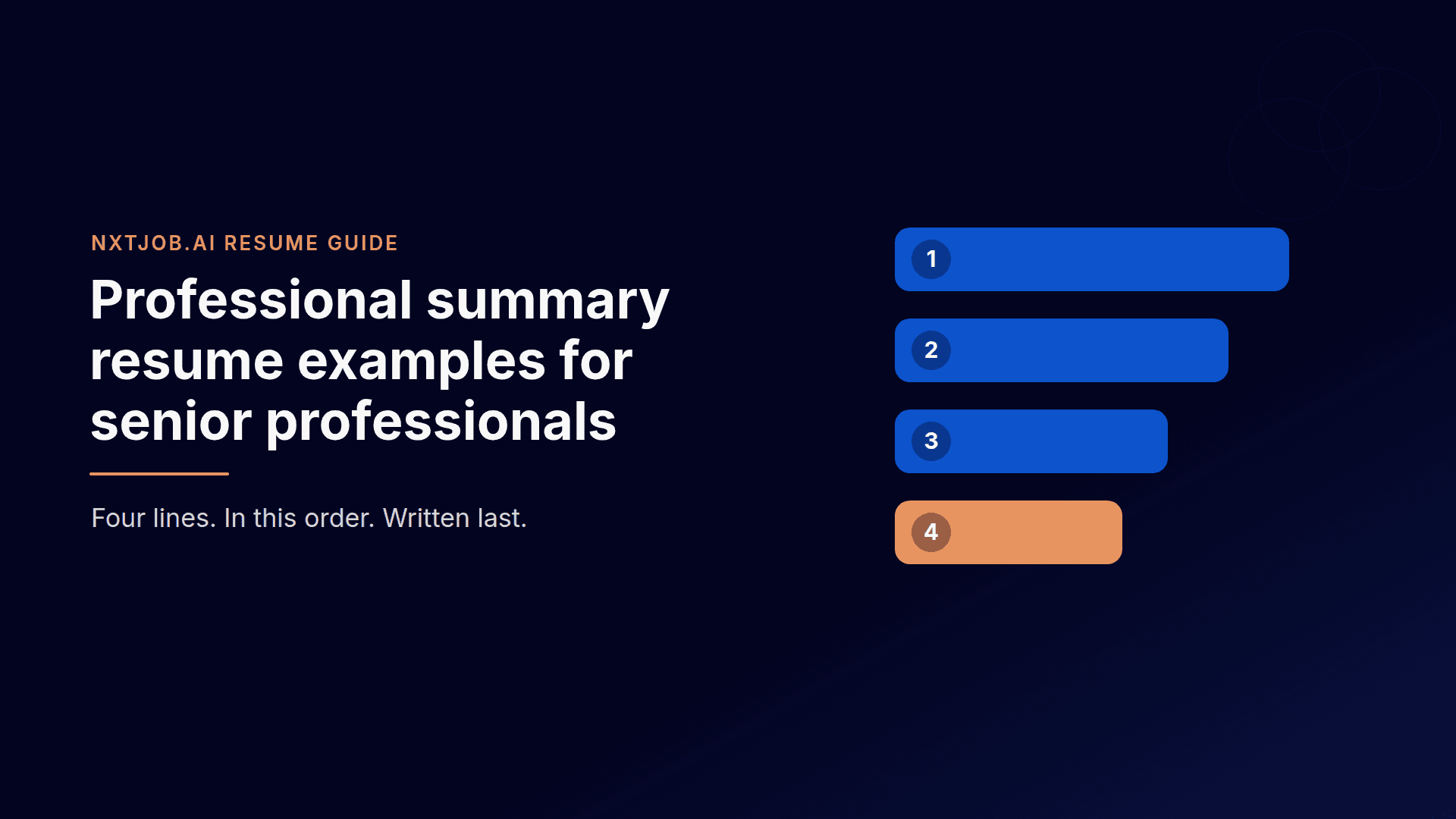
A professional summary resume section for a senior role is three or four lines under your name. It says what level you work at, how big your scope is, one result you can prove, and the role you want next. Nothing else belongs there.
Recruiters spend an average of 7.4 seconds on the first screen of a resume, according to a 2018 eye-tracking study. A summary that opens with adjectives and an objective spends those seconds on nothing.
This guide gives you the formula, five examples, a full rewrite, and the habits that make strong candidates easy to skip.
If the whole resume needs this level of rework, our live two-day bootcamp on Zoom covers role-wise resume structures and bullet writing. Join the live bootcamp.
The senior resume summary at a glance
Every line has one job. Anything that does not do that job comes out.
Line | What goes in | Example shape |
|---|---|---|
1. Identity | Job title, years of experience, function and industry | Finance Director, 18 years, manufacturing and consumer goods |
2. Scope | Team size, budget, revenue band, markets | 40 people, ₹300 crore P&L, five states |
3. Proof | One result with a number and a time | Cut working capital days from 92 to 61 in two years |
4. Target | The role you want, in the job description's words | Targeting CFO roles at listed consumer companies |
Length | Three or four lines, 40 to 60 words | Fits without scrolling or a paragraph break |
Leave out | Objective, adjectives, CTC, notice period, skills list | Skills sit lower on the page. CTC comes up later |
Every number in this guide's examples is made up to show the shape. Swap in your own.
Summary, objective or profile
Use a summary. A summary shows what you bring.
An objective says what you want, and a profile is, in most guides, another name for the summary. At senior level, the objective adds nothing, because your target role belongs in line four.
What a recruiter does with your summary
They skim it, and then they search it, so the summary has to agree with your title line and carry the right words.
The skim comes first. Read the 7.4 seconds as a rough guide, not a law.
The 2018 study, reported by HR Dive, found that resumes held attention when they had simple layouts, clear section headings, and bold titles with bulleted accomplishments. Cluttered pages, multiple columns, and long sentences lost the reader.

Your summary sits at the top of that skim, so it has to be short, and it has to agree with your title line. If your title line says Senior Manager and your summary claims a ₹300 crore P&L, the recruiter slows down for the wrong reason.
Then comes the search. Greenhouse's help page shows recruiters running keyword searches across resumes, with a snippet under each name showing where the term appears. Your summary is the first block of searchable text on the page.
Exact wording matters more than most candidates think.

Harvard Business School's 2021 hidden workers study, run with Accenture, surveyed 2,275 executives in the US, UK, and Germany. Of those, 88% believed qualified, high-skill candidates were vetted out because they did not match the exact criteria in the job description.
So use the exact job title and the terms the description repeats, if they are true for you.
The four-line formula
Write four lines: who you are, how big the job is, what you proved and what you want next.
Write them last. Finish the experience section first, so every number you need is already on the page and the summary only has to pick from it.
Line one is your identity. Give the title the market uses, your years of experience and your function or industry. If your company calls you Associate Vice President and the market calls the job Head of Sales, write "Head of Sales" only if that is what you do. Titles get checked, often against LinkedIn and references. A modest title you can defend beats a large one you cannot.
Line two is scope. Scope is what separates a senior resume from a mid-level one, because the same title means very different jobs at different companies. Give team size, budget, revenue, markets, or systems owned. If the numbers are confidential, use a band such as "above ₹100 crore". Each function is judged on different numbers.
Function | Scope numbers that count |
|---|---|
Finance | P&L or budget owned, working capital, team size |
Engineering | Headcount, annual budget, systems or products owned |
Sales | Quota, territory, team size |
HR | Employees supported, locations, attrition |
Operations and supply chain | Sites, spend, on-time delivery |
Marketing | Media budget, markets, revenue influenced |
Line three is one proof. One result, one number, one time period. Pick the result closest to the role you want, not your biggest one. If you have no clean percentage, use a count, a before and after, a speed or a scale. "Moved 14 services to one platform in 11 months" works. Do not invent a figure to fill the line. Write in plain verbs: run, lead, own, cut, move.
Line four is your target. Write the role you want in the words the job description uses. "Targeting CFO roles at listed consumer companies" tells a recruiter where you fit in one breath. "Seeking a challenging role in a dynamic organisation" tells them nothing.
Expert tip 💡
Leave CTC, notice period and age out of the summary. They get asked in the HR round, and the summary is not the place to answer them early.

Senior resume summary examples you can adapt
These five are illustrative. Each follows the same order: title, scope, proof, target.
Example 1:
Finance Director with 18 years across manufacturing and consumer goods. Run a team of 40 and a ₹300 crore P&L across five states. Cut working capital days from 92 to 61 in two years. Targeting CFO roles at listed consumer companies.
Example 2:
Engineering Director with 16 years in fintech and payments. Lead 120 engineers across four product lines on a ₹60 crore annual budget. Moved 14 services to one platform in 11 months and cut incident hours by 40%. Targeting VP Engineering roles at late stage product companies.
Example 3:
Regional Sales Head with 15 years in B2B software. Own an ₹85 crore target with 60 people in three cities. Took the region from 71% to 112% of quota in 18 months. Targeting Chief Revenue Officer roles in enterprise software.
Example 4:
HR Head with 20 years in IT services and healthcare. Support 6,500 employees across nine locations with a team of 28. Brought attrition down from 24% to 15% in 14 months. Targeting CHRO roles in healthcare or services.
Example 5:
Supply Chain Head with 17 years in pharma and FMCG. Run 11 plants and warehouses and a ₹450 crore logistics spend. Lifted on-time delivery from 88% to 96% in a year. Targeting COO or supply chain VP roles.
Look at what is missing. No adjectives, no "passionate", no "proven track record". Each line can be checked, and each number can be asked about in an interview. That is what makes a senior resume summary believable.
Our Tailor agent takes your master resume and a job description and builds a role-specific resume around that job's requirements. It works best after you have written the four lines yourself, so the facts stay yours.
Our live bootcamp also comes with a resume-building playbook and role-wise resume structures. See what the bootcamp covers.
Rewrite a weak summary in four passes
Delete first, then add. Most weak summaries need fewer words and more facts.
Here is a typical weak summary:
Results-driven leader with vast experience seeking a challenging role in a dynamic organisation where I can use my skills to add value.
Pass one. Delete every word a recruiter cannot check. "Results driven", "vast" and "dynamic" go. "Where I can use my skills to add value" goes too. What remains is almost nothing, which is the point.
Pass two. Replace the objective with a target role. Look at the job description and copy the title.
Pass three. Add scope. How many people, how much money, how many markets.
Pass four. Add one result with a number and a time. Read it aloud. If you would struggle to explain the number to a hiring manager, choose a different result.
Here is the rewrite:
Marketing Head with 14 years in consumer internet. Lead 35 people and a ₹120 crore media budget. Grew paid acquisition 3 times while holding cost per install flat. Targeting CMO roles at consumer subscription companies.

Tailor it for each role in ten minutes
Change lines one and four for every application. Leave lines two and three alone.
Your scope and your proof are facts, and facts do not change between applications.
Your title line and your target line are positioning, and positioning should match the job. If two titles genuinely fit you, keep two master versions, one per title, instead of blending them into one vague line.
Keep each master summary in one file. For each application, read the job description, copy the exact job title, pick the two or three terms it repeats and place them in lines one and four. That takes ten minutes.
Keep the numbers identical across every version you send. A team of 40 in one version and 28 in another is an easy reason to drop your application.
If you apply to many roles, our Tailor agent handles the comparison step. It takes your master resume and the job description.
It picks out the requirements, skills and keywords the role uses and builds a role specific resume around them, with an ATS score alongside. Write your four lines first, then run Tailor and check that lines two and three came through unchanged. The facts stay yours.
Seven habits that make a strong candidate easy to skip
Each of these looks harmless. Each one gives a recruiter a reason to move on.
Adjective stacks. "Strategic, visionary, dynamic leader" describes nobody in particular. A recruiter cannot search it or verify it.
An objective statement. It tells the reader what you want, not what you bring. Replace it with the target line.
A skills dump. Skills already sit lower on the page, where the ATS reads them. Repeating them here uses up your four lines.
Title inflation. Titles get checked against LinkedIn and references. A mismatch damages every other claim on the page.
Numbers that disagree with your bullets. If the summary says 40 people and the experience section says 28, the recruiter believes the smaller number and doubts the rest.
Several identities. "CFO, COO and strategy leader" reads as none of them. Pick the role you want and lead with it.
A paragraph. Five or six lines in a 7.4 second skim is a wall. Break it at four.
Use AI for drafts, then defend every line
AI can draft four versions of your summary in a minute, and it will add claims you never made. Use it like this.
Here is my resume and a job description. Write three versions of a four line professional summary. Use only facts that appear in my resume. Put a question mark next to anything you had to assume.
Then run the second prompt on the version you like:
Read this summary as a recruiter would. List every phrase you would want me to prove in a screening call.
Anything you cannot back with a project, a payslip or a reference comes out. Senior claims get tested early, often in the first call, which is why our guide to HR round questions tells you to keep every scope answer to numbers you can defend.
Reuse the four lines
The same four lines work as your LinkedIn About opening and your answer to "tell me about yourself".
On LinkedIn only the opening lines show before a reader expands the section, so lead with the identity and scope lines there. In an interview, say the four lines out loud in about 60 seconds and stop. If you have already trimmed each one to a fact, you will not ramble.
If your resume also has to pass an ATS, our guide to an ATS friendly resume covers formatting, so the summary you just wrote parses cleanly.
Write your four lines tonight
Open your resume, delete the current summary and write four new lines in this order: title and years, scope in numbers, one proven result and the role you want.
Give yourself 20 minutes. Then cross out every word a recruiter could not check, and make sure each number matches your experience section. Save that version as your master. Tomorrow, change lines one and four for the first job you apply to.
It will feel too plain the first time. That is a good sign, because plain and checkable is what a recruiter can read in seven seconds. That is the whole task.
If you want to rework the rest of the resume the same way, our live bootcamp covers resume structure and bullet writing. Get your seat.

As a content writer and SEO strategist, I help turn complex AI job search, career-tech, and growth topics into clear, practical content. At NxtJob.ai, I write to help senior professionals make smarter career moves with clarity and confidence.
Githu Ravikkumar
Creative Strategist & Copywriter, Nxtjob
Recent articles

Resume
5 min read
ATS Resume Format: How to Create a Resume That Gets Past Applicant Tracking Systems
Learn how to create an ATS-friendly resume that passes through applicant tracking systems and increases your chances of landing an interview.
Resume
5 min read
ATS Resume Format: How to Create a Resume That Gets Past Applicant Tracking Systems
Learn how to create an ATS-friendly resume that passes through applicant tracking systems and increases your chances of landing an interview.
Resume
5 min read
ATS Resume Format: How to Create a Resume That Gets Past Applicant Tracking Systems
Learn how to create an ATS-friendly resume that passes through applicant tracking systems and increases your chances of landing an interview.
Resume
5 min read
ATS Resume Format: How to Create a Resume That Gets Past Applicant Tracking Systems
Learn how to create an ATS-friendly resume that passes through applicant tracking systems and increases your chances of landing an interview.
Resume
5 min read
ATS Resume Format: How to Create a Resume That Gets Past Applicant Tracking Systems
Learn how to create an ATS-friendly resume that passes through applicant tracking systems and increases your chances of landing an interview.
Resume
5 min read
ATS Resume Format: How to Create a Resume That Gets Past Applicant Tracking Systems
Learn how to create an ATS-friendly resume that passes through applicant tracking systems and increases your chances of landing an interview.
Everything you need to know
Here you can find solutions to all your queries.
What is a professional summary on a resume?
How long should a professional summary be for a senior resume?
Should a senior resume have a summary or an objective?
What should I write if I do not have numbers?
Do I need a different summary for every application?
Should I mention CTC or notice period in the summary?
Can I use ChatGPT to write my professional summary?
Should I use "I" in a resume summary?
Resume
5 min read
Professional Summary Resumes to Grab Recruiters' Attention
Published Date:
|
Last Modified:
A professional summary resume section for a senior role is three or four lines under your name. It says what level you work at, how big your scope is, one result you can prove, and the role you want next. Nothing else belongs there.
Recruiters spend an average of 7.4 seconds on the first screen of a resume, according to a 2018 eye-tracking study. A summary that opens with adjectives and an objective spends those seconds on nothing.
This guide gives you the formula, five examples, a full rewrite, and the habits that make strong candidates easy to skip.
If the whole resume needs this level of rework, our live two-day bootcamp on Zoom covers role-wise resume structures and bullet writing. Join the live bootcamp.
The senior resume summary at a glance
Every line has one job. Anything that does not do that job comes out.
Line | What goes in | Example shape |
|---|---|---|
1. Identity | Job title, years of experience, function and industry | Finance Director, 18 years, manufacturing and consumer goods |
2. Scope | Team size, budget, revenue band, markets | 40 people, ₹300 crore P&L, five states |
3. Proof | One result with a number and a time | Cut working capital days from 92 to 61 in two years |
4. Target | The role you want, in the job description's words | Targeting CFO roles at listed consumer companies |
Length | Three or four lines, 40 to 60 words | Fits without scrolling or a paragraph break |
Leave out | Objective, adjectives, CTC, notice period, skills list | Skills sit lower on the page. CTC comes up later |
Every number in this guide's examples is made up to show the shape. Swap in your own.
Summary, objective or profile
Use a summary. A summary shows what you bring.
An objective says what you want, and a profile is, in most guides, another name for the summary. At senior level, the objective adds nothing, because your target role belongs in line four.
What a recruiter does with your summary
They skim it, and then they search it, so the summary has to agree with your title line and carry the right words.
The skim comes first. Read the 7.4 seconds as a rough guide, not a law.
The 2018 study, reported by HR Dive, found that resumes held attention when they had simple layouts, clear section headings, and bold titles with bulleted accomplishments. Cluttered pages, multiple columns, and long sentences lost the reader.
Your summary sits at the top of that skim, so it has to be short, and it has to agree with your title line. If your title line says Senior Manager and your summary claims a ₹300 crore P&L, the recruiter slows down for the wrong reason.
Then comes the search. Greenhouse's help page shows recruiters running keyword searches across resumes, with a snippet under each name showing where the term appears. Your summary is the first block of searchable text on the page.
Exact wording matters more than most candidates think.
Harvard Business School's 2021 hidden workers study, run with Accenture, surveyed 2,275 executives in the US, UK, and Germany. Of those, 88% believed qualified, high-skill candidates were vetted out because they did not match the exact criteria in the job description.
So use the exact job title and the terms the description repeats, if they are true for you.
The four-line formula
Write four lines: who you are, how big the job is, what you proved and what you want next.
Write them last. Finish the experience section first, so every number you need is already on the page and the summary only has to pick from it.
Line one is your identity. Give the title the market uses, your years of experience and your function or industry. If your company calls you Associate Vice President and the market calls the job Head of Sales, write "Head of Sales" only if that is what you do. Titles get checked, often against LinkedIn and references. A modest title you can defend beats a large one you cannot.
Line two is scope. Scope is what separates a senior resume from a mid-level one, because the same title means very different jobs at different companies. Give team size, budget, revenue, markets, or systems owned. If the numbers are confidential, use a band such as "above ₹100 crore". Each function is judged on different numbers.
Function | Scope numbers that count |
|---|---|
Finance | P&L or budget owned, working capital, team size |
Engineering | Headcount, annual budget, systems or products owned |
Sales | Quota, territory, team size |
HR | Employees supported, locations, attrition |
Operations and supply chain | Sites, spend, on-time delivery |
Marketing | Media budget, markets, revenue influenced |
Line three is one proof. One result, one number, one time period. Pick the result closest to the role you want, not your biggest one. If you have no clean percentage, use a count, a before and after, a speed or a scale. "Moved 14 services to one platform in 11 months" works. Do not invent a figure to fill the line. Write in plain verbs: run, lead, own, cut, move.
Line four is your target. Write the role you want in the words the job description uses. "Targeting CFO roles at listed consumer companies" tells a recruiter where you fit in one breath. "Seeking a challenging role in a dynamic organisation" tells them nothing.
Expert tip 💡
Leave CTC, notice period and age out of the summary. They get asked in the HR round, and the summary is not the place to answer them early.
Senior resume summary examples you can adapt
These five are illustrative. Each follows the same order: title, scope, proof, target.
Example 1:
Finance Director with 18 years across manufacturing and consumer goods. Run a team of 40 and a ₹300 crore P&L across five states. Cut working capital days from 92 to 61 in two years. Targeting CFO roles at listed consumer companies.
Example 2:
Engineering Director with 16 years in fintech and payments. Lead 120 engineers across four product lines on a ₹60 crore annual budget. Moved 14 services to one platform in 11 months and cut incident hours by 40%. Targeting VP Engineering roles at late stage product companies.
Example 3:
Regional Sales Head with 15 years in B2B software. Own an ₹85 crore target with 60 people in three cities. Took the region from 71% to 112% of quota in 18 months. Targeting Chief Revenue Officer roles in enterprise software.
Example 4:
HR Head with 20 years in IT services and healthcare. Support 6,500 employees across nine locations with a team of 28. Brought attrition down from 24% to 15% in 14 months. Targeting CHRO roles in healthcare or services.
Example 5:
Supply Chain Head with 17 years in pharma and FMCG. Run 11 plants and warehouses and a ₹450 crore logistics spend. Lifted on-time delivery from 88% to 96% in a year. Targeting COO or supply chain VP roles.
Look at what is missing. No adjectives, no "passionate", no "proven track record". Each line can be checked, and each number can be asked about in an interview. That is what makes a senior resume summary believable.
Our Tailor agent takes your master resume and a job description and builds a role-specific resume around that job's requirements. It works best after you have written the four lines yourself, so the facts stay yours.
Our live bootcamp also comes with a resume-building playbook and role-wise resume structures. See what the bootcamp covers.
Rewrite a weak summary in four passes
Delete first, then add. Most weak summaries need fewer words and more facts.
Here is a typical weak summary:
Results-driven leader with vast experience seeking a challenging role in a dynamic organisation where I can use my skills to add value.
Pass one. Delete every word a recruiter cannot check. "Results driven", "vast" and "dynamic" go. "Where I can use my skills to add value" goes too. What remains is almost nothing, which is the point.
Pass two. Replace the objective with a target role. Look at the job description and copy the title.
Pass three. Add scope. How many people, how much money, how many markets.
Pass four. Add one result with a number and a time. Read it aloud. If you would struggle to explain the number to a hiring manager, choose a different result.
Here is the rewrite:
Marketing Head with 14 years in consumer internet. Lead 35 people and a ₹120 crore media budget. Grew paid acquisition 3 times while holding cost per install flat. Targeting CMO roles at consumer subscription companies.
Tailor it for each role in ten minutes
Change lines one and four for every application. Leave lines two and three alone.
Your scope and your proof are facts, and facts do not change between applications.
Your title line and your target line are positioning, and positioning should match the job. If two titles genuinely fit you, keep two master versions, one per title, instead of blending them into one vague line.
Keep each master summary in one file. For each application, read the job description, copy the exact job title, pick the two or three terms it repeats and place them in lines one and four. That takes ten minutes.
Keep the numbers identical across every version you send. A team of 40 in one version and 28 in another is an easy reason to drop your application.
If you apply to many roles, our Tailor agent handles the comparison step. It takes your master resume and the job description.
It picks out the requirements, skills and keywords the role uses and builds a role specific resume around them, with an ATS score alongside. Write your four lines first, then run Tailor and check that lines two and three came through unchanged. The facts stay yours.
Seven habits that make a strong candidate easy to skip
Each of these looks harmless. Each one gives a recruiter a reason to move on.
Adjective stacks. "Strategic, visionary, dynamic leader" describes nobody in particular. A recruiter cannot search it or verify it.
An objective statement. It tells the reader what you want, not what you bring. Replace it with the target line.
A skills dump. Skills already sit lower on the page, where the ATS reads them. Repeating them here uses up your four lines.
Title inflation. Titles get checked against LinkedIn and references. A mismatch damages every other claim on the page.
Numbers that disagree with your bullets. If the summary says 40 people and the experience section says 28, the recruiter believes the smaller number and doubts the rest.
Several identities. "CFO, COO and strategy leader" reads as none of them. Pick the role you want and lead with it.
A paragraph. Five or six lines in a 7.4 second skim is a wall. Break it at four.
Use AI for drafts, then defend every line
AI can draft four versions of your summary in a minute, and it will add claims you never made. Use it like this.
Here is my resume and a job description. Write three versions of a four line professional summary. Use only facts that appear in my resume. Put a question mark next to anything you had to assume.
Then run the second prompt on the version you like:
Read this summary as a recruiter would. List every phrase you would want me to prove in a screening call.
Anything you cannot back with a project, a payslip or a reference comes out. Senior claims get tested early, often in the first call, which is why our guide to HR round questions tells you to keep every scope answer to numbers you can defend.
Reuse the four lines
The same four lines work as your LinkedIn About opening and your answer to "tell me about yourself".
On LinkedIn only the opening lines show before a reader expands the section, so lead with the identity and scope lines there. In an interview, say the four lines out loud in about 60 seconds and stop. If you have already trimmed each one to a fact, you will not ramble.
If your resume also has to pass an ATS, our guide to an ATS friendly resume covers formatting, so the summary you just wrote parses cleanly.
Write your four lines tonight
Open your resume, delete the current summary and write four new lines in this order: title and years, scope in numbers, one proven result and the role you want.
Give yourself 20 minutes. Then cross out every word a recruiter could not check, and make sure each number matches your experience section. Save that version as your master. Tomorrow, change lines one and four for the first job you apply to.
It will feel too plain the first time. That is a good sign, because plain and checkable is what a recruiter can read in seven seconds. That is the whole task.
If you want to rework the rest of the resume the same way, our live bootcamp covers resume structure and bullet writing. Get your seat.
Table of content

Interview
Interview Questions by HR at Senior Level: What Recruiters Screen For and How to Rehearse
The nine HR round questions senior professionals face, what each one really tests, and why interview calls fail to turn into offers. Includes a 10-day rehearsal plan and a real success story.

Job search
Career planning for mid-senior professionals is a system. Not a vision board.
A guide to career planning for mid-senior professionals, built on eight decisions and backed by 2025 and 2026 data. It includes a real case, prompts you can use with an AI assistant, and a plan you can start this week
As a content writer and SEO strategist, I help turn complex AI job search, career-tech, and growth topics into clear, practical content. At NxtJob.ai, I write to help senior professionals make smarter career moves with clarity and confidence.
Githu Ravikkumar
Creative Strategist & Copywriter, Nxtjob
What is a professional summary on a resume?
How long should a professional summary be for a senior resume?
Should a senior resume have a summary or an objective?
What should I write if I do not have numbers?
Do I need a different summary for every application?
Should I mention CTC or notice period in the summary?
Can I use ChatGPT to write my professional summary?
Should I use "I" in a resume summary?
Everything you need to know
Here you can find solutions to all your queries.
Resume
5 min read
Published Date:
|
Last Modified:
Professional Summary Resumes to Grab Recruiters' Attention
A professional summary resume section for a senior role is three or four lines under your name. It says what level you work at, how big your scope is, one result you can prove, and the role you want next. Nothing else belongs there.
Recruiters spend an average of 7.4 seconds on the first screen of a resume, according to a 2018 eye-tracking study. A summary that opens with adjectives and an objective spends those seconds on nothing.
This guide gives you the formula, five examples, a full rewrite, and the habits that make strong candidates easy to skip.
If the whole resume needs this level of rework, our live two-day bootcamp on Zoom covers role-wise resume structures and bullet writing. Join the live bootcamp.
The senior resume summary at a glance
Every line has one job. Anything that does not do that job comes out.
Line | What goes in | Example shape |
|---|---|---|
1. Identity | Job title, years of experience, function and industry | Finance Director, 18 years, manufacturing and consumer goods |
2. Scope | Team size, budget, revenue band, markets | 40 people, ₹300 crore P&L, five states |
3. Proof | One result with a number and a time | Cut working capital days from 92 to 61 in two years |
4. Target | The role you want, in the job description's words | Targeting CFO roles at listed consumer companies |
Length | Three or four lines, 40 to 60 words | Fits without scrolling or a paragraph break |
Leave out | Objective, adjectives, CTC, notice period, skills list | Skills sit lower on the page. CTC comes up later |
Every number in this guide's examples is made up to show the shape. Swap in your own.
Summary, objective or profile
Use a summary. A summary shows what you bring.
An objective says what you want, and a profile is, in most guides, another name for the summary. At senior level, the objective adds nothing, because your target role belongs in line four.
What a recruiter does with your summary
They skim it, and then they search it, so the summary has to agree with your title line and carry the right words.
The skim comes first. Read the 7.4 seconds as a rough guide, not a law.
The 2018 study, reported by HR Dive, found that resumes held attention when they had simple layouts, clear section headings, and bold titles with bulleted accomplishments. Cluttered pages, multiple columns, and long sentences lost the reader.
Your summary sits at the top of that skim, so it has to be short, and it has to agree with your title line. If your title line says Senior Manager and your summary claims a ₹300 crore P&L, the recruiter slows down for the wrong reason.
Then comes the search. Greenhouse's help page shows recruiters running keyword searches across resumes, with a snippet under each name showing where the term appears. Your summary is the first block of searchable text on the page.
Exact wording matters more than most candidates think.
Harvard Business School's 2021 hidden workers study, run with Accenture, surveyed 2,275 executives in the US, UK, and Germany. Of those, 88% believed qualified, high-skill candidates were vetted out because they did not match the exact criteria in the job description.
So use the exact job title and the terms the description repeats, if they are true for you.
The four-line formula
Write four lines: who you are, how big the job is, what you proved and what you want next.
Write them last. Finish the experience section first, so every number you need is already on the page and the summary only has to pick from it.
Line one is your identity. Give the title the market uses, your years of experience and your function or industry. If your company calls you Associate Vice President and the market calls the job Head of Sales, write "Head of Sales" only if that is what you do. Titles get checked, often against LinkedIn and references. A modest title you can defend beats a large one you cannot.
Line two is scope. Scope is what separates a senior resume from a mid-level one, because the same title means very different jobs at different companies. Give team size, budget, revenue, markets, or systems owned. If the numbers are confidential, use a band such as "above ₹100 crore". Each function is judged on different numbers.
Function | Scope numbers that count |
|---|---|
Finance | P&L or budget owned, working capital, team size |
Engineering | Headcount, annual budget, systems or products owned |
Sales | Quota, territory, team size |
HR | Employees supported, locations, attrition |
Operations and supply chain | Sites, spend, on-time delivery |
Marketing | Media budget, markets, revenue influenced |
Line three is one proof. One result, one number, one time period. Pick the result closest to the role you want, not your biggest one. If you have no clean percentage, use a count, a before and after, a speed or a scale. "Moved 14 services to one platform in 11 months" works. Do not invent a figure to fill the line. Write in plain verbs: run, lead, own, cut, move.
Line four is your target. Write the role you want in the words the job description uses. "Targeting CFO roles at listed consumer companies" tells a recruiter where you fit in one breath. "Seeking a challenging role in a dynamic organisation" tells them nothing.
Expert tip 💡
Leave CTC, notice period and age out of the summary. They get asked in the HR round, and the summary is not the place to answer them early.
Senior resume summary examples you can adapt
These five are illustrative. Each follows the same order: title, scope, proof, target.
Example 1:
Finance Director with 18 years across manufacturing and consumer goods. Run a team of 40 and a ₹300 crore P&L across five states. Cut working capital days from 92 to 61 in two years. Targeting CFO roles at listed consumer companies.
Example 2:
Engineering Director with 16 years in fintech and payments. Lead 120 engineers across four product lines on a ₹60 crore annual budget. Moved 14 services to one platform in 11 months and cut incident hours by 40%. Targeting VP Engineering roles at late stage product companies.
Example 3:
Regional Sales Head with 15 years in B2B software. Own an ₹85 crore target with 60 people in three cities. Took the region from 71% to 112% of quota in 18 months. Targeting Chief Revenue Officer roles in enterprise software.
Example 4:
HR Head with 20 years in IT services and healthcare. Support 6,500 employees across nine locations with a team of 28. Brought attrition down from 24% to 15% in 14 months. Targeting CHRO roles in healthcare or services.
Example 5:
Supply Chain Head with 17 years in pharma and FMCG. Run 11 plants and warehouses and a ₹450 crore logistics spend. Lifted on-time delivery from 88% to 96% in a year. Targeting COO or supply chain VP roles.
Look at what is missing. No adjectives, no "passionate", no "proven track record". Each line can be checked, and each number can be asked about in an interview. That is what makes a senior resume summary believable.
Our Tailor agent takes your master resume and a job description and builds a role-specific resume around that job's requirements. It works best after you have written the four lines yourself, so the facts stay yours.
Our live bootcamp also comes with a resume-building playbook and role-wise resume structures. See what the bootcamp covers.
Rewrite a weak summary in four passes
Delete first, then add. Most weak summaries need fewer words and more facts.
Here is a typical weak summary:
Results-driven leader with vast experience seeking a challenging role in a dynamic organisation where I can use my skills to add value.
Pass one. Delete every word a recruiter cannot check. "Results driven", "vast" and "dynamic" go. "Where I can use my skills to add value" goes too. What remains is almost nothing, which is the point.
Pass two. Replace the objective with a target role. Look at the job description and copy the title.
Pass three. Add scope. How many people, how much money, how many markets.
Pass four. Add one result with a number and a time. Read it aloud. If you would struggle to explain the number to a hiring manager, choose a different result.
Here is the rewrite:
Marketing Head with 14 years in consumer internet. Lead 35 people and a ₹120 crore media budget. Grew paid acquisition 3 times while holding cost per install flat. Targeting CMO roles at consumer subscription companies.
Tailor it for each role in ten minutes
Change lines one and four for every application. Leave lines two and three alone.
Your scope and your proof are facts, and facts do not change between applications.
Your title line and your target line are positioning, and positioning should match the job. If two titles genuinely fit you, keep two master versions, one per title, instead of blending them into one vague line.
Keep each master summary in one file. For each application, read the job description, copy the exact job title, pick the two or three terms it repeats and place them in lines one and four. That takes ten minutes.
Keep the numbers identical across every version you send. A team of 40 in one version and 28 in another is an easy reason to drop your application.
If you apply to many roles, our Tailor agent handles the comparison step. It takes your master resume and the job description.
It picks out the requirements, skills and keywords the role uses and builds a role specific resume around them, with an ATS score alongside. Write your four lines first, then run Tailor and check that lines two and three came through unchanged. The facts stay yours.
Seven habits that make a strong candidate easy to skip
Each of these looks harmless. Each one gives a recruiter a reason to move on.
Adjective stacks. "Strategic, visionary, dynamic leader" describes nobody in particular. A recruiter cannot search it or verify it.
An objective statement. It tells the reader what you want, not what you bring. Replace it with the target line.
A skills dump. Skills already sit lower on the page, where the ATS reads them. Repeating them here uses up your four lines.
Title inflation. Titles get checked against LinkedIn and references. A mismatch damages every other claim on the page.
Numbers that disagree with your bullets. If the summary says 40 people and the experience section says 28, the recruiter believes the smaller number and doubts the rest.
Several identities. "CFO, COO and strategy leader" reads as none of them. Pick the role you want and lead with it.
A paragraph. Five or six lines in a 7.4 second skim is a wall. Break it at four.
Use AI for drafts, then defend every line
AI can draft four versions of your summary in a minute, and it will add claims you never made. Use it like this.
Here is my resume and a job description. Write three versions of a four line professional summary. Use only facts that appear in my resume. Put a question mark next to anything you had to assume.
Then run the second prompt on the version you like:
Read this summary as a recruiter would. List every phrase you would want me to prove in a screening call.
Anything you cannot back with a project, a payslip or a reference comes out. Senior claims get tested early, often in the first call, which is why our guide to HR round questions tells you to keep every scope answer to numbers you can defend.
Reuse the four lines
The same four lines work as your LinkedIn About opening and your answer to "tell me about yourself".
On LinkedIn only the opening lines show before a reader expands the section, so lead with the identity and scope lines there. In an interview, say the four lines out loud in about 60 seconds and stop. If you have already trimmed each one to a fact, you will not ramble.
If your resume also has to pass an ATS, our guide to an ATS friendly resume covers formatting, so the summary you just wrote parses cleanly.
Write your four lines tonight
Open your resume, delete the current summary and write four new lines in this order: title and years, scope in numbers, one proven result and the role you want.
Give yourself 20 minutes. Then cross out every word a recruiter could not check, and make sure each number matches your experience section. Save that version as your master. Tomorrow, change lines one and four for the first job you apply to.
It will feel too plain the first time. That is a good sign, because plain and checkable is what a recruiter can read in seven seconds. That is the whole task.
If you want to rework the rest of the resume the same way, our live bootcamp covers resume structure and bullet writing. Get your seat.
Table of content
Interview
Interview Questions by HR at Senior Level: What Recruiters Screen For and How to Rehearse
The nine HR round questions senior professionals face, what each one really tests, and why interview calls fail to turn into offers. Includes a 10-day rehearsal plan and a real success story.
Job search
Career planning for mid-senior professionals is a system. Not a vision board.
A guide to career planning for mid-senior professionals, built on eight decisions and backed by 2025 and 2026 data. It includes a real case, prompts you can use with an AI assistant, and a plan you can start this week
As a content writer and SEO strategist, I help turn complex AI job search, career-tech, and growth topics into clear, practical content. At NxtJob.ai, I write to help senior professionals make smarter career moves with clarity and confidence.
Githu Ravikkumar
Creative Strategist & Copywriter, Nxtjob
Recent articles
Resume
5 min read
Career planning for mid-senior professionals is a system. Not a vision board.
A guide to career planning for mid-senior professionals, built on eight decisions and backed by 2025 and 2026 data. It includes a real case, prompts you can use with an AI assistant, and a plan you can start this week

Resume
5 min read
Counter Offer Negotiation: A Strategic Guide for Senior Leaders
A guide for senior professionals on why most counter offers fail and how to use market research to decide your next move.
Resume
5 min read
How to Create a 30 60 90 Plan for Senior Professionals
A 30-60-90 Day Plan for Senior Professionals that shows you can lead, get the team on the same page, and get results from day one.
Resume
5 min read
Career planning for mid-senior professionals is a system. Not a vision board.
A guide to career planning for mid-senior professionals, built on eight decisions and backed by 2025 and 2026 data. It includes a real case, prompts you can use with an AI assistant, and a plan you can start this week
Resume
5 min read
Counter Offer Negotiation: A Strategic Guide for Senior Leaders
A guide for senior professionals on why most counter offers fail and how to use market research to decide your next move.
Everything you need to know
Here you can find solutions to all your queries.
What is a professional summary on a resume?
How long should a professional summary be for a senior resume?
Should a senior resume have a summary or an objective?
What should I write if I do not have numbers?
Do I need a different summary for every application?
Should I mention CTC or notice period in the summary?
Can I use ChatGPT to write my professional summary?
Should I use "I" in a resume summary?
Join the Revolution
Your AI career copilot to land you top jobs in under 90 days.
Join the Revolution
Your AI career copilot to land you top jobs in under 90 days.
Join the Revolution
Your AI career copilot to land you top jobs in under 90 days.