
5 min read
The ATS Resume Mistakes Even 20-Year Professionals Make
Published Date:
|
Last Modified:
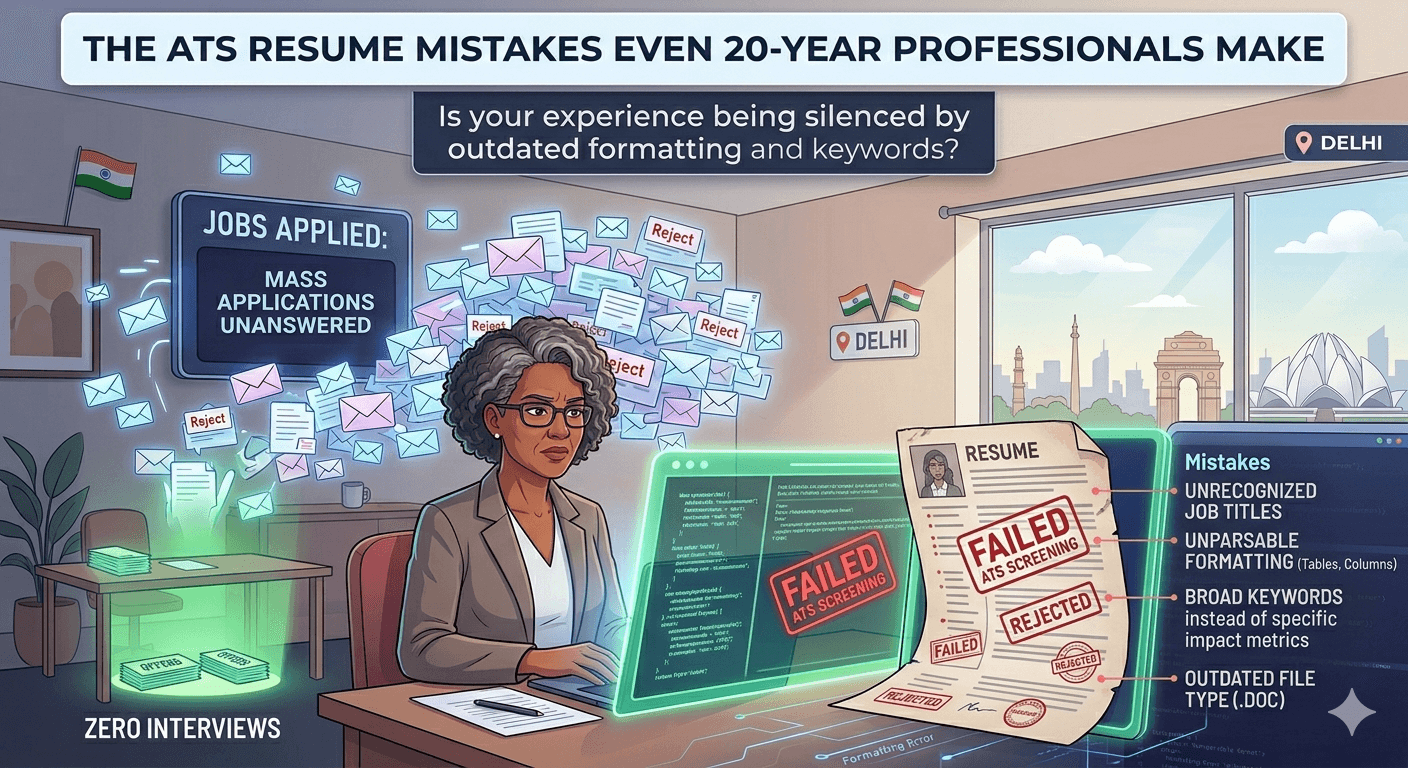
You’d think 20 years of experience would guarantee interviews.
It doesn’t.
In fact, some of the most experienced professionals are the ones getting filtered out the fastest.
Not because they lack capability.
But because they’re playing a human game in a machine-first system.
Welcome to the reality of ATS (Applicant Tracking Systems).
Before a recruiter ever sees your resume…
a machine decides if you’re worth being seen.
And most senior professionals are unknowingly failing this test.
Let’s break down the exact mistakes.
1. The “Experience Will Speak for Itself” Trap
After 15–20 years, professionals assume:
“My experience is strong enough. I don’t need to tailor.”
This is the fastest way to get rejected.
ATS doesn’t understand experience depth.
It understands keyword alignment.
If your resume doesn’t mirror the job description:
You’re invisible
You’re filtered out
You never reach a human
This is exactly why most resumes fail basic structural expectations like having the right sections, keyword alignment, and reverse chronological clarity .
Reality:
ATS doesn’t reward experience.
It rewards relevance.
2. Overloaded, “Everything I’ve Ever Done” Resumes
Senior professionals often submit 3–5 page resumes packed with:
Every role
Every responsibility
Every project
This kills your chances.
Why?
Because ATS systems and recruiters both prefer:
Clear structure
Focused experience
Prioritized impact
Even resume benchmarks suggest tight word limits and structured sections to improve readability and selection probability .
What goes wrong:
Signal gets diluted
Keywords get buried
Impact becomes unclear
Result: Rejection despite strong background.
3. Generic, Non-Quantified Achievements
One of the biggest silent killers:
“Led team operations”
“Handled client relationships”
“Improved processes”
These sound good—but they don’t convert.
ATS looks for specific, measurable signals.
Top-performing resumes use quantified impact, such as:
“Improved efficiency by 30%”
“Reduced costs by ₹2.5 Cr annually”
“Scaled team from 5 to 25”
Without numbers, your resume lacks decision-making proof.
Even resume scoring frameworks highlight quantification as a critical factor for impact and visibility .
4. Using Outdated Keywords (The Silent Career Killer)
Here’s where most 20-year professionals get blindsided.
Your experience may be strong—but your language is outdated.
Example:
You say: “Business Development”
Market says: “Revenue Growth Strategy / GTM / Strategic Partnerships”
You say: “Operations Management”
Market says: “Process Optimization / Digital Transformation”
ATS is trained on current market language—not legacy titles.
If your resume doesn’t match modern keyword patterns:
👉 You’re treated as irrelevant.
5. Poor Resume Structure That Confuses the ATS
ATS systems don’t “read” like humans.
They scan for:
Clear section headers
Logical formatting
Clean hierarchy
Missing or misplacing critical sections like:
Summary
Skills
Work Experience
Education
…can reduce your chances significantly .
Even worse:
Fancy designs
Tables
Graphics
These can break ATS parsing completely.
Translation:
Your resume looks premium to you…
But appears broken to the system.
6. One Resume for 100 Applications
This is the most common—and most expensive—mistake.
Senior professionals often:
Create one “master resume”
Apply everywhere
This destroys your success rate.
Because ATS scoring is role-specific.
Each job requires:
Different keywords
Different emphasis
Different positioning
Without customization:
Your match score drops
Your resume never surfaces
7. No Clear Positioning (The Strategic Blindspot)
At mid-senior level, roles are not just about skills.
They’re about positioning.
Yet most resumes look like:
A list of responsibilities
A timeline of roles
Instead of:
A strategic narrative
A clear value proposition
A target role alignment
ATS systems—and recruiters—look for:
👉 “Why THIS candidate for THIS role?”
If that’s not obvious in 6–8 seconds… you’re out.
The Real Problem Isn’t Your Resume
It’s your system.
Most professionals are still:
Writing resumes manually
Guessing keywords
Applying randomly
Hoping for callbacks
That’s not a strategy.
That’s gambling.
And in today’s market, guesswork loses.
What Actually Works Now
The professionals winning today are not “better.”
They’re system-driven.
They:
Reverse-engineer job descriptions
Align resumes dynamically
Optimize keywords per role
Position themselves strategically
Combine applications with networking + visibility
In other words:
They don’t “apply.”
They run a job search command system.
Final Thought
Here’s the uncomfortable truth:
You’re not competing on experience anymore.
You’re competing on precision, positioning, and systems.
And the market is brutally efficient.
It rewards those who are:
Aligned
Optimized
Strategic
Not just experienced.

As a co-founder and CEO of NxtJob.ai, I help mid and senior level professionals land 3-5 job offers within 3 months with a substantial salary hike. I am an Internationally Certified Career Coach, Resume Writing Expert, Job Interview and LinkedIn Strategist, and a Motivational Speaker.
Richik Sinha Roy
CEO, NxtJob
Recent articles

Resume
5 min read
ATS Resume Format: How to Create a Resume That Gets Past Applicant Tracking Systems
Learn how to create an ATS-friendly resume that passes through applicant tracking systems and increases your chances of landing an interview.
Resume
5 min read
ATS Resume Format: How to Create a Resume That Gets Past Applicant Tracking Systems
Learn how to create an ATS-friendly resume that passes through applicant tracking systems and increases your chances of landing an interview.
Resume
5 min read
ATS Resume Format: How to Create a Resume That Gets Past Applicant Tracking Systems
Learn how to create an ATS-friendly resume that passes through applicant tracking systems and increases your chances of landing an interview.
Resume
5 min read
ATS Resume Format: How to Create a Resume That Gets Past Applicant Tracking Systems
Learn how to create an ATS-friendly resume that passes through applicant tracking systems and increases your chances of landing an interview.
Resume
5 min read
ATS Resume Format: How to Create a Resume That Gets Past Applicant Tracking Systems
Learn how to create an ATS-friendly resume that passes through applicant tracking systems and increases your chances of landing an interview.
Resume
5 min read
ATS Resume Format: How to Create a Resume That Gets Past Applicant Tracking Systems
Learn how to create an ATS-friendly resume that passes through applicant tracking systems and increases your chances of landing an interview.
Everything you need to know
Here you can find solutions to all your queries.
5 min read
The ATS Resume Mistakes Even 20-Year Professionals Make
Published Date:
|
Last Modified:
You’d think 20 years of experience would guarantee interviews.
It doesn’t.
In fact, some of the most experienced professionals are the ones getting filtered out the fastest.
Not because they lack capability.
But because they’re playing a human game in a machine-first system.
Welcome to the reality of ATS (Applicant Tracking Systems).
Before a recruiter ever sees your resume…
a machine decides if you’re worth being seen.
And most senior professionals are unknowingly failing this test.
Let’s break down the exact mistakes.
1. The “Experience Will Speak for Itself” Trap
After 15–20 years, professionals assume:
“My experience is strong enough. I don’t need to tailor.”
This is the fastest way to get rejected.
ATS doesn’t understand experience depth.
It understands keyword alignment.
If your resume doesn’t mirror the job description:
You’re invisible
You’re filtered out
You never reach a human
This is exactly why most resumes fail basic structural expectations like having the right sections, keyword alignment, and reverse chronological clarity .
Reality:
ATS doesn’t reward experience.
It rewards relevance.
2. Overloaded, “Everything I’ve Ever Done” Resumes
Senior professionals often submit 3–5 page resumes packed with:
Every role
Every responsibility
Every project
This kills your chances.
Why?
Because ATS systems and recruiters both prefer:
Clear structure
Focused experience
Prioritized impact
Even resume benchmarks suggest tight word limits and structured sections to improve readability and selection probability .
What goes wrong:
Signal gets diluted
Keywords get buried
Impact becomes unclear
Result: Rejection despite strong background.
3. Generic, Non-Quantified Achievements
One of the biggest silent killers:
“Led team operations”
“Handled client relationships”
“Improved processes”
These sound good—but they don’t convert.
ATS looks for specific, measurable signals.
Top-performing resumes use quantified impact, such as:
“Improved efficiency by 30%”
“Reduced costs by ₹2.5 Cr annually”
“Scaled team from 5 to 25”
Without numbers, your resume lacks decision-making proof.
Even resume scoring frameworks highlight quantification as a critical factor for impact and visibility .
4. Using Outdated Keywords (The Silent Career Killer)
Here’s where most 20-year professionals get blindsided.
Your experience may be strong—but your language is outdated.
Example:
You say: “Business Development”
Market says: “Revenue Growth Strategy / GTM / Strategic Partnerships”
You say: “Operations Management”
Market says: “Process Optimization / Digital Transformation”
ATS is trained on current market language—not legacy titles.
If your resume doesn’t match modern keyword patterns:
👉 You’re treated as irrelevant.
5. Poor Resume Structure That Confuses the ATS
ATS systems don’t “read” like humans.
They scan for:
Clear section headers
Logical formatting
Clean hierarchy
Missing or misplacing critical sections like:
Summary
Skills
Work Experience
Education
…can reduce your chances significantly .
Even worse:
Fancy designs
Tables
Graphics
These can break ATS parsing completely.
Translation:
Your resume looks premium to you…
But appears broken to the system.
6. One Resume for 100 Applications
This is the most common—and most expensive—mistake.
Senior professionals often:
Create one “master resume”
Apply everywhere
This destroys your success rate.
Because ATS scoring is role-specific.
Each job requires:
Different keywords
Different emphasis
Different positioning
Without customization:
Your match score drops
Your resume never surfaces
7. No Clear Positioning (The Strategic Blindspot)
At mid-senior level, roles are not just about skills.
They’re about positioning.
Yet most resumes look like:
A list of responsibilities
A timeline of roles
Instead of:
A strategic narrative
A clear value proposition
A target role alignment
ATS systems—and recruiters—look for:
👉 “Why THIS candidate for THIS role?”
If that’s not obvious in 6–8 seconds… you’re out.
The Real Problem Isn’t Your Resume
It’s your system.
Most professionals are still:
Writing resumes manually
Guessing keywords
Applying randomly
Hoping for callbacks
That’s not a strategy.
That’s gambling.
And in today’s market, guesswork loses.
What Actually Works Now
The professionals winning today are not “better.”
They’re system-driven.
They:
Reverse-engineer job descriptions
Align resumes dynamically
Optimize keywords per role
Position themselves strategically
Combine applications with networking + visibility
In other words:
They don’t “apply.”
They run a job search command system.
Final Thought
Here’s the uncomfortable truth:
You’re not competing on experience anymore.
You’re competing on precision, positioning, and systems.
And the market is brutally efficient.
It rewards those who are:
Aligned
Optimized
Strategic
Not just experienced.
Table of content

Negotiation
Counter Offer Negotiation: A Strategic Guide for Senior Leaders
A guide for senior professionals on why most counter offers fail and how to use market research to decide your next move.
Interview
How to Create a 30 60 90 Plan for Senior Professionals
A 30-60-90 Day Plan for Senior Professionals that shows you can lead, get the team on the same page, and get results from day one.
As a co-founder and CEO of NxtJob.ai, I help mid and senior level professionals land 3-5 job offers within 3 months with a substantial salary hike. I am an Internationally Certified Career Coach, Resume Writing Expert, Job Interview and LinkedIn Strategist, and a Motivational Speaker.
Richik Sinha Roy
CEO, NxtJob
Everything you need to know
Here you can find solutions to all your queries.
5 min read
Published Date:
|
Last Modified:
The ATS Resume Mistakes Even 20-Year Professionals Make
You’d think 20 years of experience would guarantee interviews.
It doesn’t.
In fact, some of the most experienced professionals are the ones getting filtered out the fastest.
Not because they lack capability.
But because they’re playing a human game in a machine-first system.
Welcome to the reality of ATS (Applicant Tracking Systems).
Before a recruiter ever sees your resume…
a machine decides if you’re worth being seen.
And most senior professionals are unknowingly failing this test.
Let’s break down the exact mistakes.
1. The “Experience Will Speak for Itself” Trap
After 15–20 years, professionals assume:
“My experience is strong enough. I don’t need to tailor.”
This is the fastest way to get rejected.
ATS doesn’t understand experience depth.
It understands keyword alignment.
If your resume doesn’t mirror the job description:
You’re invisible
You’re filtered out
You never reach a human
This is exactly why most resumes fail basic structural expectations like having the right sections, keyword alignment, and reverse chronological clarity .
Reality:
ATS doesn’t reward experience.
It rewards relevance.
2. Overloaded, “Everything I’ve Ever Done” Resumes
Senior professionals often submit 3–5 page resumes packed with:
Every role
Every responsibility
Every project
This kills your chances.
Why?
Because ATS systems and recruiters both prefer:
Clear structure
Focused experience
Prioritized impact
Even resume benchmarks suggest tight word limits and structured sections to improve readability and selection probability .
What goes wrong:
Signal gets diluted
Keywords get buried
Impact becomes unclear
Result: Rejection despite strong background.
3. Generic, Non-Quantified Achievements
One of the biggest silent killers:
“Led team operations”
“Handled client relationships”
“Improved processes”
These sound good—but they don’t convert.
ATS looks for specific, measurable signals.
Top-performing resumes use quantified impact, such as:
“Improved efficiency by 30%”
“Reduced costs by ₹2.5 Cr annually”
“Scaled team from 5 to 25”
Without numbers, your resume lacks decision-making proof.
Even resume scoring frameworks highlight quantification as a critical factor for impact and visibility .
4. Using Outdated Keywords (The Silent Career Killer)
Here’s where most 20-year professionals get blindsided.
Your experience may be strong—but your language is outdated.
Example:
You say: “Business Development”
Market says: “Revenue Growth Strategy / GTM / Strategic Partnerships”
You say: “Operations Management”
Market says: “Process Optimization / Digital Transformation”
ATS is trained on current market language—not legacy titles.
If your resume doesn’t match modern keyword patterns:
👉 You’re treated as irrelevant.
5. Poor Resume Structure That Confuses the ATS
ATS systems don’t “read” like humans.
They scan for:
Clear section headers
Logical formatting
Clean hierarchy
Missing or misplacing critical sections like:
Summary
Skills
Work Experience
Education
…can reduce your chances significantly .
Even worse:
Fancy designs
Tables
Graphics
These can break ATS parsing completely.
Translation:
Your resume looks premium to you…
But appears broken to the system.
6. One Resume for 100 Applications
This is the most common—and most expensive—mistake.
Senior professionals often:
Create one “master resume”
Apply everywhere
This destroys your success rate.
Because ATS scoring is role-specific.
Each job requires:
Different keywords
Different emphasis
Different positioning
Without customization:
Your match score drops
Your resume never surfaces
7. No Clear Positioning (The Strategic Blindspot)
At mid-senior level, roles are not just about skills.
They’re about positioning.
Yet most resumes look like:
A list of responsibilities
A timeline of roles
Instead of:
A strategic narrative
A clear value proposition
A target role alignment
ATS systems—and recruiters—look for:
👉 “Why THIS candidate for THIS role?”
If that’s not obvious in 6–8 seconds… you’re out.
The Real Problem Isn’t Your Resume
It’s your system.
Most professionals are still:
Writing resumes manually
Guessing keywords
Applying randomly
Hoping for callbacks
That’s not a strategy.
That’s gambling.
And in today’s market, guesswork loses.
What Actually Works Now
The professionals winning today are not “better.”
They’re system-driven.
They:
Reverse-engineer job descriptions
Align resumes dynamically
Optimize keywords per role
Position themselves strategically
Combine applications with networking + visibility
In other words:
They don’t “apply.”
They run a job search command system.
Final Thought
Here’s the uncomfortable truth:
You’re not competing on experience anymore.
You’re competing on precision, positioning, and systems.
And the market is brutally efficient.
It rewards those who are:
Aligned
Optimized
Strategic
Not just experienced.
Table of content
Negotiation
Counter Offer Negotiation: A Strategic Guide for Senior Leaders
A guide for senior professionals on why most counter offers fail and how to use market research to decide your next move.
Interview
How to Create a 30 60 90 Plan for Senior Professionals
A 30-60-90 Day Plan for Senior Professionals that shows you can lead, get the team on the same page, and get results from day one.
As a co-founder and CEO of NxtJob.ai, I help mid and senior level professionals land 3-5 job offers within 3 months with a substantial salary hike. I am an Internationally Certified Career Coach, Resume Writing Expert, Job Interview and LinkedIn Strategist, and a Motivational Speaker.
Richik Sinha Roy
CEO, NxtJob
Recent articles
Resume
5 min read
Expected CTC: How to Answer Salary Expectations As a Senior Professional Copy
Learn how to answer the expected CTC question. Avoid early anchoring, handling HR pushback, and getting a fair salary offer.
Resume
5 min read
Expected CTC: How to Answer Salary Expectations As a Senior Professional
Learn how to answer the expected CTC question. Avoid early anchoring, handling HR pushback, and getting a fair salary offer.

Resume
5 min read
Beyond the 30% Cap: The Senior Salary Hike Percentage Guide for India
Discover the salary hike percentage professionals can expect in India and learn how to negotiate stronger compensation during a job switch.
Resume
5 min read
Expected CTC: How to Answer Salary Expectations As a Senior Professional Copy
Learn how to answer the expected CTC question. Avoid early anchoring, handling HR pushback, and getting a fair salary offer.
Resume
5 min read
Expected CTC: How to Answer Salary Expectations As a Senior Professional
Learn how to answer the expected CTC question. Avoid early anchoring, handling HR pushback, and getting a fair salary offer.
Everything you need to know
Here you can find solutions to all your queries.
Join the Revolution
Your AI career copilot to land you top jobs in under 90 days.
Join the Revolution
Your AI career copilot to land you top jobs in under 90 days.
Join the Revolution
Your AI career copilot to land you top jobs in under 90 days.