
Job search
5 min read
Is 40 Too Old for a Career Change? Myths vs Reality
Published Date:
|
Last Modified:

Introduction: The Question That Haunts Many Professionals
If you’re in your late 30s or early 40s, chances are this thought has crossed your mind: “Is it too late to change careers now?”
Maybe you’ve been in the same industry for 15–20 years, and the passion is gone. Maybe your current role feels stagnant, or technology has disrupted your field, leaving you wondering if you’re still relevant. Or maybe you’ve always had a dream—consulting, teaching, entrepreneurship—that you never dared to pursue.
In India, this question feels even heavier. By 40, most professionals have family responsibilities, EMIs, kids’ education, and social expectations. The fear of risk multiplies. You worry about whether recruiters will hire you, whether your salary will dip, or whether your peers will overtake you.
But here’s the truth—40 is not too old for a career change. The challenge is real, but it’s far from impossible. In fact, many professionals in India are making the shift successfully, provided they approach it with clarity and strategy. Let’s break this down, myth by myth, and see what’s reality.
Myth 1: Employers Don’t Hire People Over 40
This is one of the most common fears. Many mid-senior professionals assume that companies prefer younger candidates because they’re “cheaper” and “more flexible.” While this may happen in certain entry-level jobs, the reality is different for mid-senior roles.
What employers value at 40: experience, leadership, domain expertise, stability, and decision-making skills.
Where the challenge lies: if you try to compete directly with 25-year-olds in technical entry-level roles, yes, you’ll face resistance. But if you reposition yourself as someone who brings both skill and maturity, you can become very attractive to recruiters.
In fact, sectors like consulting, HR, project management, education, healthcare, and entrepreneurship often prefer professionals with 15+ years of life and work experience.
Myth 2: You’ll Have to Start from Zero
Another misconception is that a career change at 40 means going back to scratch, like a fresher. That’s not true. You may have to reinvent, but you don’t have to erase everything you’ve built.
Think of it this way:
A software engineer who moves into product management doesn’t discard their tech experience; instead, they use it as leverage to understand technical feasibility.
A banker who moves into fintech brings credibility, regulatory knowledge, and a strong client network.
A marketing manager shifting into HR brings people skills, communication, and organizational knowledge.
Your past experience is an asset. The key is to reframe it for your new career path.
Myth 3: Learning New Skills at 40 is Too Difficult
We’ve all heard this—“You can’t teach an old dog new tricks.” But let’s be real. You’re not an old dog. You’re at a stage in life where you’ve already mastered how to learn quickly, filter what matters, and apply it effectively.
Today, the accessibility of learning is unbelievable. Platforms like Coursera, LinkedIn Learning, UpGrad, or even IIT/IIM executive programs are designed exactly for mid-career professionals.
The difference is mindset. At 25, you learn because you have to. At 40, you learn because you want to. That intentional learning is far more powerful.
Myth 4: A Career Change Will Mean a Pay Cut
This one has some truth to it—but it’s not the whole story. Yes, if you jump into a completely unrelated field without a strategy, you may have to accept a lower package initially. But if you plan your transition smartly, you can minimize or even avoid the dip.
Here’s how:
Transition into an adjacent role where your existing skills overlap (e.g., IT manager to cybersecurity, sales head to business development consulting).
Pursue executive education to show credibility in your new field.
Leverage your network to land roles where you don’t compete with entry-level candidates but position yourself as a seasoned professional bringing maturity.
And even if there is a dip, it’s often temporary. Within 2–3 years, many professionals bounce back to their previous salary bracket—sometimes higher, because they bring unique crossover expertise.
Myth 5: Career Change is Risky at 40 Because of Family Responsibilities
This fear is valid. In India, by 40, you’re often balancing children’s education, home loans, and supporting parents. Risk feels scarier. But here’s the other side:
Staying stuck in a stagnant role carries equal or greater risk. Companies downsize, industries evolve, and job security is an illusion.
If you start preparing early, you can plan the financial cushion—saving 6–12 months of expenses before making the switch.
Your family often benefits when you pursue something that makes you fulfilled, rather than dragging yourself through an uninspiring job.
The biggest mistake is waiting until you’re forced into a change. A proactive, well-planned career transition is far safer than a reactive one.
Reality: What Career Change at 40 Looks Like in India
Let’s ground this in reality. A mid-senior professional in India who changes careers at 40 will face:
Initial adjustment pain: adapting to new learning curves, proving yourself again.
Need for strategic positioning: reframing your resume, LinkedIn profile, and personal brand.
Networking dependence: most midlife transitions happen through networks, referrals, and reputation—not just job portals.
Mindset shift: accepting that you’re no longer climbing a linear ladder, but building a portfolio career.
But once you push through, the rewards are massive. You get renewed excitement, you align your career with your true interests, and you set an example for your kids, peers, and colleagues that reinvention is possible.
Practical Steps to Make the Transition
Audit your current career
Identify what skills and experiences are transferable, and which gaps you need to fill.Pick a realistic target role/industry
Don’t jump randomly. Research industries with growth (AI, fintech, healthtech, renewable energy, digital marketing, consulting).Upskill strategically
Instead of learning everything, pick 1–2 certifications or programs that signal seriousness to recruiters.Rebuild your brand
Update your LinkedIn, start sharing insights in your target field, join relevant forums or alumni groups.Network intentionally
Reach out to peers, ex-colleagues, and industry leaders. In India, referrals open more doors than cold applications.Test before you leap
Explore side projects, consulting gigs, or part-time opportunities in your desired field before a full transition.Plan your finances
Save aggressively for a transition buffer. It reduces stress and gives you flexibility.
Final Word: Reinvention is Not Age-Bound
The world is full of examples of professionals who reinvented themselves after 40. In India, too, we’re seeing doctors becoming entrepreneurs, engineers becoming VCs, corporate managers starting boutique consultancies, and marketers moving into teaching or coaching.
The truth is, at 40, you’re not too old—you’re seasoned. You’ve got wisdom, resilience, and clarity that younger professionals don’t yet have. The only thing that can hold you back is fear.
So, if you’ve been asking, “Is 40 too old for a career change?”, the answer is simple: No. It’s not too late—it’s just the right time to choose consciously and build a career that excites you for the next 20–25 years.

As a co-founder and CEO of NxtJob.ai, I help mid and senior level professionals land 3-5 job offers within 3 months with a substantial salary hike. I am an Internationally Certified Career Coach, Resume Writing Expert, Job Interview and LinkedIn Strategist, and a Motivational Speaker.
Richik Sinha Roy
CEO, NxtJob
Recent articles

Resume
5 min read
ATS Resume Format: How to Create a Resume That Gets Past Applicant Tracking Systems
Learn how to create an ATS-friendly resume that passes through applicant tracking systems and increases your chances of landing an interview.
Resume
5 min read
ATS Resume Format: How to Create a Resume That Gets Past Applicant Tracking Systems
Learn how to create an ATS-friendly resume that passes through applicant tracking systems and increases your chances of landing an interview.
Resume
5 min read
ATS Resume Format: How to Create a Resume That Gets Past Applicant Tracking Systems
Learn how to create an ATS-friendly resume that passes through applicant tracking systems and increases your chances of landing an interview.
Resume
5 min read
ATS Resume Format: How to Create a Resume That Gets Past Applicant Tracking Systems
Learn how to create an ATS-friendly resume that passes through applicant tracking systems and increases your chances of landing an interview.
Resume
5 min read
ATS Resume Format: How to Create a Resume That Gets Past Applicant Tracking Systems
Learn how to create an ATS-friendly resume that passes through applicant tracking systems and increases your chances of landing an interview.
Resume
5 min read
ATS Resume Format: How to Create a Resume That Gets Past Applicant Tracking Systems
Learn how to create an ATS-friendly resume that passes through applicant tracking systems and increases your chances of landing an interview.
Everything you need to know
Here you can find solutions to all your queries.
Is 40 really a good age to switch careers in India?
Will I have to take a big salary cut if I change careers at 40?
How can I prepare myself for a career change at this stage?
Which industries in India are more open to midlife career changes?
Isn’t it risky to change careers with family and financial responsibilities at 40?
Job search
5 min read
Is 40 Too Old for a Career Change? Myths vs Reality
Published Date:
|
Last Modified:
Introduction: The Question That Haunts Many Professionals
If you’re in your late 30s or early 40s, chances are this thought has crossed your mind: “Is it too late to change careers now?”
Maybe you’ve been in the same industry for 15–20 years, and the passion is gone. Maybe your current role feels stagnant, or technology has disrupted your field, leaving you wondering if you’re still relevant. Or maybe you’ve always had a dream—consulting, teaching, entrepreneurship—that you never dared to pursue.
In India, this question feels even heavier. By 40, most professionals have family responsibilities, EMIs, kids’ education, and social expectations. The fear of risk multiplies. You worry about whether recruiters will hire you, whether your salary will dip, or whether your peers will overtake you.
But here’s the truth—40 is not too old for a career change. The challenge is real, but it’s far from impossible. In fact, many professionals in India are making the shift successfully, provided they approach it with clarity and strategy. Let’s break this down, myth by myth, and see what’s reality.
Myth 1: Employers Don’t Hire People Over 40
This is one of the most common fears. Many mid-senior professionals assume that companies prefer younger candidates because they’re “cheaper” and “more flexible.” While this may happen in certain entry-level jobs, the reality is different for mid-senior roles.
What employers value at 40: experience, leadership, domain expertise, stability, and decision-making skills.
Where the challenge lies: if you try to compete directly with 25-year-olds in technical entry-level roles, yes, you’ll face resistance. But if you reposition yourself as someone who brings both skill and maturity, you can become very attractive to recruiters.
In fact, sectors like consulting, HR, project management, education, healthcare, and entrepreneurship often prefer professionals with 15+ years of life and work experience.
Myth 2: You’ll Have to Start from Zero
Another misconception is that a career change at 40 means going back to scratch, like a fresher. That’s not true. You may have to reinvent, but you don’t have to erase everything you’ve built.
Think of it this way:
A software engineer who moves into product management doesn’t discard their tech experience; instead, they use it as leverage to understand technical feasibility.
A banker who moves into fintech brings credibility, regulatory knowledge, and a strong client network.
A marketing manager shifting into HR brings people skills, communication, and organizational knowledge.
Your past experience is an asset. The key is to reframe it for your new career path.
Myth 3: Learning New Skills at 40 is Too Difficult
We’ve all heard this—“You can’t teach an old dog new tricks.” But let’s be real. You’re not an old dog. You’re at a stage in life where you’ve already mastered how to learn quickly, filter what matters, and apply it effectively.
Today, the accessibility of learning is unbelievable. Platforms like Coursera, LinkedIn Learning, UpGrad, or even IIT/IIM executive programs are designed exactly for mid-career professionals.
The difference is mindset. At 25, you learn because you have to. At 40, you learn because you want to. That intentional learning is far more powerful.
Myth 4: A Career Change Will Mean a Pay Cut
This one has some truth to it—but it’s not the whole story. Yes, if you jump into a completely unrelated field without a strategy, you may have to accept a lower package initially. But if you plan your transition smartly, you can minimize or even avoid the dip.
Here’s how:
Transition into an adjacent role where your existing skills overlap (e.g., IT manager to cybersecurity, sales head to business development consulting).
Pursue executive education to show credibility in your new field.
Leverage your network to land roles where you don’t compete with entry-level candidates but position yourself as a seasoned professional bringing maturity.
And even if there is a dip, it’s often temporary. Within 2–3 years, many professionals bounce back to their previous salary bracket—sometimes higher, because they bring unique crossover expertise.
Myth 5: Career Change is Risky at 40 Because of Family Responsibilities
This fear is valid. In India, by 40, you’re often balancing children’s education, home loans, and supporting parents. Risk feels scarier. But here’s the other side:
Staying stuck in a stagnant role carries equal or greater risk. Companies downsize, industries evolve, and job security is an illusion.
If you start preparing early, you can plan the financial cushion—saving 6–12 months of expenses before making the switch.
Your family often benefits when you pursue something that makes you fulfilled, rather than dragging yourself through an uninspiring job.
The biggest mistake is waiting until you’re forced into a change. A proactive, well-planned career transition is far safer than a reactive one.
Reality: What Career Change at 40 Looks Like in India
Let’s ground this in reality. A mid-senior professional in India who changes careers at 40 will face:
Initial adjustment pain: adapting to new learning curves, proving yourself again.
Need for strategic positioning: reframing your resume, LinkedIn profile, and personal brand.
Networking dependence: most midlife transitions happen through networks, referrals, and reputation—not just job portals.
Mindset shift: accepting that you’re no longer climbing a linear ladder, but building a portfolio career.
But once you push through, the rewards are massive. You get renewed excitement, you align your career with your true interests, and you set an example for your kids, peers, and colleagues that reinvention is possible.
Practical Steps to Make the Transition
Audit your current career
Identify what skills and experiences are transferable, and which gaps you need to fill.Pick a realistic target role/industry
Don’t jump randomly. Research industries with growth (AI, fintech, healthtech, renewable energy, digital marketing, consulting).Upskill strategically
Instead of learning everything, pick 1–2 certifications or programs that signal seriousness to recruiters.Rebuild your brand
Update your LinkedIn, start sharing insights in your target field, join relevant forums or alumni groups.Network intentionally
Reach out to peers, ex-colleagues, and industry leaders. In India, referrals open more doors than cold applications.Test before you leap
Explore side projects, consulting gigs, or part-time opportunities in your desired field before a full transition.Plan your finances
Save aggressively for a transition buffer. It reduces stress and gives you flexibility.
Final Word: Reinvention is Not Age-Bound
The world is full of examples of professionals who reinvented themselves after 40. In India, too, we’re seeing doctors becoming entrepreneurs, engineers becoming VCs, corporate managers starting boutique consultancies, and marketers moving into teaching or coaching.
The truth is, at 40, you’re not too old—you’re seasoned. You’ve got wisdom, resilience, and clarity that younger professionals don’t yet have. The only thing that can hold you back is fear.
So, if you’ve been asking, “Is 40 too old for a career change?”, the answer is simple: No. It’s not too late—it’s just the right time to choose consciously and build a career that excites you for the next 20–25 years.
Table of content
Interview
Salary Negotiation With HR: How Senior Professionals Should Handle the Conversation
Learn how senior professionals can handle salary negotiation with HR, respond to pushback, protect their value, and avoid underselling themselves.
Resume
How to Make an ATS-Friendly Resume: Format, Tips, and Examples for Experienced Professionals
Learn how to make an ATS-friendly resume with the right format, keywords, structure, and role-specific details for experienced professionals.
As a co-founder and CEO of NxtJob.ai, I help mid and senior level professionals land 3-5 job offers within 3 months with a substantial salary hike. I am an Internationally Certified Career Coach, Resume Writing Expert, Job Interview and LinkedIn Strategist, and a Motivational Speaker.
Richik Sinha Roy
CEO, NxtJob
Is 40 really a good age to switch careers in India?
Will I have to take a big salary cut if I change careers at 40?
How can I prepare myself for a career change at this stage?
Which industries in India are more open to midlife career changes?
Isn’t it risky to change careers with family and financial responsibilities at 40?
Everything you need to know
Here you can find solutions to all your queries.
Job search
5 min read
Is 40 Too Old for a Career Change? Myths vs Reality
Published Date:
|
Last Modified:
Introduction: The Question That Haunts Many Professionals
If you’re in your late 30s or early 40s, chances are this thought has crossed your mind: “Is it too late to change careers now?”
Maybe you’ve been in the same industry for 15–20 years, and the passion is gone. Maybe your current role feels stagnant, or technology has disrupted your field, leaving you wondering if you’re still relevant. Or maybe you’ve always had a dream—consulting, teaching, entrepreneurship—that you never dared to pursue.
In India, this question feels even heavier. By 40, most professionals have family responsibilities, EMIs, kids’ education, and social expectations. The fear of risk multiplies. You worry about whether recruiters will hire you, whether your salary will dip, or whether your peers will overtake you.
But here’s the truth—40 is not too old for a career change. The challenge is real, but it’s far from impossible. In fact, many professionals in India are making the shift successfully, provided they approach it with clarity and strategy. Let’s break this down, myth by myth, and see what’s reality.
Myth 1: Employers Don’t Hire People Over 40
This is one of the most common fears. Many mid-senior professionals assume that companies prefer younger candidates because they’re “cheaper” and “more flexible.” While this may happen in certain entry-level jobs, the reality is different for mid-senior roles.
What employers value at 40: experience, leadership, domain expertise, stability, and decision-making skills.
Where the challenge lies: if you try to compete directly with 25-year-olds in technical entry-level roles, yes, you’ll face resistance. But if you reposition yourself as someone who brings both skill and maturity, you can become very attractive to recruiters.
In fact, sectors like consulting, HR, project management, education, healthcare, and entrepreneurship often prefer professionals with 15+ years of life and work experience.
Myth 2: You’ll Have to Start from Zero
Another misconception is that a career change at 40 means going back to scratch, like a fresher. That’s not true. You may have to reinvent, but you don’t have to erase everything you’ve built.
Think of it this way:
A software engineer who moves into product management doesn’t discard their tech experience; instead, they use it as leverage to understand technical feasibility.
A banker who moves into fintech brings credibility, regulatory knowledge, and a strong client network.
A marketing manager shifting into HR brings people skills, communication, and organizational knowledge.
Your past experience is an asset. The key is to reframe it for your new career path.
Myth 3: Learning New Skills at 40 is Too Difficult
We’ve all heard this—“You can’t teach an old dog new tricks.” But let’s be real. You’re not an old dog. You’re at a stage in life where you’ve already mastered how to learn quickly, filter what matters, and apply it effectively.
Today, the accessibility of learning is unbelievable. Platforms like Coursera, LinkedIn Learning, UpGrad, or even IIT/IIM executive programs are designed exactly for mid-career professionals.
The difference is mindset. At 25, you learn because you have to. At 40, you learn because you want to. That intentional learning is far more powerful.
Myth 4: A Career Change Will Mean a Pay Cut
This one has some truth to it—but it’s not the whole story. Yes, if you jump into a completely unrelated field without a strategy, you may have to accept a lower package initially. But if you plan your transition smartly, you can minimize or even avoid the dip.
Here’s how:
Transition into an adjacent role where your existing skills overlap (e.g., IT manager to cybersecurity, sales head to business development consulting).
Pursue executive education to show credibility in your new field.
Leverage your network to land roles where you don’t compete with entry-level candidates but position yourself as a seasoned professional bringing maturity.
And even if there is a dip, it’s often temporary. Within 2–3 years, many professionals bounce back to their previous salary bracket—sometimes higher, because they bring unique crossover expertise.
Myth 5: Career Change is Risky at 40 Because of Family Responsibilities
This fear is valid. In India, by 40, you’re often balancing children’s education, home loans, and supporting parents. Risk feels scarier. But here’s the other side:
Staying stuck in a stagnant role carries equal or greater risk. Companies downsize, industries evolve, and job security is an illusion.
If you start preparing early, you can plan the financial cushion—saving 6–12 months of expenses before making the switch.
Your family often benefits when you pursue something that makes you fulfilled, rather than dragging yourself through an uninspiring job.
The biggest mistake is waiting until you’re forced into a change. A proactive, well-planned career transition is far safer than a reactive one.
Reality: What Career Change at 40 Looks Like in India
Let’s ground this in reality. A mid-senior professional in India who changes careers at 40 will face:
Initial adjustment pain: adapting to new learning curves, proving yourself again.
Need for strategic positioning: reframing your resume, LinkedIn profile, and personal brand.
Networking dependence: most midlife transitions happen through networks, referrals, and reputation—not just job portals.
Mindset shift: accepting that you’re no longer climbing a linear ladder, but building a portfolio career.
But once you push through, the rewards are massive. You get renewed excitement, you align your career with your true interests, and you set an example for your kids, peers, and colleagues that reinvention is possible.
Practical Steps to Make the Transition
Audit your current career
Identify what skills and experiences are transferable, and which gaps you need to fill.Pick a realistic target role/industry
Don’t jump randomly. Research industries with growth (AI, fintech, healthtech, renewable energy, digital marketing, consulting).Upskill strategically
Instead of learning everything, pick 1–2 certifications or programs that signal seriousness to recruiters.Rebuild your brand
Update your LinkedIn, start sharing insights in your target field, join relevant forums or alumni groups.Network intentionally
Reach out to peers, ex-colleagues, and industry leaders. In India, referrals open more doors than cold applications.Test before you leap
Explore side projects, consulting gigs, or part-time opportunities in your desired field before a full transition.Plan your finances
Save aggressively for a transition buffer. It reduces stress and gives you flexibility.
Final Word: Reinvention is Not Age-Bound
The world is full of examples of professionals who reinvented themselves after 40. In India, too, we’re seeing doctors becoming entrepreneurs, engineers becoming VCs, corporate managers starting boutique consultancies, and marketers moving into teaching or coaching.
The truth is, at 40, you’re not too old—you’re seasoned. You’ve got wisdom, resilience, and clarity that younger professionals don’t yet have. The only thing that can hold you back is fear.
So, if you’ve been asking, “Is 40 too old for a career change?”, the answer is simple: No. It’s not too late—it’s just the right time to choose consciously and build a career that excites you for the next 20–25 years.
Table of content
Interview
Salary Negotiation With HR: How Senior Professionals Should Handle the Conversation
Learn how senior professionals can handle salary negotiation with HR, respond to pushback, protect their value, and avoid underselling themselves.
Resume
How to Make an ATS-Friendly Resume: Format, Tips, and Examples for Experienced Professionals
Learn how to make an ATS-friendly resume with the right format, keywords, structure, and role-specific details for experienced professionals.
As a co-founder and CEO of NxtJob.ai, I help mid and senior level professionals land 3-5 job offers within 3 months with a substantial salary hike. I am an Internationally Certified Career Coach, Resume Writing Expert, Job Interview and LinkedIn Strategist, and a Motivational Speaker.
Richik Sinha Roy
CEO, NxtJob
Recent articles
Resume
5 min read
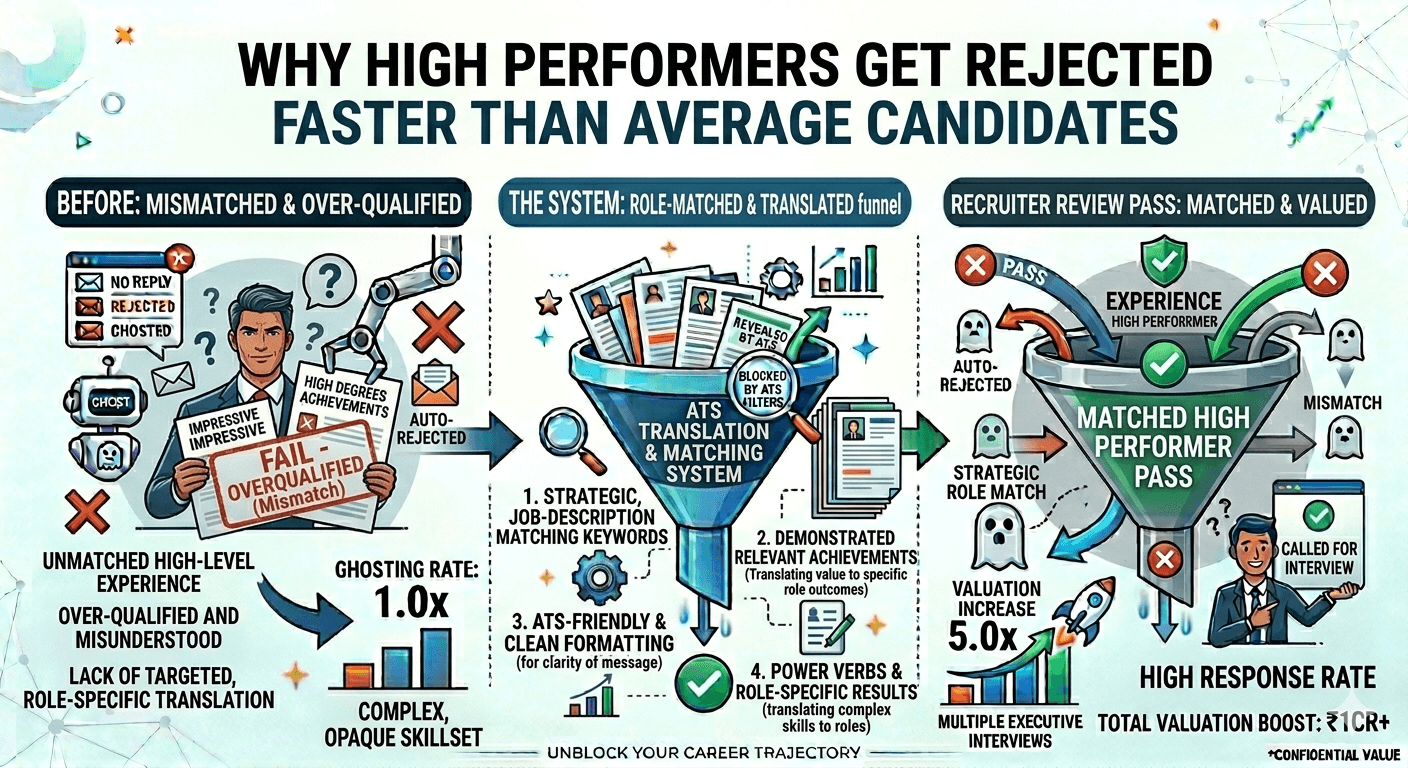
Why High Performers Get Rejected Faster Than Average Candidates
Why High Performers Get Rejected Faster Than Average Candidates
Resume
5 min read
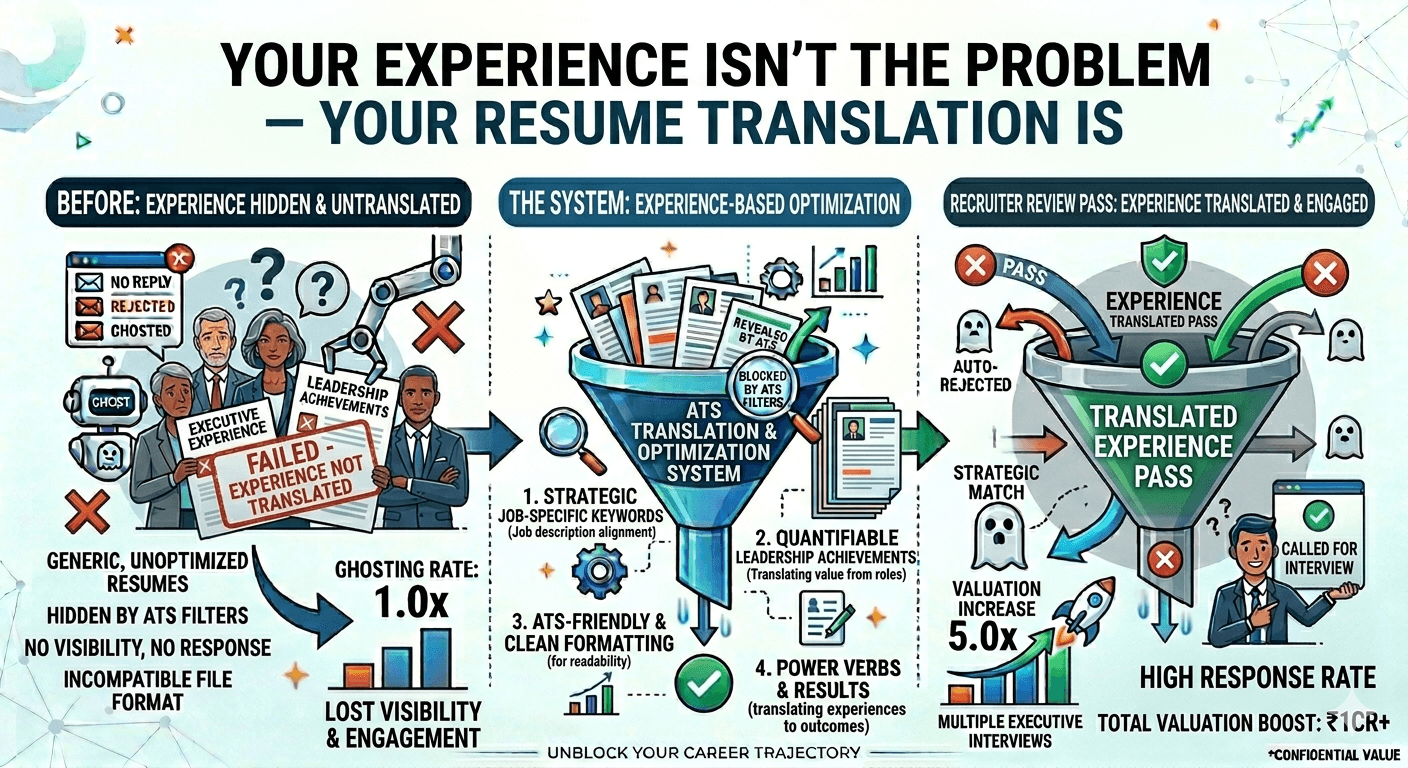
Your Experience Isn’t the Problem, Your Resume Translation Is
Struggling to get interviews despite strong experience? Discover how an ATS Resume Checker reveals hidden resume gaps and helps you translate your experience into results that recruiters actually notice.
Resume
5 min read
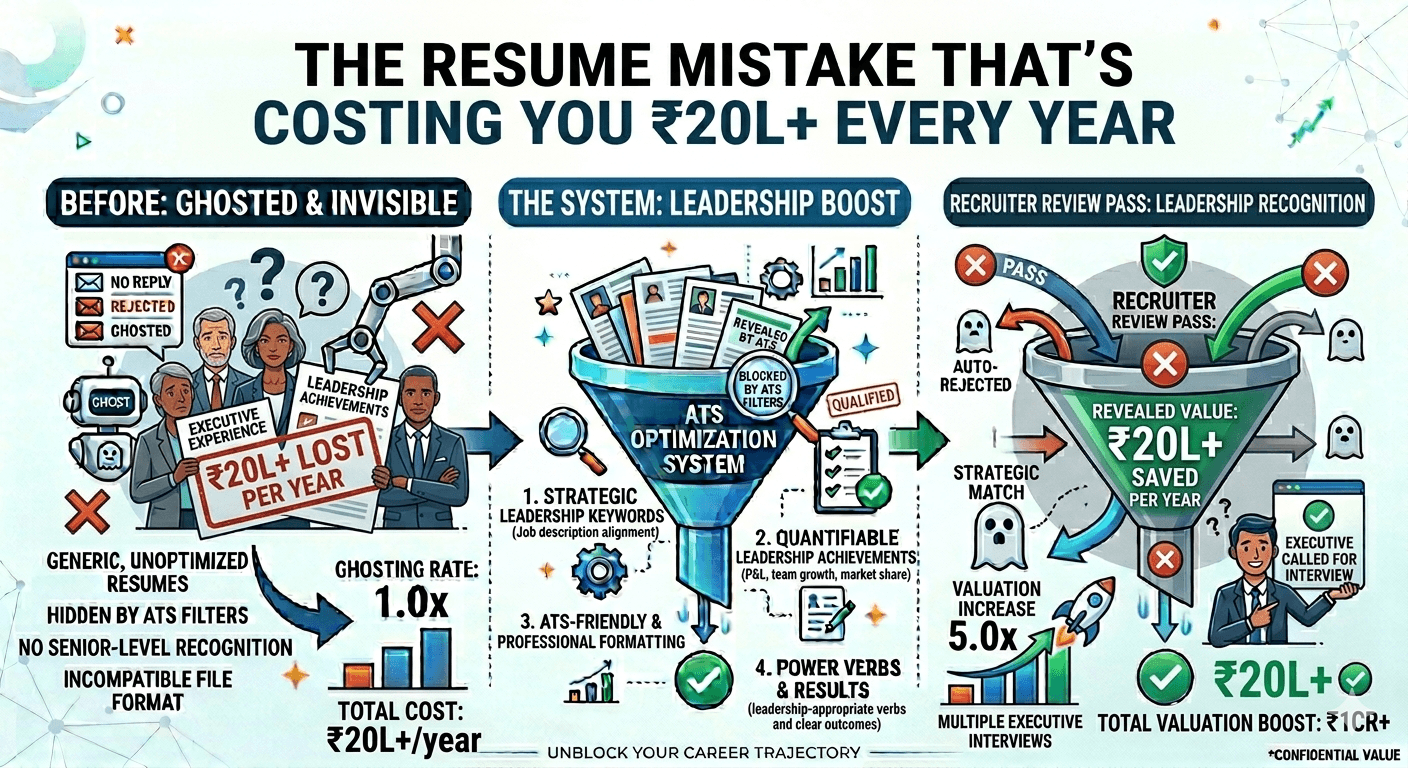
The Resume Mistake That’s Costing You ₹20L+ Every Year
The Resume Mistake That’s Costing You ₹20L+ Every Year
Resume
5 min read
Why High Performers Get Rejected Faster Than Average Candidates
Why High Performers Get Rejected Faster Than Average Candidates
Resume
5 min read
Your Experience Isn’t the Problem, Your Resume Translation Is
Struggling to get interviews despite strong experience? Discover how an ATS Resume Checker reveals hidden resume gaps and helps you translate your experience into results that recruiters actually notice.
Everything you need to know
Here you can find solutions to all your queries.
Is 40 really a good age to switch careers in India?
Will I have to take a big salary cut if I change careers at 40?
How can I prepare myself for a career change at this stage?
Which industries in India are more open to midlife career changes?
Isn’t it risky to change careers with family and financial responsibilities at 40?
Join the Revolution
Your AI career copilot to land you top jobs in under 90 days.
Join the Revolution
Your AI career copilot to land you top jobs in under 90 days.
Join the Revolution
Your AI career copilot to land you top jobs in under 90 days.